“Bringing sport to life for young people is at the heart of effective coaching”

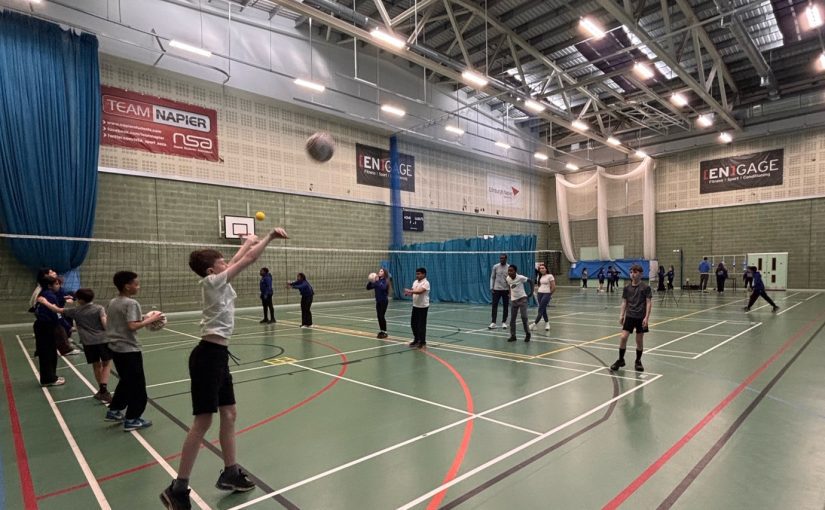
Bringing sport to life for young people is at the heart of effective coaching, and a recent initiative delivered in partnership with Active Schools Edinburgh did exactly that. Organised by Dr Cedric English and Dr Gordon Dunlop, P6 and P7 pupils from three local primary schools—Gylemuir Primary School, Murrayburn Primary School and Broomhouse Primary School—were invited to take part in a series of engaging, two-hour coaching sessions designed to inspire participation, build confidence, and introduce new sporting experiences.

The sessions were delivered by third-year Sports Coaching students from Edinburgh Napier University (ENU) as part of their Practical Coaching and Development module. This provided a valuable opportunity for students to apply their learning in a real-world setting, developing their coaching skills while making a meaningful impact in local schools.

Each session was carefully structured to expose pupils to four different activities: volleyball, pickleball, boccia, and a sports science testing station. For many of the children, these were entirely new experiences. Volleyball and pickleball offered fast-paced, skill-based games that encouraged teamwork and coordination, while boccia introduced a more inclusive activity, emphasising precision, strategy, and teamwork.
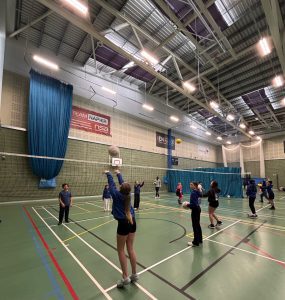
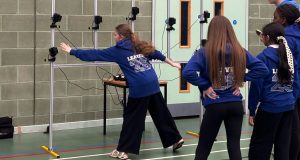
One of the highlights of the programme was the sports science station, where pupils had the chance to test their physical abilities in a fun and interactive way. Measuring their fastest 10m sprint, highest jump, and quickest reaction times, this element sparked curiosity and excitement, allowing children to engage with the science behind sport. It also encouraged a sense of personal challenge, as pupils (and often teachers!) aimed to improve their own performances.

The value of this varied and inclusive approach was reflected in feedback from participating schools:

“The staff and students were welcoming and inclusive of all learners. The rotations gave children enough time to develop their skills while keeping their interest throughout. The sports science section was a particular highlight, with pupils fascinated by the equipment and enjoying the competitive element. I would be delighted to attend similar sessions with future classes.” Lynsey Joyce, Gylemuir Primary School

From a coaching perspective, the initiative was equally impactful. ENU students were responsible for planning, delivering, and adapting sessions to meet the needs of diverse groups of young participants. This required clear communication, creativity, and the ability to think on their feet—encouraging them to become more reflective and agile practitioners, key attributes for any developing coach. Working across different schools also exposed students to varied environments and learner needs, further enhancing their experience.

Importantly, the sessions fostered a positive and supportive atmosphere where enjoyment was prioritised. Smiles, laughter, and enthusiastic participation were clear indicators of success, and for many pupils, this initiative may represent their first step towards ongoing involvement in sport and physical activity, reinforcing the longer-term value of creating positive early experiences of sport.

This positive experience was also reflected by Amy Maclennaghan from the Active Schools Forrester Hub, who said:

“It was an amazing experience for our pupils from start to finish. They were impressed with the outstanding facilities and enjoyed having so much space compared to the standard gym hall size they are used to. The variety of activities on offer was excellent, and the students’ sessions were engaging and fun.”

Overall, the programme highlights the value of partnerships between universities and local schools. It not only enriches the learning experience of coaching students but also provides young people with access to high-quality, engaging physical activity opportunities. Initiatives like this demonstrate how coaching can extend beyond performance, contributing to community engagement, education, and lifelong participation in sport.

Written by: Dr Gordon Dunlop and Dr Cedric English
 

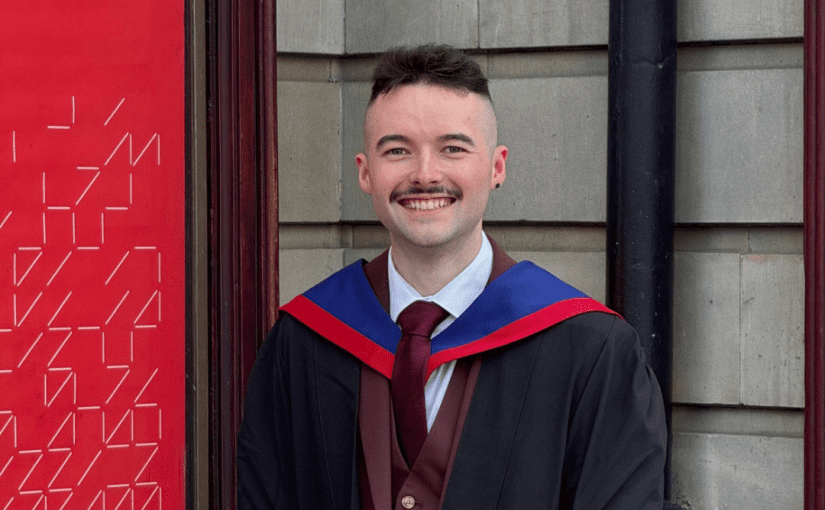
Meet graduate Jack Carberry, PGDE Biology

Jack graduated in 2025 and is currently completing his probationary year in Stirling.

“Completing the PGDE in Biology at Edinburgh Napier University was a really important experience that shaped me into the teacher I am today. Before starting the course, I was extremely nervous about the idea of standing in front of a class and teaching for the first time, but the structure and support built into the programme helped push me out of my comfort zone. Each module and school placement gradually built my confidence and helped me find my voice and develop my own teaching style.

What stood out to me was that the course not only taught me about education theory but also how to apply that knowledge in real classroom situations. For example, exploring topics like cognitive load theory and the wider context of learning gave me a much better understanding of how pupils process information and how thoughtful lesson planning can make a real difference to pupils’ learning and understanding.

I really valued the balance between theory and practice. Spending time in labs developing Biology and BGE Science teaching skills, as well as practising teaching in front of peers, giving and receiving feedback, and practising marking assessments, gave me the hands-on experience I needed. These sessions were challenging but incredibly worthwhile, and they made me feel much more prepared for teaching in real schools, especially when it came to probation.

The peer support throughout the course was also something I really appreciated. Everyone was so willing to share ideas and encouragement, and that sense of community made such a difference during the more demanding parts of the year. The lecturers were also extremely supportive, and their enthusiasm for each subject and aspect of the course made a huge impact by making it a more enjoyable experience.

Overall, the PGDE was a demanding but rewarding year. It gave me the confidence, knowledge, and mindset I needed to start my probationary year feeling ready, supported, and excited about my future in teaching. I highly recommend Edinburgh Napier for PGDE because it provides an excellent balance of academic study, practical experience, and personal support, all of which prepare you for the classroom while inspiring you to become the best teacher you can be.”

Written by: Jack Carberry, PGDE Biology

Edinburgh Napier University offers a PGDE in specialisms such as Maths, Physics, English, Biology & Chemistry, both full-time and part-time.

CASES first chair of Teaching and Learning Enhancement Division

We congratulate Dr Mel Leggate, Associate Professor in Exercise Physiology and Head of Sport, Exercise and Health Sciences at Edinburgh Napier University, on her appointment as the inaugural chair of the Teaching and Learning Enhancement Division at the Chartered Association for Sport and Exercise Sciences, CASES.

A delighted Mel said, “I have learned a great deal through my involvement with the Education and Teaching Special Interest Group (E&T SIG), under the excellent leadership of Professor Joanne Hudson FCASES, and I am excited to take this next step as we establish ourselves as a newly formed Division.

“This is an important time for teaching and learning in Sport and Exercise Science. Educators across the sector face unprecedented sector pressures, and how students learn and engage with their studies has evolved significantly. The Division will promote excellence through scholarship in teaching and learning, support evidence-informed practice, and provide practical support that helps to deliver quality education.

“I am passionate about creating a Division that brings people together, shares good practice across diverse settings, and ensures CASES provides tangible value for members at all career stages. I look forward to working with the Division Committee and the Board to identify our priorities and support teaching and learning excellence in Sport and Exercise Science.”

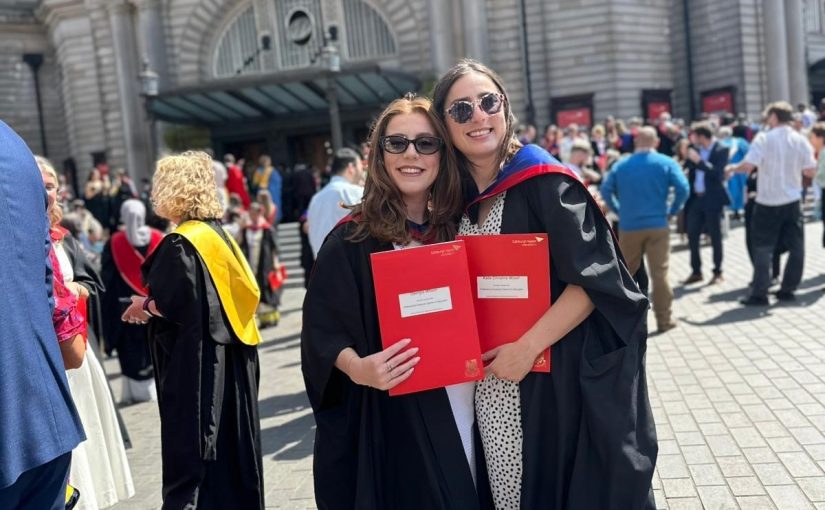
Meet graduate Kate Wood, PGDE Biology

Kate Wood is proudly working at Speyside High School in Morayshire after graduation.

“Choosing to complete my PGDE (Biology) at Edinburgh Napier University was one of the best decisions I’ve made, and I would wholeheartedly recommend the programme to anyone considering a career in teaching.

I first approached the university a couple of years before applying, when I was considering a career change and exploring becoming a teacher. Dr Eric Easton generously took the time to review my transcript and offer thoughtful advice. That early compassion and professionalism turned out to reflect the ethos of the entire programme.

Once on the course, I found the staff to be deeply experienced, supportive, and genuinely committed to shaping well-rounded, reflective practitioners. The tutors complemented one another exceptionally well, offering different strengths and perspectives that created a dynamic and holistic learning experience. I particularly enjoyed learning about inclusivity delivered by Dr Heather Earnshaw. This wasn’t a flat, “2D” approach to teacher education; it was nuanced, thoughtful, and rooted in real classroom practice.

One of the aspects I valued most was the space the tutors created for thoughtful discussion of the current issues affecting education today. They were able to guide us through complex and sometimes sensitive matters with compassion and expertise. These discussions broadened my understanding beyond the individual child or class, helping me to consider the wider, interconnected factors influencing education — from local community contexts to national trends and challenges.

Throughout the year, we were exposed to the full breadth of what it means to be a teacher: child development, theories of learning, pedagogical approaches, interdisciplinary learning, contexts of learning, assessment strategies, understanding additional support needs, inclusivity, and differentiation, the list goes on! Weekly subject-specific sessions were invaluable, and I draw upon the experience gained from these sessions daily in my role.

Despite the intensity of the one-year course, everything was delivered with clarity, purpose, and an evidence-informed foundation. We weren’t just taught what to do — we were taught why we do it, learning to ground our decisions in relevant research and current literature. This strong theoretical base has been invaluable now that I am in my probation year.

Placement experiences were organised with great care. I felt supported not only by my school mentor but also by the university tutors, who maintained support throughout. Their guidance helped me translate what we learned at university into real, practical teaching skills in the classroom.

I can genuinely say that the PGDE at Edinburgh Napier has equipped me with the skills, understanding, and professional values I rely on every day as a practising teacher. It is a course delivered by educators who embody the very best of the profession, and I am incredibly grateful for the experience.

I have not only been able to hit the ground running as a newly qualified teacher, but I have been able to engage in professional discussions with my new colleagues and be a contributing member to my team.”

Written by: Kate Wood, PGDE Biology

Edinburgh Napier University offers a PGDE in specialisms such as Maths, Physics, English, Biology & Chemistry, both full-time and part-time.

Meet graduate Hayley Guy, PGDE Chemistry

Hayley Guy graduated in 2024 and has just completed her first year of teaching in Fife.

“Having just completed my first year of teaching, I’ve had a chance to really appreciate how well the PGDE at Edinburgh Napier University prepared me for this role. The course gave me the perfect balance between theory and practice; we weren’t just learning about teaching, we were constantly putting it into action. From the first placement onwards, I felt supported and encouraged to try new approaches, reflect on what worked, and build my confidence in front of a class.

One of the things that stood out most to me was the sense of community. The lecturers were always approachable and genuinely wanted us to succeed, offering guidance and reassurance whenever things felt overwhelming. My peers were such a big part of the experience too, we shared ideas, supported each other through challenges, and celebrated the small wins along the way. This has continued throughout our probationary years and beyond.

I also really valued how much emphasis was placed on reflection. That mindset has carried through into my first year of teaching. I still find myself using the same reflective habits to improve my lessons and adapt to my pupils’ needs.

Looking back now, I feel incredibly grateful for the time I spent at ENU. The PGDE gave me the tools, confidence, and resilience I needed to not just survive my first year, but to really enjoy it. It set me up with a strong foundation, a supportive network, and the belief that I can keep growing and improving throughout my career as a teacher.”

Written by: Hayley Guy,  PGDE Chemistry

Edinburgh Napier University offers a PGDE in specialisms such as Maths, Physics, English, Biology & Chemistry, both full-time and part-time.

Meet graduate Katherine Lymer, PGDE Physics

Katherine Lymer graduated in 2022 and has completed her fourth year of teaching, with a promoted position of Principal Teacher of Communities and Partnerships.

How did the programme help you in placements?

Preparation for the placements was thorough, terrifying at times (on reflection, our insightful and structured role-playing now brings a smile to my face), and covered all the important aspects of our placements: lesson planning, preparation and reflection, learning to manage with common (mis) behaviours (hence the role-playing!) as well as hands-on practice of some of the practical elements of our subject. Professional expectations and responsibilities were clearly and appropriately set, (e.g. our progressive timetables, teaching focus (junior vs senior phase) and planning deadlines – our lecturer was open to any and all questions as we prepared for placement (even those relating to wardrobe!).

While on placement, it was reassuring to know that our lecturer was on the other end of their email or phone and while, initially, their visits were a source of anxiety, as the placements progressed, they were an exciting opportunity to share improvements in practice.

How did the programme help prepare you for your first year “on the job”?

Well, of course the first year was tough – but then we had been repeatedly warned that it would be!  Our lecturers shared their experiences of their first (NQT) year and our physics lecturer had arranged a call with a recent graduate so we could ask them about their training vs their first job.

In the second half of our programme, we needed to juggle completing our placement while also conducting a research project, a “Professional Enquiry”, (the results of which were presented on our return to university) and complete the documents for provisional registration as a teacher. To say it was intensive would be an understatement!  However, the stages of the Professional Enquiry were broken down (“scaffolded”, in teacher speak), allowing us to meet clear and staggered deadlines. In addition, we had dedicated sessions to help us navigate registration. This approach was very helpful during our first year on the job when we were required to complete another research project, a “Practitioner Enquiry”, alongside the mandatory training, alongside teaching an approaching full timetable, alongside completing all the documentation for obtaining full registration as a teacher.

How did studying at Edinburgh Napier University help progress you to where you are now?

I’m now in my fourth year of teaching, with a promoted position of Principal Teacher of Communities and Partnership, and it’s true to say that without my degree from ENU, I absolutely wouldn’t be where I am now! As a mature student, I was encouraged to use my previous life experiences to help inform my “teacher voice” – and my approach to teaching and professional development.  Without this, I wouldn’t have had the confidence to seek promotion so early in my career.

What was your experience like as a student?

In short, really positive. I applied to ENU because of their modern approach to teaching teachers, as well as their reputation in excelling in academic support and student satisfaction – examples of which I experienced before even setting a foot on campus:  My initial queries were promptly answered by the course lead and subject lecturer, and I was supported to complete a speedy and efficient application process.

I loved having lectures as part of a much larger cohort (and relished the opportunities to bond over coffee in the cafe – honestly, I still miss those cappuccinos), while the focussed, subject-specific seminars were “gold”.  The lab where we developed our practical science skills was fantastically resourced, and there was a huge library of physics-equipment that we could access.

Written by: Katherine Lymer, PGDE Physics

Edinburgh Napier University offers a PGDE in specialisms such as Maths, Physics, English, Biology & Chemistry, both full-time and part-time.

Meet graduate Erin Lowe, PGDE English

Edinburgh Napier University offers a PGDE in specialisms such as Maths, Physics, English, Biology & Chemistry, both full-time and part-time.

The practical focus of the course, paired with the specialist knowledge from tutors, helped stand graduate Erin Lowe in good stead in her first teaching role. Having completed her PGDE in English, she has now been teaching at Tynecastle High School in Edinburgh for two years – and has even returned to mentor other ENU students.

“I absolutely loved my time at Napier and felt so supported by the entire team throughout the process. Everyone is so passionate about teaching, learning, and improving the lives of young people and this bleeds through into their engaging and inspiring lectures. It is a welcoming department, and the importance of inclusivity and equity was highlighted on our very first day. I was so inspired to see our tutors challenge assumptions and prejudices throughout the course; helping us all to become practitioners who are committed to social justice.

All of the content and concepts we learnt felt fresh, current, and relevant. Since becoming a teacher, I have gone to many CPD events where we are taught concepts and ideas that were embedded into my practice as a result of my training at Napier. Napier truly feels like a leader in teacher training and seems to be doing something quite unique. There is a real focus on effective teaching and learning with helpful strategies and ideas that become second nature by the time you go out on placement. I understand how learning happens and what I can do as a practitioner to ensure my pupils are learning as much as they can while in my classroom. I use what I was taught every single day and feel very confident in my pedagogy as a result. Of course, I am always reflecting and learning but Napier embedded this in me too!

Our time with the English cohort was inspiring, reflective and fun. I learnt so many new techniques and texts to teach and it felt truly collaborative. I met one of my now best friends on the course and now we work together and continue this collaborative approach as we continue to share ideas and reflections every day.

Of course, nothing beats being in a classroom in front of young people but being in a lecture hall with some incredible friends, now colleagues, learning from wonderful professionals was a fantastic way to start my teaching career. I wouldn’t be where I am now without Napier and I am so thankful to the incredible team that helped me take my first steps into teaching!”

Read more about Erin’s graduate success in the Edinburgh Evening News.

CIEEM first for Edinburgh Napier 

The  MSc Wildlife Biology and Conservation programme at Edinburgh Napier University has become the first Distance Learning route to be accredited by the Chartered Institute of Ecology and Environmental Management.

The CIEEM Degree Accreditation Scheme celebrates undergraduate and postgraduate courses that equip students with the knowledge, practical experience, and field skills most valued by employers.

Accredited degrees combine strong ecological and environmental theory with hands-on field experience. “We believe that real-world practice is essential to building the skills employers are looking for,” reported CIEEM’s assessors.

They also highlighted that the “enthusiasm and dedication of the teaching staff is exemplary.  Teaching materials are of excellent quality; covering the most up to date and extensive topics which ensures graduates will be excellently placed to enter the ecological profession at a graduate and even higher level of employment.  The flexibility of learning (part time, in the learner’s own time, ability to pause studies, and mix and match number of modules in any academic year) are also excellent and provides the opportunity for learners who may otherwise be unable to access postgraduate studies.”

Jay Mackinnon, the programme leader for the distance learning Masters at Edinburgh Napier said: “This is a first by CIEEM. There hasn’t been an accredited distance programme before, and because CIEEM’s focus is very much on technical competencies and practical fieldwork it was quite a bold move on our part. We are delighted that the high level of accomplishment demonstrated by our students and graduates is recognised with CIEEM accreditation of the distance learning MSc.

“We share with CIEEM a commitment to inclusion and developing high-level, relevant professional competencies in learners and being able to study an accredited programme by distance learning means that it doesn’t matter where you are, it’s what you achieve that counts.”

The distance learning programme is open for applications for January 2026 >>>

Wildlife Biology & Conservation MSc Distance learning | Edinburgh Napier University

The campus-based full-time MSc Wildlife Biology & Conservation holds prior accreditation from CIEEM.

Making Waves: The Future of Surf Science & Collaboration

On Monday 27 October, Lost Shore Surf Resort in Ratho hosted the official launch of Edinburgh Napier University’s The Surf Lab, a one-day gathering of academics and industry leads. The event was hosted to inform invited guests to explore how The Surf Lab was created to discover how surfing can drive better health, stronger communities, and be a key centre to help develop innovation across the sport, support tourism and encourage sustainability within the sector.

The day involved a collection of presentations from key staff from Edinburgh Napier University, and the founder of Lost Shore Surf Resort, expanding on how the journey was established in the creation of this world’s first partnership between a commercial wave pool facility and a University.

Welcoming Innovation at The Surf Lab

Professor Gary Hutchison opened the event, providing the attendees how the inception of the Surf Lab was delivered to him by both Dr Brendon Ferrier and Dr Jamie Marshall. In his presentation, Gary outlined how the concept of The Surf Lab and the partnership with Lost Shore Surf resort addressed Edinburgh Napier University’s strategic objectives of building careers, growing networks and advancing knowledge.

Gary emphasised how The Surf Lab concept showed strong relationship with the University’s parallel centre for cycling innovation at the Mountain Bike Centre of Scotland (MTBCoS). Noting that due to the success of the MTBCoS, he was willing to take a chance with The Surf Lab concept, especially due to its alignment with the objectives and aim of both the School of Applied Sciences, but also the broader Edinburgh Napier University community.

Riding the Wave of Innovation: The Lost Shore Story

Andy Hadden, the founder and developer of Lost Shore Surf Resort further highlighted the initial development of The Surf Lab and how Lost Shore Surf Resort as a commercial venture supported its development. Andy outlined the inception of the resort, from how he came to the concept whilst working in London, using his first £5,000 to fund the first PhD in Surf Therapy, to then building Lost Shore. The atmosphere Andy generated whilst outlining the journey he and the team went through from inception to recently celebrating their first year of business illustrated to the audience how the Surf Lab was an intrinsic part of the business model. Which re-enforced the partnership between Lost Shore and Edinburgh Napier University.

From Lab to Line-up

Dr Brendon Ferrier and Dr Jamie Marshall then presented the past, current and future projects The Surf Lab have been involved with. The focus of the presentation was how Lost Shore Surf Resort utilised The Surf Lab to help them with their initial purchase of their rental fleet of wetsuits. This small project helped establish the environmental focus that Lost Shore share, with their investment in the first rental fleet of Yulex based wetsuits. A natural rubber-based material, moving away from the heavily petrochemical based neoprene material usually found as the base for wetsuits. It was also outlined how Dr Marshall’s role with the International Surf Therapy Organisation resulted with Lost Shore and Edinburgh Napier University hosting the annual surf therapy conference over the five days prior to the launch day. Highlighting how The Surf Lab re-enforced the objectives of Edinburgh Napier University.

From Board to Bench: The Science of Surfing at Surf Lab

During the breakout sessions, several attendees visited the Surf Lab space and was presented with some of the projects and opportunities the lab space can be utilised for. Both Alex Mbuli, a teaching associate at Edinburgh Napier University and Damaris Vasquez, a potential PhD candidate working out of The Surf Lab provided information within their respective fields. This discussion quickly turned to an open discussion with attendees about innovative opportunities for industry and academic research groups at several Edinburgh based universities to become involved with the Surf Lab. Building on the innovative approach of the Surf Lab. But also, the collaborative approach we strive for within the Surf Lab.

Waves and Wellness

During the Waves and Wellness breakout session, Dr Jamie Marshall sparked an engaging discussion on the growing momentum behind surf therapy and the broader concept of blue health – the idea that proximity to water can positively influence mental and physical wellbeing. These conversations didn’t stop at surfing; they explored how lessons from these approaches can inform physical activity promotion and social prescribing, offering new pathways for integrating nature-based interventions into healthcare and community programmes.

The session also highlighted several future research directions, including projects examining the role of aquatic environments in reducing stress, improving resilience, and fostering social connection. All of this unfolded poolside, with the backdrop of surfers carving waves in the Lost Shore Surf Resort’s state-of-the-art wave pool – a fitting setting for envisioning how water-based activities can transform health and wellness strategies.

Surf Lab Connections: Unlocking Innovation Through Partnership

Hosted by Professor Susan Brown, Head of Sport Engagement at Edinburgh Napier University, the afternoon session explored an ambitious vision that goes far beyond surfing as a sport. At its core, The Surf Lab at Lost Shore aims to make surfing more accessible, inclusive, and sustainable, while delivering measurable benefits for mental and physical wellbeing. It’s about creating opportunities for people of all backgrounds to engage in an activity that fosters resilience, confidence, and connection with nature.

Professor Brown highlighted how The Surf Lab helps cement principles of sport engagement that extend well beyond traditional sporting outcomes:

“The Surf Lab really helps us cement our principles around developing the evidence base for the benefit of sport engagement, which are not always sporting related, but do also help support mental, physical health and wellbeing of our community populations – cementing community cohesion, reducing crime and increasing educational engagement.”

This approach positions surfing as a catalyst for positive social impact – strengthening communities, promoting education, and contributing to a healthier, more connected society.

Driving Innovation and Growth Through Collaboration

The Surf Lab isn’t just transforming access to sport, it’s also a catalyst for innovation and regional growth. By creating jobs, fostering new businesses, and driving economic development, it’s shaping the future of surfing and beyond.

For industry partners, this is a unique opportunity to collaborate with Edinburgh Napier University’s world-class experts and facilities. As Maggie Reid, Business Development and Relationship Manager, explained: “Working with Edinburgh Napier allows you to access world-leading experts and world-leading facilities, research and knowledge exchange, and actually, it can underpin your business innovation and your strategy and your growth.”

If you’re ready to explore partnership opportunities, tap into cutting-edge research, or co-create solutions that deliver real impact, get in touch with Edinburgh Napier’s team today and be part of the Surf Lab journey.

Find out more at napier.ac.uk/surflab or contact innovation@napier.ac.uk

Written by: Dr Brendon Ferrier 

How does weather shape seabird relationships?

How weather shapes seabird relationships

When we think about seabird behaviour, we often focus on things like foraging or migration. But what about their relationships? Our new study in Animal Behaviour shows that the weather in late winter, just before the breeding season, can play a surprisingly important role in whether seabird pairs stay together or “divorce” between breeding seasons.

Studying shags on the Isle of May

We studied European shags (Gulosus aristotelis) on the Isle of May National Nature Reserve in the Firth of Forth. Thanks to the UK Centre for Ecology & Hydrology’s incredible long-term monitoring programme, we had access to two decades of data on more than 1,500 individual birds.

I first started working on this project during my time at the UKCEH. It has been a real privilege to see how combining this long-term dataset with BioSS’s statistical expertise, together with my current position at Edinburgh Napier University (Centre for Conservation and Restoration Science), has opened up new ways of understanding pair fidelity.

birds and chicks (Photo: Ken Ritchie)

What we found

On average, only about 45% of shags stay with the same partner from one breeding season to the next, but that number fluctuates dramatically, from as low as one in five pairs to nearly three-quarters in other years.

We know from previous studies that older birds and those that bred successfully are more likely to stick together, and our results confirmed that these intrinsic factors are especially strong. What we wanted to understand was whether the environment also plays a role.

The answer is yes. We found that when late winter was windier and the seas were warmer, shags were more likely to switch partners. That makes sense, because this is the time when birds are returning to the colony, re-establishing bonds, and preparing to breed. Tough conditions at this stage seem to make pair stability harder to maintain.

Interestingly, pairs that did reunite tended to lay earlier in the season, and early laying was linked to greater reproductive success. So, while divorce itself didn’t directly reduce success, its knock-on effects on timing did matter.

birds (Photo: Gerrit Peters)

Why it matters

Our findings support the idea that environmental conditions shape animal social behaviour, in this case through pair bonding decisions. And with climate change predicted to bring warmer seas and more variable wind conditions, this could mean more greater instability in seabird partnerships and potential ripple effects for population dynamics in the future.

For me, one of the most rewarding aspects of this study is that it could only have been done because of the long-term fieldwork on the Isle of May. Decades of careful monitoring gave us the chance to ask questions that simply couldn’t be answered with short-term data. It’s a reminder of how important it is to keep investing in long-term ecological research and the insights it brings are invaluable.

About the study

This research was a collaboration between Edinburgh Napier University, the UK Centre for Ecology & Hydrology (UKCEH), and BioSS, using over 20 years of detailed field data from the Isle of May National Nature Reserve.

birds

European shags on the Isle of May. Long-term monitoring of these seabirds has revealed how winter weather influences their pair bonds (photo Francis Daunt)

Written by: Lecturer and Lead Researcher, Dr Sue Lewis

Read our most recent news story/press release.