How weather shapes seabird relationships
When we think about seabird behaviour, we often focus on things like foraging or migration. But what about their relationships? Our new study in Animal Behaviour shows that the weather in late winter, just before the breeding season, can play a surprisingly important role in whether seabird pairs stay together or “divorce” between breeding seasons.
Studying shags on the Isle of May
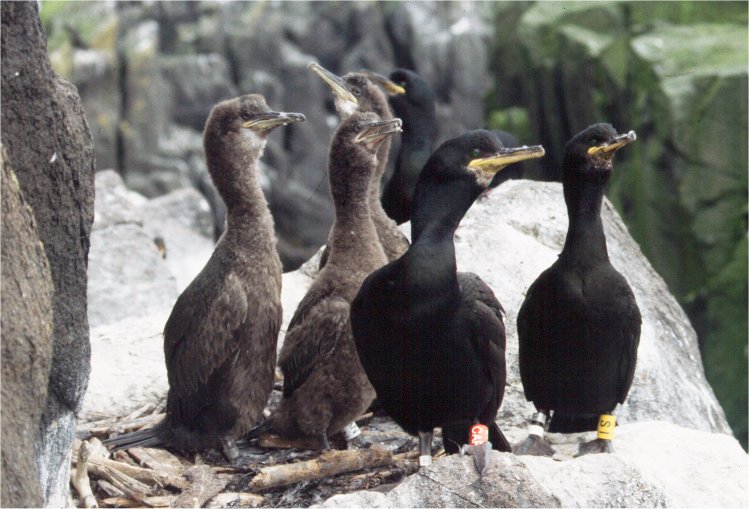
We studied European shags (Gulosus aristotelis) on the Isle of May National Nature Reserve in the Firth of Forth. Thanks to the UK Centre for Ecology & Hydrology’s incredible long-term monitoring programme, we had access to two decades of data on more than 1,500 individual birds.
I first started working on this project during my time at the UKCEH. It has been a real privilege to see how combining this long-term dataset with BioSS’s statistical expertise, together with my current position at Edinburgh Napier University (Centre for Conservation and Restoration Science), has opened up new ways of understanding pair fidelity.
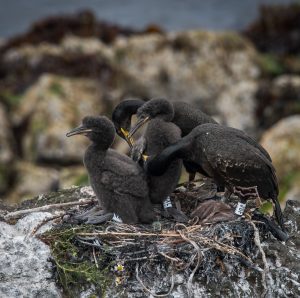 (Photo: Ken Ritchie)
What we found
On average, only about 45% of shags stay with the same partner from one breeding season to the next, but that number fluctuates dramatically, from as low as one in five pairs to nearly three-quarters in other years.
We know from previous studies that older birds and those that bred successfully are more likely to stick together, and our results confirmed that these intrinsic factors are especially strong. What we wanted to understand was whether the environment also plays a role.
The answer is yes. We found that when late winter was windier and the seas were warmer, shags were more likely to switch partners. That makes sense, because this is the time when birds are returning to the colony, re-establishing bonds, and preparing to breed. Tough conditions at this stage seem to make pair stability harder to maintain.
Interestingly, pairs that did reunite tended to lay earlier in the season, and early laying was linked to greater reproductive success. So, while divorce itself didn’t directly reduce success, its knock-on effects on timing did matter.
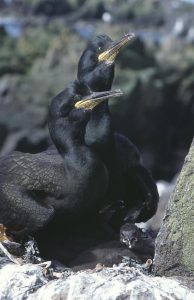 (Photo: Gerrit Peters)
Why it matters
Our findings support the idea that environmental conditions shape animal social behaviour, in this case through pair bonding decisions. And with climate change predicted to bring warmer seas and more variable wind conditions, this could mean more greater instability in seabird partnerships and potential ripple effects for population dynamics in the future.
For me, one of the most rewarding aspects of this study is that it could only have been done because of the long-term fieldwork on the Isle of May. Decades of careful monitoring gave us the chance to ask questions that simply couldn’t be answered with short-term data. It’s a reminder of how important it is to keep investing in long-term ecological research and the insights it brings are invaluable.
About the study
This research was a collaboration between Edinburgh Napier University, the UK Centre for Ecology & Hydrology (UKCEH), and BioSS, using over 20 years of detailed field data from the Isle of May National Nature Reserve.
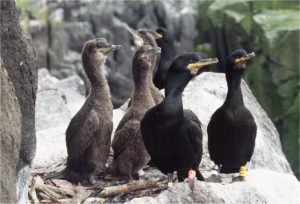
European shags on the Isle of May. Long-term monitoring of these seabirds has revealed how winter weather influences their pair bonds (photo Francis Daunt)
Written by: Lecturer and Lead Researcher, Dr Sue Lewis
Read our most recent news story/press release.