Month: October 2021

Ian Hay and the ‘New Generation’ in Their Name Liveth On

The final chapter of Ian Hay’s Their Name Liveth: The Book of the Scottish National War Memorial (London: John Lane, The Bodley Head, 1931) provides a striking insight to interwar Scottish war memory and the War Books Boom. “Ian Hay” was the nom de plume of John Hay Beith, who would become Major-General in the First World War; born in Manchester to parents of Scottish descent and schooled at Fettes College, Edinburgh, his paternal grandfather Alexander Beith was one of the founders of the Free Church of Scotland in 1843.  While Hay does not overtly attack disenchanted war literature, which many perceived as portraying soldiers negatively, he subtly asks his readers to recognise that the blame should lie with the nature of the war itself: ‘the institution and the instrument are equally condemned’ (p. 154).  

Hay, an establishment figure, imagines at length what a member of the New Generation might think about the war, bemoaning that they ‘quote to you various passages from one of the new style War novels’ (Hay, 1931, p. 151). For Hay, in these novels, the soldier is ‘variously depicted as a machine, a slave, or a dupe; frequently as a brute or a coward’ (p. 154). He sees these ‘new style War novels’ as eroding the honour and glory of the collective memory of the war; the rosy view of conditions which formed Hay’s view of his service in the Argyll and Sutherland Highlanders, and which he put forth in The First Hundred Thousand (1915) and Carrying On (1916),  now seemed distant. 
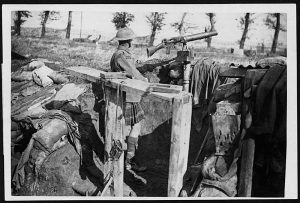
A kilted machine-gunner from the Highland Regiment.

John Warwick Brooke, ‘Highland machine-gunner ready with his gun for any emergency’. Official war photograph thanks to National Library of Scotland. https://digital.nls.uk/first-world-war-official-photographs/archive/74547316

Hay is also to some degree sensitive and pragmatic in his understanding of the New Generation’s lack of affection for the heroic warrior figure and dislike for the horrors of modern war. He writes that ‘we can hardly blame the New Generation for not caring. In any case, it behoves us to be very, very tender with the New Generation, for theirs has been a barren inheritance’ (p. 155). Hay demonstrates a consciousness of the inadequacies of the post-war world, the ‘fit country for heroes to live in’ seeming less and less likely to materialise, It also highlights the perception of a gap in understanding between the war and post-war generations (although this was far from the only schism). This is a moment at which the glorious and honourable representation of the World War, still common in the 1920s, no longer seems tenable: society’s ‘blind determination to make a hero out of everybody who had contributed’ has turned back on itself to reflect the country’s growing sense of disillusionment and disenchantment (p. 153). 

Hay’s overall conclusion goes against the many contemporary newspaper articles that suggest that the War Books Boom occurred because people were finally ready to discuss accurate experiences of the war. He insists that:

we are, at present, too close to that world tragedy, the Great War, to be able to judge it in any true perspective. […] Plainly, then, our reactions and emotions upon the subject of recent history are at present too fluid to have any lasting value. We must leave Time to crystallise them. (Hay, 1931, pp. 153-4) 

Hay argues that the books produced during the War Books Boom still do not have the appropriate temporal and emotional distance to be able to represent the Great War accurately. He dismisses the narratives produced during the War Books Boom, asking his readers only to remember those who lost their lives, stating ‘that is all our dead ask of us’ (p. 156).

Beth Campbell

(with edits by Andrew Frayn)
Ten years after Versailles: Germany in the UK War Books Boom

The year 1929 witnessed a worldwide economic devastation which coincided with the tenth anniversary of the Treaty of Versailles. In the year before, the tenth anniversary of the Armistice, a number of non-fiction books were published assessing the treaty and its impact, questioning the outcome of the Great War. Hermann Stegemann openly condemns the treaty in The Mirage of VersaillesIn the wildness of its design and the glaringness of its colours it shows that the World War has not resolved the world crisis, but has ended in blind confusion” (1919, p. 18). 

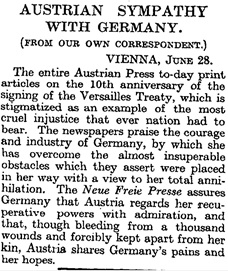
Questions surrounding not only the treaty itself but the war-guilt clause and accusations of Germany’s sole responsibility for the war also came to a head. The Times reported the discontent felt with the treaty by the states accused. The below extract from The Times is one example of the reaction from both Europe and the US. Whether or not Britons had as strong a reaction towards Germany’s discontentment, there was an undeniable growing interest in the German experience of the war demonstrated by the increasing demand for translated German war books. During that same year, Erich Maria Remarque’s iconic Im Westen Nichts Neues (All Quiet on the Western Front) was released and his portrayal of German soldiers as a ‘miserable, downtrodden pawn’ (Eksteins, 1980, p. 375) was met with a mixture of both sympathy and condemnation by British readers and reviewers.  Assessments veered between seeing it as disreputable and exceptional; similarly, in Germany it was criticised from both political wings,: from the left, for not condemning war enough, and from the right, for criticising the German soldier. 

Times Newspaper article of 29 June 1929 headlined "Austrian Sympathy with Germany"

“Austrian Sympathy with Germany”, The Times, 29 June 1929.

During the anniversary of the treaty and with the increasing popularity of Remarque’s German bestseller, the demand for German translations continued to grow. In the database of works of the War Books Boom that has been compiled for this project (which will be made publicly available via a DOI when a related academic article is published), 1930 sees over 50% of the translated works recorded coming from German originals; there is a steady increase in the number of texts translated from German, peaking, as with the boom itself, in 1930.  

Alongside Remarque’s work, Walter Bloem’s World War I memoir Vormarsch (The Advance from Mons 1914: The Experiences of a German Infantry Officer), which was translated into English in 1930, was successful among British readers. Lieut.-Colonel F. E. Whitton claims it as the ‘most accurate war-book that has come out of Germany’ (Whitton, 1930). Similarly, Edwin Erich Dwinger’s The Army Behind Barbed Wire: A Siberian Diary (1930) was received with success, later praised for its ‘documentary style which embellished its truth value’ (Fritzche, 2012, p.111). It tells of Dwinger’s individual suffering and accusations towards the dehumanising impact of war. He writes about a dead body, stating that this man ‘is no longer a sapper from Hardberg called Meier or Muller, this winter, he is only Typhus Casualty Number 14324’ (Dwinger, 1930, p.121). The tales of the war’s devastation and trauma felt by German soldiers within these translations revealed to British readers the similarities between individual German experiences and their own. 

Beth Campbell

(with edits by Andrew Frayn)

Bibliography 

Dwinger, Erich Erwin (1930). The Army Behind Barbed Wire: A Siberian Diary. London: George Allen & Unwin. 

Eksteins, Modris (1980). “All Quiet on the Western Front and the Fate of a War.” Journal of Contemporary History, 15. 345-66. 

Fritzche, Peter (2012). “Return to Soviet Russia.” In Fascination and Enmity: Russia and Germany as Entangled Histories, 1914–1945, ed. by Michael David-Fox, Peter Holquist, Alexander M. Martin. Pittsburgh, PA: University of Pittsburgh Press. 109-22 

Whitton, F.E. (1930). “Five Books on the War.” The Bookman, vol.79, iss. 271 (December 1930), p. 223 <https://data.journalarchives.jisc.ac.uk/view?pubId=bp1000302143419301434_19301201_3089261pdf&terms=bloem%20whitton&tab=date> 

Note on funding

This blog is part of a research project on The War Books Boom, 1928-30 led by Andrew Frayn.  This was partly funded by Edinburgh Napier University, and funding for a cognate project came from the Carnegie Trust for the Universities of Scotland. Beth Campbell’s work on this as an intern was funded by the Centre for Literature and Writing at ENU.

Project twitter account: https://twitter.com/warbooksboom