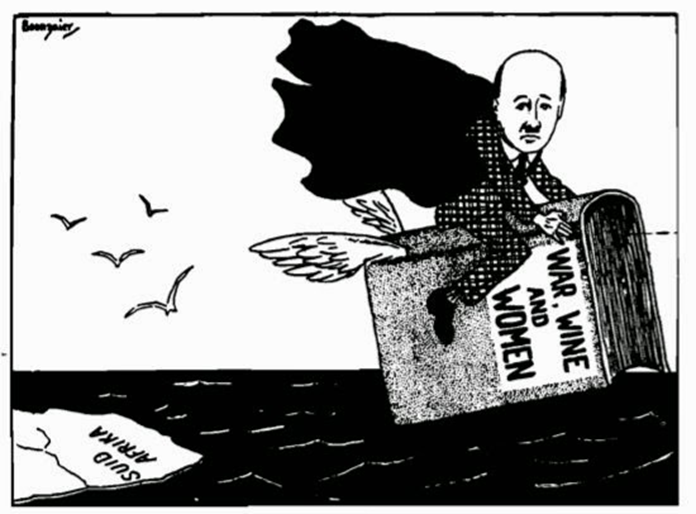
War, wine and women (1931) was published under the pseudonym Wilfred Saint Mandé. The book was received as an autobiographical account of service in the conflict, and was hugely popular at the time. It was scheduled for publication on 31 May 1931, and by 25 June the Daily Herald ran an advertisement proclaiming that 7,000 copies had been sold in the first few weeks; an advertisement in the Western Mail (covering west and south Wales) on 10 January 1935 also promoting other books by the author stated that War, wine and women was in its tenth edition; it was still selling into the Second World War, with a twelfth impression in November 1940 (cited here).
This work was reviewed as following in the footsteps of works by writers such as Remarque, often praised and criticized from different quarters for their depiction of the degradations that war enacted on those serving in it. Saint-Mandé is very graphic about the experience of the trenches. The latter two parts of the title also perhaps contributed to something of a succès de scandale: the descriptions of women were considered particularly racy. Indeed, A.J. Cummings, reviewing for the London Daily News on 11 June 1931 (which is asserted as the publication date) showed some scepticism as to the fidelity of the work:
I stopped trying to count the number of times he was wounded. I cannot recall all his war decoration, though one was indubitably the Victoria Cross. It would be a graceless task to add up all his easy conquests of beautiful and seductive women, the circumstances of which he describes in detail with engaging candour and manly gusto. (Daily News, 11 June 1931, p. 4)
Cummings did not view this necessarily as a failing, describing it as ‘If his actual experiences had been only 10 per cent of all that happens in War, Wine and Women I should salute with respect the undaunted spirit of this war-drenched hero’ (p. 4). Saint-Mandé was later revealed to be a British man of Scottish descent, John Henry Parkyn Lamont. He served in the First World War but acknowledged that, like many such accounts, War, Wine and Women was derived from truth but not faithful to it.
The soldier-protagonist is central to the narrative, which follows a conventional story of the outbreak of war, and the experiences of a band of recruits which shifts as men join up, go on leave, are wounded, and killed. The descriptions of the discussions between soldiers are affecting, and clearly owe something to hindsight and fictional construction. In conversation with a friend called Greening, the latter tells the author that:
war is getting more and more mechanical every day, and tends to develop cunning more than anything else. In a war of attrition such as this promises to be, men lie in wet lousy holes, cursing, and scratching, and sinking, morally, below the level of the beasts. There is courage, comradeship and self-sacrifice, but will anyone gain as a result? When it’s over the world will drift back to the rotten old secret alliances, spying and so forth. […] War develops the qualities necessary to the burglar, the food-pad, the assassin. We mow each other down at long range with machine-guns, and a baboon could do that. (pp. 141-2)
The philosophizing seems out of place in wartime, manifesting the tropes of the war novel which were starting to become entrenched even by this time: the enduring front-line soldiers who are in the right and recognize their poor conditions, the certainty about the iniquities of war, the accentuating of the bestial nature of conflict. Assertions such as this, of course, were unpopular with those who wanted to continue to see value in their own or others’ fighting, and perhaps deaths in conflict, or simply more conservative and nationalist thinkers. There is also a clear nod here to the increasing volatility of German politics.
The eroticism in the work is indicated from its beginning, where a connection is made with a putative Saint-Mandé ancestor’s work in revolutionary France, generally a symbol in the UK of sexual licence and decadence. After two chapters, we move into June 1914, with the protagonist just finished school, and a priapic teenager visiting elderly relatives in Dundee: ‘I longed for romance, and every pretty girl fanned the flame of sexual desire which burnt fiercely within me. It seems to me both stupid and hypocritical to deny the power and persistence of the sexual impulse’ (p. 22). After he has signed up, he uses his French language prowess to seduce a young Belgian refugee called Monique:
I could not control the trembling that shook my body. We were soon locked in a passionate embrace. I could feel the beating of her heart and the pressure of her breasts. She was dressed in black silk and it was impregnated with a subtle and provoking perfume. Since that evening I have had affairs with many women but never met one that could beat Monique at love-making ; she was an artist. Her dexterity must have been the result of a long and delightful apprenticeship, but I in my ignorance believed her when she assured me she had never kissed a man before. (p. 58)
Here, by ‘love-making’ the protagonist means in the early-twentieth century sense, not including sexual intercourse, although the eroticism of the encounter is rendered powerfully. This is made clear when he curses himself for not having sex with Monique, and is particularly chagrined when he tries later to meet her again and sees her with ‘a new cavalier’ (p. 59). The encounters continue, but become, if anything, more fantastic. On leave in Paris, for example, the protagonist has to fight his way out of an encounter with a sex-worker-thief and her violent male accomplices, registering it in his deadened senses as ‘less exciting than a patrol’ (p. 369), although the plot is straight from a thriller. It is difficult not to believe that these accounts are designed to appeal to the salacious interests of readers.
By the time the work was published, Lamont was a Lecturer in French at the University of Pretoria, in South Africa. In the reception of the book there, it was strongly criticized for an unflattering account of British man who had spent a short time in South Africa, Danesford, who in turn criticizes Afrikaners (pp. 292-9; see Hale 1999, pp. 57-9). It took less than a year for there to be suspicions that “Wilfred Saint-Mandé” was Lamont, precipitating a campaign against the book in the local press. A retraction was published, anonymously, in which Lamont highlighted that these views are expressed by fictional characters, briefly, in a lengthy novel (Hale 1999, p. 61). The controversy grew; questions were asked in Parliament by May 1932 (Hale 1999, p. 64)
Having been exposed as the author of the book, on 23 May 1932 Lamont was abducted by a group of four students who assaulted him, stripped him, covered him in grease and feathers, and hung a sign around his neck identifying him as the author of the book. They left him on Church Square in central Pretoria. His assailants were convicted, but freed by their fines being paid by Afrikaner nationalists (Hale 1999, p. 67). Lamont was signed off sick, then suspended, then sacked (Hale 1999, p. 69).
Lamont remains little-known, even in war literature circles, despite his success at the time; he would publish at least four other volumes as Wilfred Saint-Mandé between 1931 and 1935, capitalizing on his success like so many other authors of breakthrough popular novels. Among them was the ironically-titled Halcyon Days in Africa (1934), a self-aggrandising and vengeful account of his treatment in the furore after the publication of his first novel (Hale 2001, ch. 8)
Initial research and writing by Ray Thomson
Edited and developed by Andrew Frayn
Works Cited
A.J. Cummings, ‘The War from the English Side’, Daily News, 11 June 1931, p. 4.
Frederick Hale, ‘Academic Freedom vs. Afrikaner Nationalism: The Case of H.P. Lamont’s War, Wine, and Women (1932)’, South African Journal of Cultural History, 13.1 (1999), 55-70 <https://journals.co.za/doi/pdf/10.10520/AJA10113053_299> [accessed 20 Aug 2024]
Frederick Hale, Literary Challenges to the Heroic Myth of the Voortrekkers: H.P. Lamont’s War, Wine and Women and Stuart Cloete’s Turning Wheels (doctoral thesis, Stellenbosch University, 2001) <https://scholar.sun.ac.za/items/d6c8a5ff-8ee3-4a8b-9e16-eed7367bcdea> [accessed 20 Aug 2024]
Wilfred Saint-Mandé [J.H.P. Lamont], War, Wine and Women (1931; London: Cassell, 1940)
Recent Comments