Month: July 2024

J.M. Barrie, The Old Lady Shows Her Medals (1917)

A hugely popular playwright before the First World War, best known for his Peter Pan, or The Boy Who Wouldn’t Grow Up (performed 1904; published 1928), the Scottish author J.M. Barrie (1860-1937) continued to write during and after the conflict.

Barrie was affected profoundly by the death in the First World War (in 1915) of George Llewelyn Davies, one of the five brothers to whom he became guardian after their parents’ deaths in 1907 and 1910 (Birkin 1979, pp. 243-6), the wounding of another, Peter, the model for Peter Pan (Birkin 1979, p. 257), and other losses of families and friends around the time. These experiences form part of the backdrop for the play The Old Lady Shows Her Medals (1917), first published in the collection Echoes of the War (1918), and later as the title piece of a collection of four plays in the Uniform Edition of Barrie’s work (1921; cited here).

The title character is Mrs Dowey: the ‘medals’ are imagined letters from an imagined son whose name she has taken from the newspaper. This dissimulation, replete with pathos, is situated in the prose introduction as ‘a secret sorrow, namely, the crime’ (pp. 8-9); the narratorial prose voice which interjects among the dialogue throughout the play in place of what might usually be stage directions, later relents: ‘The wicked woman: but let us also say “Poor Sarah Ann Dowey”’ (p. 17).

By fortune and circumstance, the ‘son’ Kenneth agrees to spend his five days’ leave with her. He is described as:

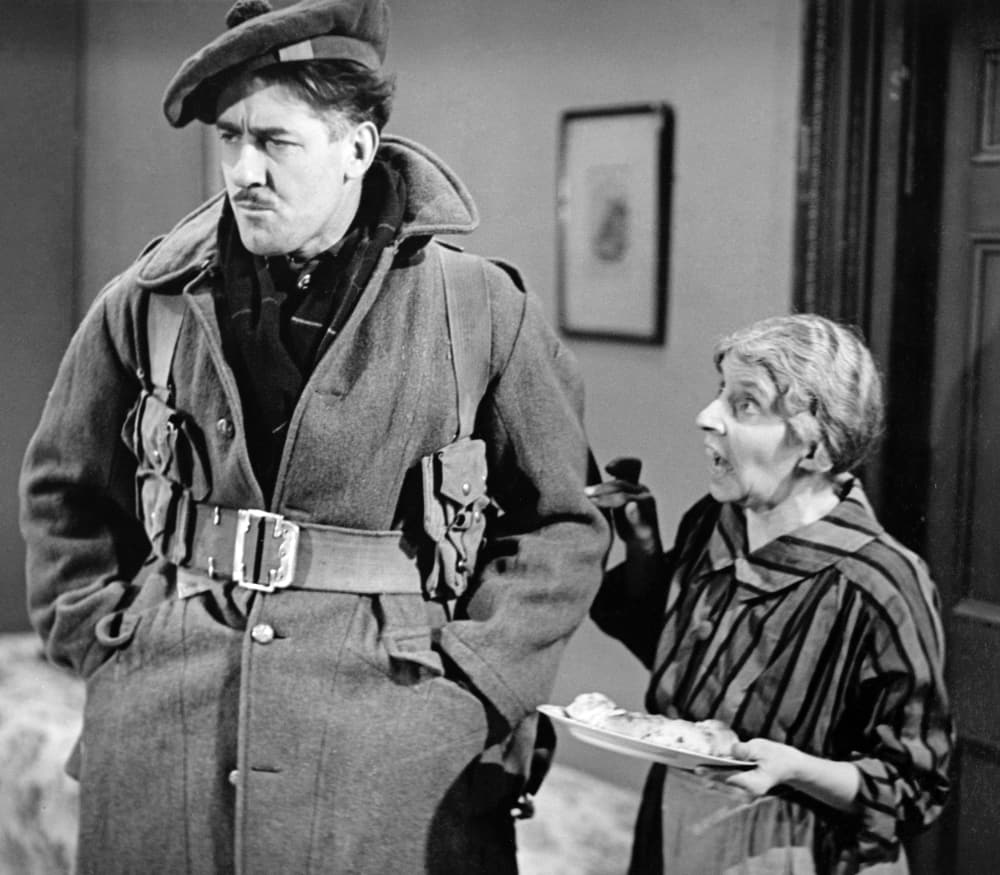
a great rough chunk of Scotland, howked out of her not so much neatly as liberally; and in his Black Watch uniform, all caked with mud, his kit and nearly all his worldly possessions on his back, he is an apparition scarcely less fearsome (but so much less ragged) than those ancestors of his who trotted with Prince Charlie to Derby. (p. 24)

The Scots word ‘howk’ is usually associated with collecting crops, particularly potatoes in the autumn (some areas still today receive an elongated ‘tattie howkin’’ school holiday). The connection with the Jacobite ‘Young Pretender’ is surprising for 1917-18, a time at which we would expect British national unity to be uppermost. At Kenneth’s curiosity for an explanation, she explains that she calls herself ‘Missis to give me a standing’, and mourns that ‘It was everybody’s war, mister, except mine’ (p. 26).  The pragmatic response to systemic misogyny and the non-combatant desire to participate, or at least share, is exculpatory, and the latter perhaps also speaks to Barrie’s own feelings, as a man in his late 50s, in the face of the conflict.

After their ‘queer first meeting’ (p. 34) the two reach a rapprochement, as Kenneth reveals that he does not have his own family. He is curious enough, and glad enough of her desire to look after him, that the bargain that she can, ‘for [her] own personal glory […] go on pretending to the neighbours’ seems worth its chance (p. 41).  He finds her funny (peculiar and humorous), but does not make her a joke; they share their lack of family, in the wartime state of exception, and for Kenneth in the face of death, form that bond in a matter of days. At the end of his leave they speak to each other as mother and son, and he makes her his next of kin.

The play culminates, inevitably, with her receiving his personal effects, including his ‘bonnet, a thin packet of real letters, and the famous champagne cork’, from the bottle they shared on his leave (p. 57).  The end of the play feels odd: ‘Her air of triumph becomes her.  She lifts the pail and the mop, and slouches off gamely to the day’s toil’ (p. 58).  The triumph is… that she has made this human connection?  That she feels she has participated in the conflict?  That, deus ex machina, she has not been caught out in her lie?

The play offers many things to a late wartime audience: soldiers returning home on leave, the forming of new emotional connections, the hope that scenarios which seem unlikely to resolve themselves can achieve a satisfactory resolution; the importance of women’s role during the conflict.  It also offers the chance to grieve, along with the redeemed title character, who has barely had time to get to know her ‘new son’.

We came erroneously to add this play to the War Books Boom database.  It was advertised in the Bookman in December 1926, but this seems not to be a new publication: the edition advertised is the Uniform Edition, which seems to have remained in print over the five years since its publication.  This raises a further question which we might take into account: how, and whether it is possible, to account for works which are not newly published in this period, but are enduringly popular.

This play continued to be popular across multiple forms, as with so many of the successes of the War Books Boom.  There were two American pre-Code film adaptations (1930, 1933), an early BBC television adaptation first screened over the 1937 Christmas holidays, with further radio performances subsequently and through the war years, as well as a 1952 television revival.  There were numerous other US adaptations for screen and radio in the post-Second World War years, as well as a one-act musical (1960).  This attests to Barrie’s enduring power, but also the continuing desire for people to process these sorts of emotions via creative works.

Initial research by Ray Thomson

Revised version by Andrew Frayn

Works cited

J.M. Barrie, The Old Lady Shows Her Medals, in The Old Lady Shows Her Medals (London: Hodder and Stoughton, 1921), pp. 3-58

Andrew Birkin, J.M. Barrie & The Lost Boys: The Love Story that Gave Birth to Peter Pan (New York: Clarkson N. Potter, 1979)
Hans Carossa, A Roumanian Diary (English trans. 1929)

Hans Carossa (1878-1956) volunteered in the First World War as an army physician for the German army; as his name suggests, he was of Italian descent, but was born and raised in Germany.

A picture of Hans Carossa with autograph below.  He faces the camera, turned to his left, in a dark suit with shite shirt and tie.

Hans Carossa

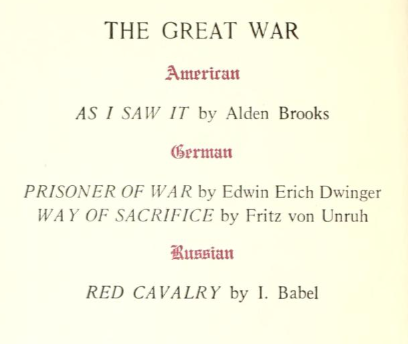
Already a poet before the War, and later a novelist, Carossa’s memoir Rumänisches Tagebuch (1924; trans. 1929 as A Roumanian Diary) follows his military experiences in Romania. The work was translated by the Scottish author Willa Muir under her pseudonym Agnes Neill Scott; she would also translate Carossa’s Verwandlungen einer Jugend (1928; trans. 1931 as Boyhood and Youth) and Doctor Gion (1931; trans. 1933). Highlighting its position in the War Books Boom, the US edition (Knopf, 1930) advertises other American, German and Russian books on the Great War on the page facing the title page.

The Great War American As I Saw It by Alden Brooks German Prisoner of War by Edwin Erich Dwinger Way of Sacrifice by Fritz von Unruh Russian Red Cavalry by I. Babel

Advertising other War Books Boom books in A Roumanian Diary (Knopf, 1930)

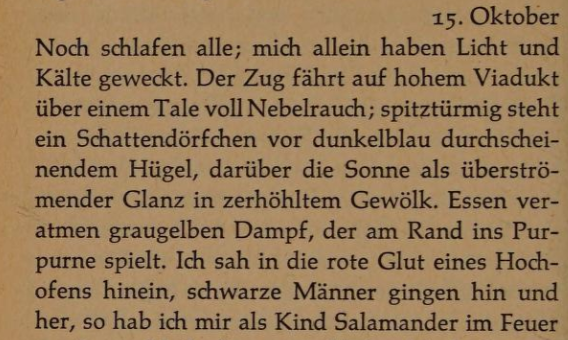
A Roumanian Diary is a remarkably detailed record of his experiences during the Romanian Campaign from 4 October to 15 December 1916. This was shortly after Romania had entered the war in response to an Allied ultimatum, on 27 August 1916.  The country had previously been neutral. The Campaign lasted from August 1916 until December 1917 when, following Russia’s withdrawal from the conflict due to the October Revolution, Romania also withdrew; it briefly rejoined the War on 10 November 1918.

Carossa’s diary entries detail his travels with his regiment and his experience of censoring their outgoing letters. He includes his recollections of and reflections on several letters written by a soldier named Glavina, who ‘often writes such wonderful letters to his friends’ (p. 9). Carossa appreciates in Glavina a sensitivity to poetry, and a lyrical use of language, manifested in descriptions such as ‘“The world, rough, raw, and monstrous as it is—I live in it as in a thin and gaudily iridescent soap bubble, holding my breath to keep from bursting it’ (p. 58).  Glavina’s death from a seemingly insignificant wound (p. 132) makes him a totemic figure to whom Carossa returns.

A Roumanian Diary was the first of Carossa’s writings to gain popularity outside of Germany. It was described by Lambert Davis in The Virginia Quarterly Review as ‘one of the few spiritual records that have come out of the War’, going on to state that Carossa’s ‘descriptions of warfare in the snow-bound Transylvanian mountains are among the most striking in war literature’ (p. 638).

Carossa would win the Swiss-based Gottfried Keller Prize (1931) and Germany’s prestigious Goethe Prize (1938).  The award at this moment in Germany points to his problematic position in that nation’s literature.  He did not leave Germany in the late 1930s as other German intellectuals chose or were forced to.  He was championed by the Nazi regime, and was included by Goebbels on the September 1944 list of artists and cultural figures exempted from military service.  Likely as a consequence, his later work attracted less interest beyond Germany, although he regained his popularity there.

Ray Thomson
(edited by Andrew Frayn)

Works Cited

Hans Carossa, A Roumanian Diary, trans. by Agnes Neill Scott [Willa Muir] (London: Martin Secker, 1929)

Lambert Davis, ‘Armageddon—Twelve Years After’, Virginia Quarterly Review, 6.4 (1930), 630-40 <https://www.jstor.org/stable/26433678> [accessed 14 June 2024]

Millicent Sutherland, That Fool of a Woman (1925)

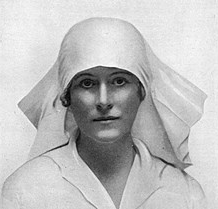
Millicent, Duchess of Sutherland (1867-1955), was among the first involved in establishing a Red Cross Ambulance Unit in Belgium in 1914. In 1915, after the German invasion of Belgium, Sutherland escaped to England and then France where her unit then became a British Red Cross Hospital Unit. Sutherland was awarded the British Royal Red Cross, the French Croix de Guerre and the British Red Cross in honour of her service during the War. She was also an advocate for social reform and better working conditions. She wrote a total of seven novels, plays, memoirs and short story volumes, including That Fool of a Woman and four other sombre tales (1925). It is a collection of five semi-autobiographical items, ‘a novelette which titles it and four somber short stories’ (‘New Books’, p. 939).

The title story follows a widow named Chloe. It begins with the death of her husband (Sutherland’s first husband died in 1913) and follows her journey throughout the War. Chloe, mostly like Sutherland, becomes a nurse for the French Red Cross but is quickly captured by German soldiers in Belgium; after escaping she returns to the UK, where she continues to nurse.

While the story follows Chloe’s experiences as a nurse, it is more focused on her relationships, especially with the men in her life and, moreover, the way that war impacts on these. The focus on romance rather than the War was not uncommon in 1925. Prior to the 1928-9 successes of the starkly disillusioned texts of the War Books Boom, the lens was less violent and less dehumanized than it would subsequently be.

Following the death of her husband and her first experience of the War, Chloe becomes overwhelmed by the horrors of war and impulsively marries Freddie. However, their relationship does not last and they divorce shortly after Armistice (Sutherland remarried in October 1914 and divorced in 1919). We also follow her relationship with her son Rex, who is a soldier in the War.

Chloe’s final and most pivotal relationship is with Major Wentworth Longden, who she meets during the War; this makes apparent her incompatibility with Freddie. They correspond during and after the War, their letters providing her with an escape from the conflict. eventually marrying. While her relationship with Longden does begin by being healthier and happier than her previous marriage, they grow unhappy and divorce (Sutherland remarried in October 1919 and divorced in 1925). The relationship seems unable to function in peacetime. Chloe moves back to England before returning to Paris to write pantomimes, plays and essays, returning to her pre-War passions.

The volume was harshly reviewed in The Bookman (US) the summer after its publication, in a brutally brief ‘tabloid review’: ‘Seldom does a title characterize a book so fitly — even the reader feels included’ (p. 474). Other war and post-war books reviewed particularly favourably in this list are Philip Gibbs’s Unchanging Quest and C.E. Montague’s Rough Justice; also commented upon with less distinction are Warwick Deeping’s Sorrell and Son, William Faulkner’s Soldiers’ Pay, R.H. Mottram’s The Crime at Vanderlynden’s, and Sylvia Thompson’s The Hounds of Spring (Andrew writes about both Montague’s and Mottram’s books in Writing Disenchantment). The reviewer for the Saturday Review of Literature comments on the ‘emotional but extremely intelligent style’ of the text, but criticizes the weakness of the other four stories compared to the long title story.

This book of 1925 is included in the dataset, as we searched a slightly longer period (1925-34, against 1926-33) in looking for books of the Scottish War Books Boom, to see if it took a different shape (this work was done by Louise Bell, to whom thanks are due).  The author was born in Dysart, near Kirkcaldy, Fife.  It is clear from this item that the War was still on the minds of both writers and readers alike, and that readers were interested in a range of experiences during it.

Ray Thomson

(edited by Andrew Frayn)

Bibliography

‘The Bookman’s Guide to Fiction’, Bookman (US), 63.4 (June 1926), 471-4 <https://www.unz.com/print/Bookman-1926jun-00471/> [accessed 31 Oct 2023]

‘The New Books’, Saturday Review of Literature, 2.51 (17 July 1926), 939-40 <https://www.unz.com/print/SaturdayRev-1926jul17-00939a02/> [accessed 31 Oct 2023]

Sutherland, Millicent (1925). That Fool of a Woman (London and New York: Putnams)