
There will be plenty on this blog about the research that the department is doing – understandably! But I wanted to share with you a few things that I read (mostly) for pleasure over the summer while on holiday. For me, it’s important to read widely, and not only in the area that I research. Reading outside the area you’re most interested in can make you rethink productively things you already (think you) know. Admittedly, I found reading for pleasure much harder when I was a student (both an undergrad and a research student), but remembering why you enjoy reading can also make studying easier, too.
Having scanned my non-work bookshelves at the beginning of the year, I’ve been reading lots of contemporary women writers in an effort to address an unconscious bias. Two that I particularly enjoyed were by Irish authors.
Anne Enright’s The Gathering, which won the 2007 Man Booker Prize, deals with the tragically early loss of a sibling. The narrator, Veronica, endeavours to make sense of Liam’s suicide by engaging with the complex, troubled and troubling history of her family. Enright movingly depicts the peculiar closenesses and distances that characterise family life, those feelings as true in the same room as when living hundreds or thousands of miles apart. I particularly enjoyed – if that’s the right word for this moving, tragic novel – the gradual unfolding of the family’s secrets, and the subtle but accessible style.
Lisa McInerney’s The Glorious Heresies, which won both the Baileys Women’s Prize for Fiction and the Desmond Elliott Prize in 2016, is an altogether different kettle of fish. Ryan Cusack is endeavouring to deal with the impact of his mother’s death, and his alcoholic father’s role as a low-level gangland pawn. None of this is made any easier by an over-attentive older neighbour, a prostitute searching for her disappeared boyfriend, and his own sometime career as a drug dealer. And none of that is helping his treasured relationship with his girlfriend Karine. McInerney’s prose is earthily authentic, pulling no punches, and the brisk pace of the novel makes it a good read.
Finally, on a more work-y note, I really enjoyed Richard Burton’s long biography of the late modernist poet Basil Bunting – all 608 engaging pages of it. Bunting led a remarkable life: a conscientious objector as he turned 18 at the end of the First World War, dissolute in Paris in the mid-1920s, a longstanding friend of Ezra Pound, a senior military diplomat in the middle east in the Second World War, and finally (re)discovered as a poet in the 1960s (and his sixties) thanks to the publication of his masterpiece Briggflatts (1965) and the patronage of the poets of the British Poetry Revival.
These were just the highlights. I hope you’ve managed to make some time to read for pleasure yourselves, too.
Andrew Frayn
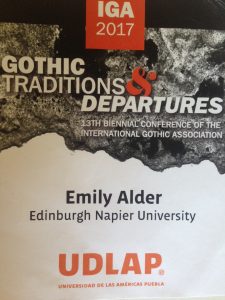 I have been a member of this Association for ten years and this was my fifth conference. It’s always a pleasure to see old friends and familiar faces as well as getting to know the many fascinating new people I inevitably meet at events like this.
 LitLong: Edinburgh
Recent Comments