How does weather shape seabird relationships?

How weather shapes seabird relationships

When we think about seabird behaviour, we often focus on things like foraging or migration. But what about their relationships? Our new study in Animal Behaviour shows that the weather in late winter, just before the breeding season, can play a surprisingly important role in whether seabird pairs stay together or “divorce” between breeding seasons.

Studying shags on the Isle of May

We studied European shags (Gulosus aristotelis) on the Isle of May National Nature Reserve in the Firth of Forth. Thanks to the UK Centre for Ecology & Hydrology’s incredible long-term monitoring programme, we had access to two decades of data on more than 1,500 individual birds.

I first started working on this project during my time at the UKCEH. It has been a real privilege to see how combining this long-term dataset with BioSS’s statistical expertise, together with my current position at Edinburgh Napier University (Centre for Conservation and Restoration Science), has opened up new ways of understanding pair fidelity.
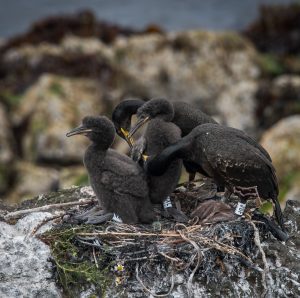
birds and chicks (Photo: Ken Ritchie)

What we found

On average, only about 45% of shags stay with the same partner from one breeding season to the next, but that number fluctuates dramatically, from as low as one in five pairs to nearly three-quarters in other years.

We know from previous studies that older birds and those that bred successfully are more likely to stick together, and our results confirmed that these intrinsic factors are especially strong. What we wanted to understand was whether the environment also plays a role.

The answer is yes. We found that when late winter was windier and the seas were warmer, shags were more likely to switch partners. That makes sense, because this is the time when birds are returning to the colony, re-establishing bonds, and preparing to breed. Tough conditions at this stage seem to make pair stability harder to maintain.

Interestingly, pairs that did reunite tended to lay earlier in the season, and early laying was linked to greater reproductive success. So, while divorce itself didn’t directly reduce success, its knock-on effects on timing did matter.
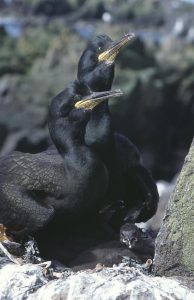
birds (Photo: Gerrit Peters)

Why it matters

Our findings support the idea that environmental conditions shape animal social behaviour, in this case through pair bonding decisions. And with climate change predicted to bring warmer seas and more variable wind conditions, this could mean more greater instability in seabird partnerships and potential ripple effects for population dynamics in the future.

For me, one of the most rewarding aspects of this study is that it could only have been done because of the long-term fieldwork on the Isle of May. Decades of careful monitoring gave us the chance to ask questions that simply couldn’t be answered with short-term data. It’s a reminder of how important it is to keep investing in long-term ecological research and the insights it brings are invaluable.

About the study

This research was a collaboration between Edinburgh Napier University, the UK Centre for Ecology & Hydrology (UKCEH), and BioSS, using over 20 years of detailed field data from the Isle of May National Nature Reserve.
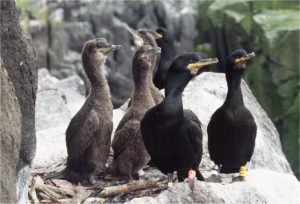
birds

European shags on the Isle of May. Long-term monitoring of these seabirds has revealed how winter weather influences their pair bonds (photo Francis Daunt)

Written by: Lecturer and Lead Researcher, Dr Sue Lewis

Read our most recent news story/press release.

ENU’s Stellar Contributions to the Scottish Institute of Policing Research in 2023

The Scottish Institute for Policing Research (SIPR) is a collaborative organisation which brings together 15 Scottish Universities, as well as Police Scotland and The Scottish Police Authority, whose aim is to ‘support internationally excellent, multi-disciplinary policing research to enable evidence-informed policy & practice.’

Edinburgh Napier’s Contribution to the SIPR Annual report demonstrates the outstanding and sheer volume of work and dedication that has gone into this area of research from academics within the university, with our very own Professor Liz Aston leading the research institute.

Some of the work in this year’s report includes examples of the kind of collaboration carried out, including knowledge and exchange events, which has contributed to organisational learning, such as hosting Norwegian Police.

Our ENU head of Social Sciences, Dr Andrew Wooff, now an incoming Associate Director of SIPR is co-lead of the Education and Leadership network. Indeed, he also co-wrote a report with Drs Shane Horgan and Andy Tatnell; ‘Pluralised responses to policing the pandemic: analysing the emergence of informal order maintenance strategies, the changing of ‘policing web’, and the impacts of COVID19 in rural communities.’

Dr Jennifer Murray collaborated on an engaging report on the ‘Estimation of risk for missing individuals: Development of an empirical risk assessment and decision support tool for missing person investigations’ and as well as this, our Edinburgh Napier Carnegie grant PhD scholar, Abigail Cunningham delivered research on ‘Encountering policing – a dialogic exploration of Scottish Pakistanis’ experience of ‘policing.’

Edinburgh Napier also leads The Scottish Centre for Policing and Public health, with Prof Nadine Dougall and Drs Inga Heyman, Andrew Tatnell and Andrew Wooff contributing ‘How cross-service collaboration can improve community safety and wellbeing – a systematic review and case study of a community hub intervention’, again showing the range of multi-disciplinary research submitted to the report.

Furthermore, Dr Shane Horgan collaborated on a report titled: ‘Influence Policing’ which looked at contemporary issues with targeted communication campaigns.

There was much more submitted by our Edinburgh Napier SIPR academics, and you can read the full annual report here: SIPR-Annual-report-2023.pdf

To find out more about SIPR and what they do, visit the site: SIPR – Scottish Institute for Policing Research

You can also sign-up to the newsletter!


napier.ac.uk

Growing the cycling industry in Scotland

In 2023, Scotland is to host the Cycling World Championships, a two-week extravaganza that will bring together 13 international competitions in one country for the first time.

This inaugural mega event will provide an outstanding opportunity to showcase the Mountain Bike Centre of Scotland (MTBCOS) research group and a new Innovation Centre at Innerleithen, in the Scottish Borders.

Edinburgh Napier University’s Professor Geraint Florida-James is playing a key role in establishing the new innovation centre – which marks an important milestone for the sport of cycling at home and worldwide. An applied researcher who is passionate about sports science and cycling, Professor Florida-James has been involved with the biking industry for nearly twenty years, also coaching athletes for the Downhill and the Cross-Country World Cups, as well as Professional Enduro Racers.

The MTBCOS is a project that started in 2014, with Edinburgh Napier University working in partnership with Scottish Enterprise and the Scottish Cycling. Its role has been to help grow a Scottish cycling industry, with relevant research and help businesses take advantage of one of the country’s fastest-growing sports. The group provides support with market research, developing, testing, and launching new products.

The success of the project caught the attention of the Scottish and UK Governments and raised the profile of the sector internationally. As a result, with an additional partner, the South of Scotland Enterprise, the Centre has been fundamental in securing £19M of Borderlands Regional Growth Deal Funding to purchase the Caerlee Mill in Innerleithen, an old textile mill that has been out of use since 2013. Professor Florida-James emphasises that partnerships such as these are key for the Centre’s continued success.

Also included in the Borderlands Project is the first mechanical lift-assisted Bike Park in the Northern Hemisphere, which will be with a short ride of the Mill. Once renovated, the Mill and the surrounding world-class bike tracks will serve as an innovation site for the cycling industry ­- led by Edinburgh Napier – where new products can be developed and tested. In addition, the Hub will also explore supply chain issues and can connect local entrepreneurs with international audiences.

Professor Florida-James says, “we expect huge international interest around the 2023 Championships, which will help more companies become aware of the research and development potential here, and the potential to reshore some of the cycling industry to Scotland”.

The Centre has equally been supporting internal partners within Edinburgh Napier who are involved with mental health and wellbeing research, to identify ways cycling can boost these issues in Scotland and beyond. Various schools within the University will combine their research with the Centre through the new Innovation Hub, recognising the opportunities cycling presents for future health, wellbeing and economic development.