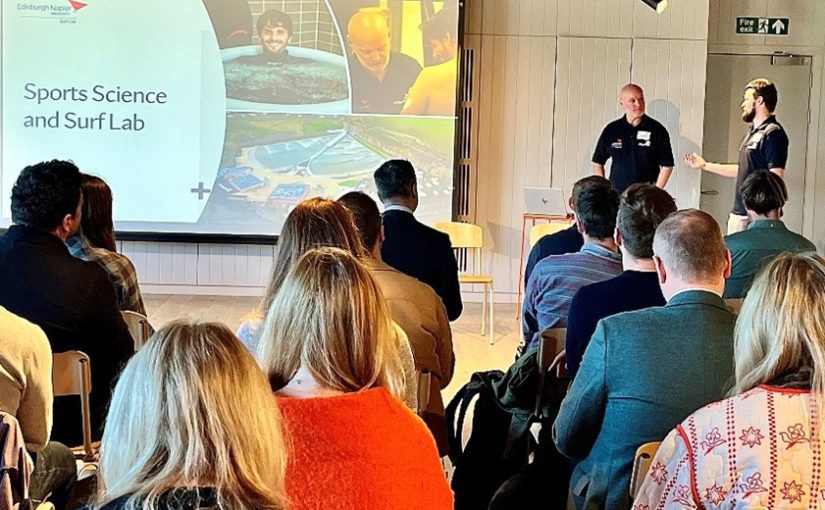
On Monday 27 October, Lost Shore Surf Resort in Ratho hosted the official launch of Edinburgh Napier University’s The Surf Lab, a one-day gathering of academics and industry leads. The event was hosted to inform invited guests to explore how The Surf Lab was created to discover how surfing can drive better health, stronger communities, and be a key centre to help develop innovation across the sport, support tourism and encourage sustainability within the sector.
The day involved a collection of presentations from key staff from Edinburgh Napier University, and the founder of Lost Shore Surf Resort, expanding on how the journey was established in the creation of this world’s first partnership between a commercial wave pool facility and a University.
Welcoming Innovation at The Surf Lab
Professor Gary Hutchison opened the event, providing the attendees how the inception of the Surf Lab was delivered to him by both Dr Brendon Ferrier and Dr Jamie Marshall. In his presentation, Gary outlined how the concept of The Surf Lab and the partnership with Lost Shore Surf resort addressed Edinburgh Napier University’s strategic objectives of building careers, growing networks and advancing knowledge.
Gary emphasised how The Surf Lab concept showed strong relationship with the University’s parallel centre for cycling innovation at the Mountain Bike Centre of Scotland (MTBCoS). Noting that due to the success of the MTBCoS, he was willing to take a chance with The Surf Lab concept, especially due to its alignment with the objectives and aim of both the School of Applied Sciences, but also the broader Edinburgh Napier University community.
Riding the Wave of Innovation: The Lost Shore Story
Andy Hadden, the founder and developer of Lost Shore Surf Resort further highlighted the initial development of The Surf Lab and how Lost Shore Surf Resort as a commercial venture supported its development. Andy outlined the inception of the resort, from how he came to the concept whilst working in London, using his first £5,000 to fund the first PhD in Surf Therapy, to then building Lost Shore. The atmosphere Andy generated whilst outlining the journey he and the team went through from inception to recently celebrating their first year of business illustrated to the audience how the Surf Lab was an intrinsic part of the business model. Which re-enforced the partnership between Lost Shore and Edinburgh Napier University.
From Lab to Line-up
Dr Brendon Ferrier and Dr Jamie Marshall then presented the past, current and future projects The Surf Lab have been involved with. The focus of the presentation was how Lost Shore Surf Resort utilised The Surf Lab to help them with their initial purchase of their rental fleet of wetsuits. This small project helped establish the environmental focus that Lost Shore share, with their investment in the first rental fleet of Yulex based wetsuits. A natural rubber-based material, moving away from the heavily petrochemical based neoprene material usually found as the base for wetsuits. It was also outlined how Dr Marshall’s role with the International Surf Therapy Organisation resulted with Lost Shore and Edinburgh Napier University hosting the annual surf therapy conference over the five days prior to the launch day. Highlighting how The Surf Lab re-enforced the objectives of Edinburgh Napier University.
From Board to Bench: The Science of Surfing at Surf Lab
During the breakout sessions, several attendees visited the Surf Lab space and was presented with some of the projects and opportunities the lab space can be utilised for. Both Alex Mbuli, a teaching associate at Edinburgh Napier University and Damaris Vasquez, a potential PhD candidate working out of The Surf Lab provided information within their respective fields. This discussion quickly turned to an open discussion with attendees about innovative opportunities for industry and academic research groups at several Edinburgh based universities to become involved with the Surf Lab. Building on the innovative approach of the Surf Lab. But also, the collaborative approach we strive for within the Surf Lab.
Waves and Wellness
During the Waves and Wellness breakout session, Dr Jamie Marshall sparked an engaging discussion on the growing momentum behind surf therapy and the broader concept of blue health – the idea that proximity to water can positively influence mental and physical wellbeing. These conversations didn’t stop at surfing; they explored how lessons from these approaches can inform physical activity promotion and social prescribing, offering new pathways for integrating nature-based interventions into healthcare and community programmes.
The session also highlighted several future research directions, including projects examining the role of aquatic environments in reducing stress, improving resilience, and fostering social connection. All of this unfolded poolside, with the backdrop of surfers carving waves in the Lost Shore Surf Resort’s state-of-the-art wave pool – a fitting setting for envisioning how water-based activities can transform health and wellness strategies.
Surf Lab Connections: Unlocking Innovation Through Partnership
Hosted by Professor Susan Brown, Head of Sport Engagement at Edinburgh Napier University, the afternoon session explored an ambitious vision that goes far beyond surfing as a sport. At its core, The Surf Lab at Lost Shore aims to make surfing more accessible, inclusive, and sustainable, while delivering measurable benefits for mental and physical wellbeing. It’s about creating opportunities for people of all backgrounds to engage in an activity that fosters resilience, confidence, and connection with nature.
Professor Brown highlighted how The Surf Lab helps cement principles of sport engagement that extend well beyond traditional sporting outcomes:
“The Surf Lab really helps us cement our principles around developing the evidence base for the benefit of sport engagement, which are not always sporting related, but do also help support mental, physical health and wellbeing of our community populations – cementing community cohesion, reducing crime and increasing educational engagement.”
This approach positions surfing as a catalyst for positive social impact – strengthening communities, promoting education, and contributing to a healthier, more connected society.
Driving Innovation and Growth Through Collaboration
The Surf Lab isn’t just transforming access to sport, it’s also a catalyst for innovation and regional growth. By creating jobs, fostering new businesses, and driving economic development, it’s shaping the future of surfing and beyond.
For industry partners, this is a unique opportunity to collaborate with Edinburgh Napier University’s world-class experts and facilities. As Maggie Reid, Business Development and Relationship Manager, explained: “Working with Edinburgh Napier allows you to access world-leading experts and world-leading facilities, research and knowledge exchange, and actually, it can underpin your business innovation and your strategy and your growth.”
If you’re ready to explore partnership opportunities, tap into cutting-edge research, or co-create solutions that deliver real impact, get in touch with Edinburgh Napier’s team today and be part of the Surf Lab journey.
Find out more at napier.ac.uk/surflab or contact innovation@napier.ac.uk
Written by: Dr Brendon Ferrier
 (Photo: Ken Ritchie)
 (Photo: Gerrit Peters)