Scotland Net Zero 2045: What can be done to secure a Just Transition?
Leadership, Policy and Sustainability | CBISS Research Forum on Scotland’s Just Transition
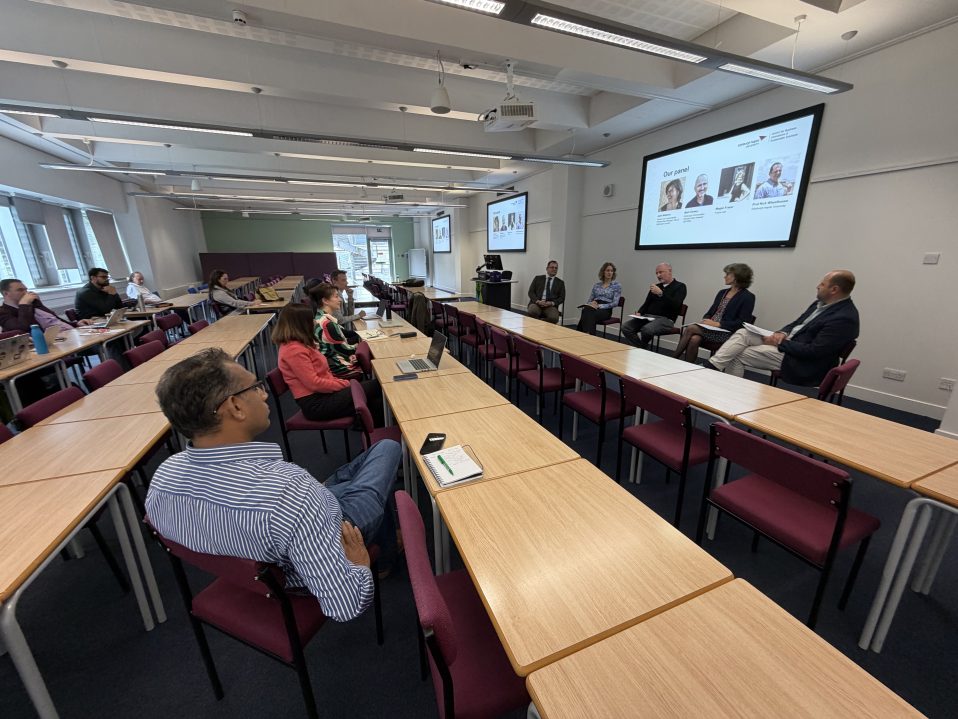
Scotland has committed to reaching net-zero greenhouse gas emissions by 2045. That commitment will heavily affect those working in public services, local businesses, communities and government. To reflect on the complexity of that challenge, Dr Cristian Surubaru and Dr Guanyu Jason Ran, at The Business School, recently hosted a panel at Craiglockhart Campus to explore what a “Just Transition” means for Scotland and the challenges involved in delivering it.
Dr. Surubaru and Dr. Ran brought together representatives from the City of Edinburgh Council, the Edinburgh Communities Climate Action Network, sustainability coaching consultancy Future Led, and Edinburgh Napier University.
For Cristian Surubaru, Lecturer in Public Administration and Management and co-lead of the new Sustainability Governance and Policies research theme within the Centre for Business Innovations and Sustainable Solutions (CBISS)*, the event was designed to create space for conversation between organisations that do not always have the opportunity to share their experiences.
“We tried to get these different perspectives in place to see what can be done in terms of a just transition,” he explained. “We were speaking the same language, but we didn’t really know it.”
The event formed part of an international symposium involving ten universities across the UK and the United States, demonstrating growing global interest in Just Transition approaches and debates.
The discussion highlighted that while many organisations are striving towards similar sustainability ambitions, they often face common barriers, including limited resources, competing priorities, and a lack of shared frameworks for implementation. Cristian’s own research focuses on organisational and administrative capacity and how public sector bodies can strengthen their capacity and ability to deliver sustainability goals.
Drawing on experience gained earlier in his career working with European funding programmes, he is particularly interested in how organisations can successfully implement climate policies rather than simply develop them. “Every sector needs a strategy, specific priorities and implementation plans,” he said. “The challenge is making sure organisations have the capacity to deliver them.”
The panel revealed how priorities can differ depending on the sector. For instance, sustainability consultant Megan Fraser emphasised the human dimension, encouraging leaders to better understand the long-term implications of climate change and embed sustainability into decision-making.
Meanwhile, from a local government perspective, Edinburgh City Council representative Julie Waldron highlighted the practical realities related to housing, budgets, and public accountability.
One area of discussion centred on the challenge of delivering affordable housing while also meeting environmental goals. Based on emerging research about Net-Zero implementation, sustainable housing developments can be more expensive to build, creating tensions between social needs, economic pressures and climate ambitions.
Beyond exploring challenges, the event aimed to identify practical areas for future action: “It’s all about making council representatives feel more empowered so they have a better capacity to deal with sustainability and Just Transition or Net-Zero goals.”.
Cristian next plans to host another panel event this autumn on “Building Capacity Across Scottish Councils for Net-Zero and Climate Action” together with Dr Liliana Fonseca from the University of Strathclyde, and with support from the British Academy and Sustainable Scotland Network (SSN). This will continue to develop Edinburgh Napier’s new Sustainability Governance and Policies research theme.
“We will examine how sustainability governance is organised at the public level and what can be improved in terms of capacity and making policies better,” he said. “Our new theme will help get people from across the university to talk about climate change and work with us.”
To register interest in attending the next Net Zero panel session taking place on 30th of November 2026 please contact marketing@napier.ac.uk
* Visit: Centre for Business Innovations and Sustainable Solutions