Turning climate action into community action in Viet Nam
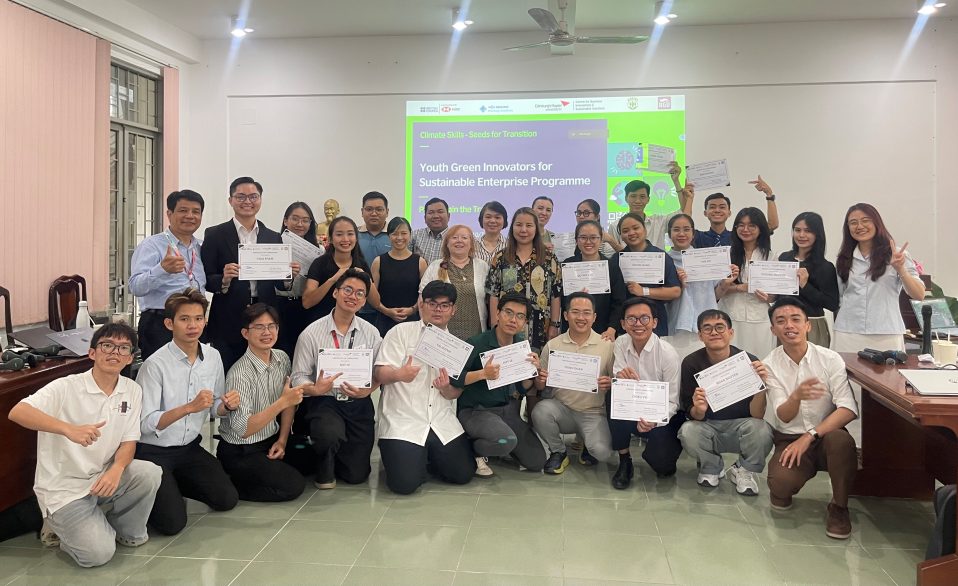
A joint project by Edinburgh Napier University and Can Tho University
We spoke to Sukanlaya Sawang, the Director of Centre for Business Innovation and Sustainable Solutions (CBISS) at Edinburgh Napier University, on her work in support of an international collaboration to develop green skills for young people.
Professor Sawang worked as Project Lead with researchers from ENU’s CBISS (Jackie Brodie, Renata Osowska), and in collaboration with Can Tho University, to help those aged 18-30 in Viet Nam learn more about implementing sustainable practices into their businesses and local communities. Both universities were awarded funding under the Climate Skills Global Collaboration Grants, a global programme delivered by the British Council and supported by HSBC.
What is the Youth Green Innovation for Sustainable Enterprise Programme?
This is an applied research project that aims to build climate skills among young people in marginalised communities. At CBISS, we took what we learned from our research on sustainability and innovation and turned it into a practical programme running over six to nine months. The programme helps young people gain useful knowledge and skills for their future, while also supporting them to make a positive difference in their communities.
The research we used to build out the curriculum examines the models of how people and businesses can adopt green approaches. This includes asking: What stops them? What helps them? What encourages small and medium sized businesses to make changes? It’s not about only understanding climate change but being able to use that understanding to embed it into businesses, or even simply bringing that knowledge into a community.
What was your role with the programme?
I was the Project Lead, so I was looking after the overall direction of the project. At the beginning, I worked closely with our university partner in Viet Nam to shape the curriculum and make sure that our research on sustainability and innovation was behind what we were teaching.
Then I led the team to develop the curriculum and learning materials. We worked with the local partners to make sure the content fitted the local context and was practical and useful for the young people.
We wanted to use this programme as a pilot and learn from it. The aim was not only for the young people to become green innovators. We also wanted to give them the skills and confidence to become trainers in their own communities. They can then share what they have learned with other people, so the impact of the programme can continue to grow.
Can you tell us about the participating students?
For our first cohort, there were around 20 people aged between 18 and 30. Most participants recently graduated or are about to finish their studies. Some of them have already started businesses.
We ran an analysis of the student feedback and found that in terms of the awareness and understanding, the cohort gained confidence in their green knowledge, climate change, the circular economy and how environmental, social, and economic values work together.
18 out of the 20 students described that they already have an entrepreneurial project or will start a project after this. They all intended to share their learning with farmers, with other peers, students, young people, people with disabilities and family members about this programme.
What is the most rewarding aspect of working on this project?
To be able to see the research that we have done translate into the real world. Our work goes beyond the academic paper that only scholarly people would read, but rather we can see something that will directly impact the community.
Another rewarding part of this project for me is working with young people and particularly people that come from marginalised communities. This cohort involved people from more rural communities and some living with disabilities. I like to think we can give this group more opportunities to brighten their future.
We also started a youth innovation lab in Viet Nam. It’s a safe place for young people to test their ideas and get support from mentors. The mentors would be an experienced researcher, academic in a relevant area, or from the business industry to help give advice.