

Books on timber properties, like the BRE Handbook of hardwoods (Farmer, 1972), give vast amounts of information, but it is not often clear which data went into the findings. The handbook of hardwoods, for example, states: “Although much of the information is derived from tests carried out at the Princes Risborough Laboratory, data from other reliable sources have also been freely used.” In our paper, Hardwoods in the United Kingdom – Considerations When Looking to Future Planting and Future Value Chains, Dan and I give a lot of info on the properties of homegrown timbers and where these data came from, but we had to cut much of the detail from the final version. Here’s some more background on how most information on physical properties, working qualities, drying schedules, natural durability and even fire resistance of many of our homegrown timbers was gathered over the years. Even though my delve into the National Archives was very much focused on hardwoods, this also applies to softwoods to a large extent.
For details on where (hardwood) mechanical property data comes from, see this post.
From the early 20th century, the Department of Scientific and Industrial Research recognised a need for a timber research programme in the UK, and in 1918 formed Timber Research Organisation, which was little later replaced by the Forest Products Research Board (National Archives, n.d.; Rendle, 1976). The board started to form committees to conduct fundamental research on a) wood identification and structure b) timber testing and the physical and mechanical properties c) seasoning and physical properties d) decay and preservatives e) extractives, but already in 1923 recognised the need for a research facility with a more commercial focus, and negotiations for the establishment of a forest products research laboratory started at this time (Rendle, 1976). Strategic research into the properties of home-grown and overseas timbers really began with the foundation of the Forest Products Research Laboratory (FPRL) in 1925 and the opening of its facilities at Princes Risborough in 1927. Different lines of investigation were followed in several research projects (Table 1) that all yielded large amounts of data on a wide variety of (hardwood) species. Much of these data, mostly generated between 1926 and the second world war, forms the basis of our understanding of timber properties of these species even now.
The different research projects conducted at FPRL mostly followed the same structure, which is convenient for anyone who wants to review their reports now, almost 100 years later. The first report of a series lines out the methods used for sampling and testing, and subsequent reports mostly give results for a specific consignment of timber. For example, the first report in project 1 sets out test methods for mechanical properties of small-clear specimens of 2-inch cross section (Chaplin, 1928), and subsequent reports within the project give results for several species tested according to these methods (Forest Products Research, 1929). This also means that most information on test methods can be derived from the first reports of a series, even where detailed reports on species are no longer available. This is especially important since most basic data have been published and re-published in several extensive summary reports which omit details on sampling and testing. Where available, project reports on specific consignments usually contain more information on growth origin of the trees, with a description of the sampling site, soil conditions, age of the trees and some growth characteristics like growth ring width and percentage “summerwood”.
Physical (and mechanical) properties
One of the most important lines of work in the early years of FPRL was the characterisation of physical and mechanical properties, and work on these started as project 1. The project set out to characterise properties of different species by testing small clear specimens of 2-inch cross section in three-point bending, impact bending, compression parallel and perpendicular to grain, tension perpendicular to grain, shear, cleavage and Janka hardness. Specimens were cut from logs in pairs for testing in green and air-dry condition, which allowed to quantify the moisture-dependency of mechanical properties. Project 1 also included investigations into physical properties, namely radial, tangential and volumetric shrinkage, as well as the fibre saturation point of different species (Department of Scientific and Industrial Research, 1929, 1930).
Only two reports on the properties of oak, ash, and several softwood species are available in the national archives, but several end of year reports of the Forest Products Research Board mention that additional species (and thousands of specimens) have been tested within project 1 (Department of Scientific and Industrial Research, 1929, 1930). Most testing on home-grown species appears to have been finished when the second edition of the Handbook of home-grown Timbers was published in 1939 (Forest Products Research Laboratory, 1939), which contains shrinkage data from green to 15% moisture content and from 20% to 10% moisture content for many species.
Additional tests on “movement” have apparently been carried out after the publication of the handbook. Results for shrinkage between two climatic conditions, 90% and 60% relative humidity at 25°C, are given in the 1956 Handbook of hardwoods (Forest Products Research, 1956). Shrinkage figures from the green condition have here also been adapted (and potentially supplemented with new data) to reflect shrinkage to 12% moisture content, instead of 15%. For most species, the same figures are still published in the 1972 version of the Handbook for hardwoods (Farmer, 1972).
Air- and kiln-drying
Next to physical and mechanical properties, a highly important line of investigations from the earliest days of FPRL was the establishment of effective and efficient air- and kiln-drying methods (Department of Scientific and Industrial Research, 1929). Project 5 started with lab-scale trials to establish seasoning characteristics of species from 1926 and quickly advanced to full-scale kiln tests to support industry. Next to the development of drying schedules, a goal of the project was to establish the influence of kiln-drying (as opposed to air-drying) on mechanical properties. Within project 5, reports for each species usually come in multiple parts – some reporting on the seasoning characteristics and others on mechanical properties.
Reports on kiln-seasoning properties within project 5 contain descriptions of the tree stands, the history of the logs, information on defects visible in logs and sawn timber, as well as data on specific gravity in green and dried state and shrinkage in radial and tangential direction. Each report also makes advances towards a suitable drying regime for a species, drawing from observations of previous reports. Two accompanying projects, project 25 and 28 (Table 1), also investigate the kiln-and air-drying behaviours of different timbers. Species reports within these projects contain detailed information on growth conditions of the trees, defects present in logs and boards, drying regimes applied, and drying defects observed in every plank after air- and kiln-drying. The findings of these projects are summarised in a 1938 report, where eight kiln-drying schedules are introduced and species recommendations made (Bateson & Hodge, 1938). The schedules and shrinkage values from green to 15% moisture content are also given in the 1939 Handbook of home-grown Timbers. No species reports on drying properties from after 1937 are available in the National Archives, but increasing experience has evidently been used to improve the knowledge base, as a tweaked set of drying schedules is published in the Kiln Operator’s Handbook (Stevens & Pratt, 1952). By 1956, twelve drying schedules had been published in the Handbook of Hardwoods, which were changed again in its second edition (Farmer, 1972). The probably most modern summary, the third edition of the BRE Timber Drying Manual, contains twelve further amended schedules (Pratt, 1997). Still, the BRE guide, on shrinkage figures and kiln schedule recommendations, states “The data […] have largely been obtained from tests carried out during the period 1930 to 1982, at the former Forest Products Research Laboratory and Princes Risborough Laboratory.” (Pratt, 1997), so the detailed project 5 reports likely form the biggest share of the knowledge base for home-grown hardwoods.
Additional data on mechanical and physical properties was also generated in project 18 “Investigation of the Relation between the Structure, Chemical Composition and the Physical Properties of Timber”. In the beginning of the project, the general anatomy of different species and the influence of wood structure on timber properties was investigated, but later the focus shifted more towards tension wood in temperate hardwoods, as this seems to be most influential. Data on compression strength, toughness and tensile strength are published in various reports, although average properties are often not explicitly stated, and reports focus rather on the comparison of normal and tension wood. Some reports also determine longitudinal shrinkage in tension and normal wood and report on observations during machining. The findings are summarised in a 1939 report (Clarke, 1939), but the property data, even of normal wood, collected within project 18 is not included in summaries like the Handbook of home-grown Timbers.
Natural durability and treatability
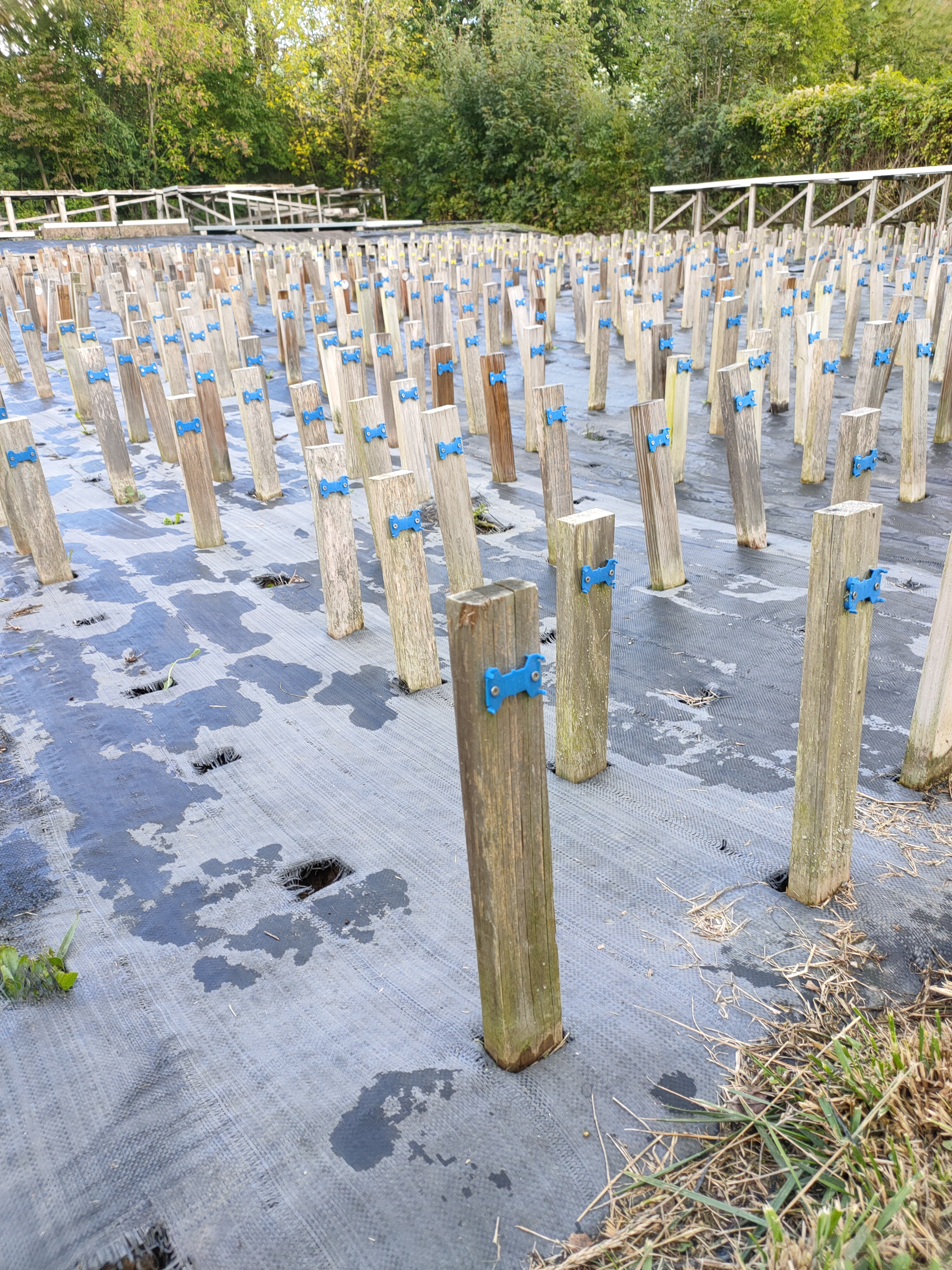
Decay and timber preservation has been another cornerstone of FPRL research since its beginning. Much of the early research focused on the fundamental understanding of decay organisms and their effects on wood (e.g. Cartwright & Findlay, 1936; Findlay, 1932; Findlay & Pettifor, 1937; Munro & Fisher, 1927) as well as the effectiveness of certain preservatives (e. g. Findlay, 1931; Findlay & Cann, 1932; Findley, 1929). Investigations into species properties had also already begun by the early 1930s (Cartwright & Bryan, 1932), and information on the durability of most species is found in the Handbook of home-grown Timbers. The information in the handbook, however, is not necessarily based on objective experiments, and the level of detail given varies widely between species – while for some timbers details on specific insects and fungi that attack the trees or timber are given, others are classified on a scale from “very resistant” to “perishable”. A summary of more extensive field tests to classify the durability of a large number of species was published in 1949 (FPRL, 1949). This publication introduces comparable resistance grades, that reflect an expected service life in years. Apparently more field trials have been conducted until 1975, and a BRE report details testing of 180 timber species and more than 6,000 specimens (Purslow, 1976).
The permeability to preservatives (specifically creosote) is also given in the 1939 handbook for most species. Although few research reports on the topic seem to have been published beforehand, the findings seem to be based on experiments, since the classification system for permeability is based on the required pressure and duration of treatment to reach a certain penetration depth. More scientific values on permeability to air are given in a report from 1958 (Smith and Lee, 1958)
Further research on durability and preservative uptake was carried out by the Building Research Establishment (BRE), and these data, as well as the Princes Risborough data, are summarised in a later publication (Construction Research Communications Ltd, 1998). In this report, the classification system is also related to the EN 350 system which is still in use.
Workability
It was also recognised from the earliest days of FPRL research that the working properties of timber species should be made known. The first end of year report of the laboratory states that timber quality in this respect is often described subjectively by those working with timber, and that these empirical findings were to be supplemented with data gathered by more objective test methods (Department of Scientific and Industrial Research, 1929). Work on the properties of different species seems to have started little later, and two reports on working qualities of timbers are available in the National Archives (Table 1, project 16). The Handbook of home-grown timber gives a description of the findings for each species, with recommendations on which type of circular saw should be used. After these initial studies it seems that the Woodworking Section of FPRL started to focus more on theoretical work, i.e. the forces involved in sawing, as well as the optimisation of machine parameters (e.g. Endersby, 1953; Harris, 1937). Machining behaviour of additional tropical species was also investigated (Department of Scientific and Industrial Research, 1939, 1950). The 1956 Handbook of Hardwoods introduces two new parameters that make species comparable: “Resistance in cutting” is classified on a scale of low, medium or high, and “blunting effect” is classified on a scale from mild to severe. The list of saw types is also updated, representing eight different saw types compared to the three in the 1939 handbook.
The BRE Handbook of hardwoods combined the FPRL data with “other published information” and “experience with the timber in industry” and gives information not only on sawing, but also planing, boring, nailing and other machining characteristics. Simple trials for boring and nailing behaviour are described. E.g. if boring with two different tools can be “carried out without difficulty, then the species is classed as being satisfactory”. Detailed reports on these tests could not be located. Saw types have also been re-classified to conform to the newly established standards at the time (BS 411 and BS 4411), and additional information on bandsaw and ripsaw behaviour has been added.
Wood bending
Some special properties were under investigation in different times, depending on markets that were seen to be promising at the time. Very early on, the steam bending quality of different timbers was investigated extensively in project 18. The test methods used for determining bending quality of a species are described by Stevens (Stevens, 1936). One method involves the use of a standardised machine for bending timbers to assess the optimum production parameters for a species. A comparison of bending quality of different species is achieved by a method that involves measuring strains in compression and tensile tests of small specimens that have been steamed for 30 minutes3. The result of this test is a ratio of timber thickness and minimum radius to which it can be bent without failure. Reports on individual species within project 18 (Table 1) usually describe in more detail the origin of the timber, defects present and their influence on the quality of the bent timber, both in green and dry state. Where results are available, the Handbook of home-grown Timbers gives a summary of these findings for each species, and the ones tested after 1939 have been added to the Handbook of Hardwoods (Forest Products Research, 1956). This publication also gives bending ratios of thin, unsteamed laminates for some species, and information is again summarised in the 1970 Wood Bending Handbook (Stevens & Turner, 1970).
Other properties
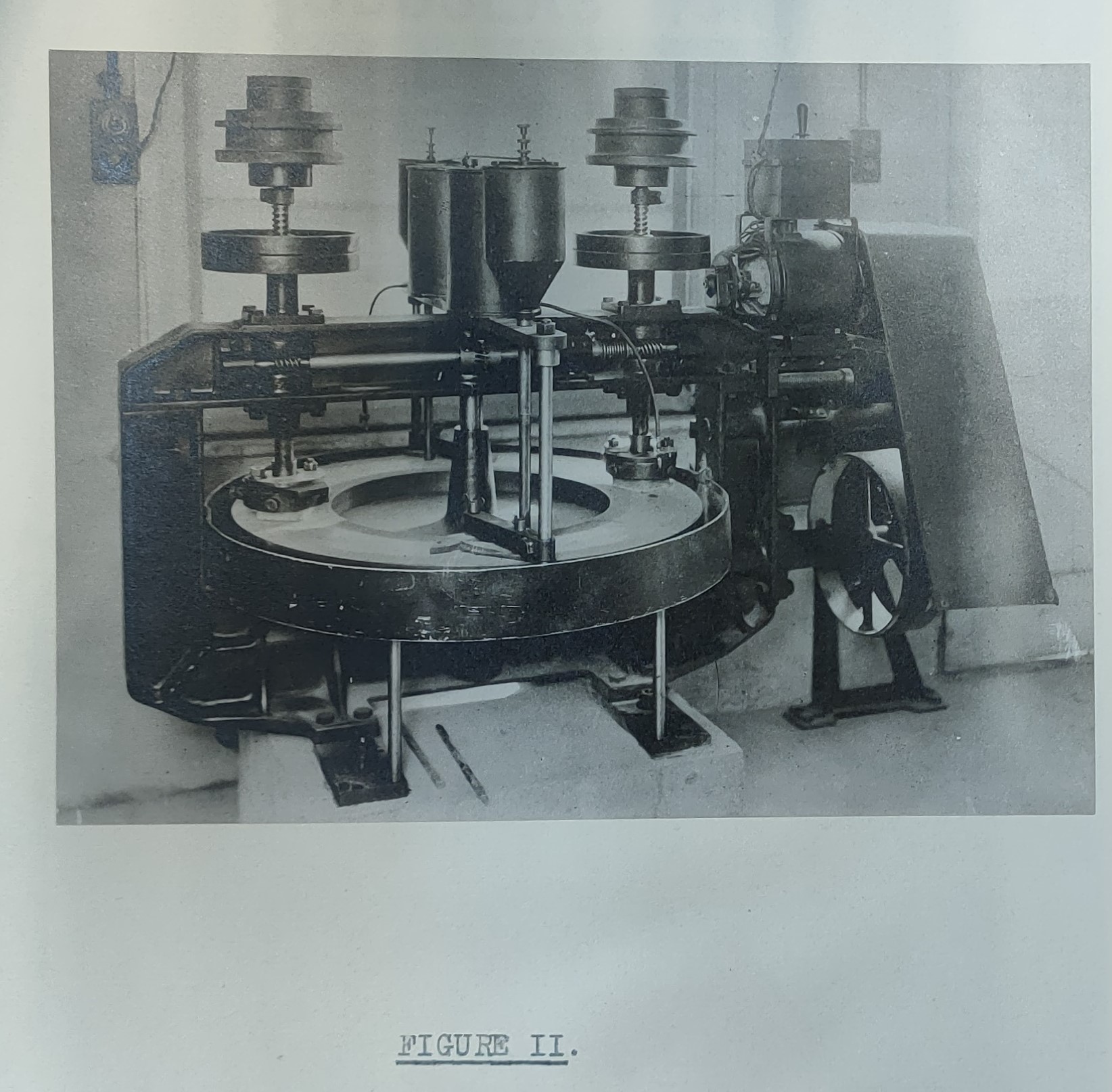
Little after the publication of the Handbook of home-grown timbers the abrasion resistance of timbers that might be used in flooring was investigated in project 35. A machine was devised for measuring abrasion resistance of different species objectively, and measurements performed mostly on tropical species, but also oak, beech and Canadian maple, next to some softwoods (FPRL, n.d.). The loss in weight, loss in volume and loss in thickness were reported, next to specific gravity. The influence of anatomical structure on wear resistance was also investigated. The findings of the project are summarised in three reports (Armstrong, 1948, 1949, 1957).
From the 1940s a large number of timber species was investigated for suitability in plywood-manufacture. Mostly tropical species were subject to peeling- and slicing trials, but also homegrown poplar, oak and Turkey oak, as well as softwood species, were reported on. Species reports contain details on the origin of the timber, pre-treatment of billets, processing parameters like knife-variables and nosebar-variables, and quality of the obtained veneers depending on veneer thickness. Further the drying of the veneers including shrinkage is described, yield of clipped veneer quantified, and gluing parameters and the quality of the plywood assessed. Slicing and peeling trials for decorative veneers were also performed for home-grown Turkey oak and birch, using similar methods.
A study on the fire resistance of different timbers, many of them homegrown, was carried out in 1940 (Bryan and Doman, 1940). As much as actually assessing fire properties of different timbers, the report focuses on developing test methods for determining three fire-resistance properties, namely resistance to ignition, resistance to penetration of a large heat source and rate of spread or rate of heat evolution. Timbers are classified into fire-resistance six groups based on a minimum of ten tests per species on heartwood only.
Table 1 Overview of FPRL reports available from the National Archives
| Project | Timeframe, approximate | Reports available from the National Archives |
| Project 1 Mechanical and Physical Properties of Timbers | 1927-29 | AY 18/1107 (1928) Mechanical and physical properties of timbers: tests of small clear specimens by C J Chaplin AY 18/1108 (1928) Progress report 1: tests of some home-grown timbers in their green condition by C J Chaplin AY 18/1109 (1929) Progress report 2: tests of some home-grown timbers in their green and seasoned conditions by C J Chaplin and F M Mooney |
| Project 5 Investigations into the kiln-seasoning properties of home- and empire-grown timbers | 1926-37 | On seasoning properties: AY 18/1118 (1927) Investigation into kiln-seasoning properties: home and empire-grown timbers by S T C Stillwell AY 18/1119 (1926) Investigation into kiln-seasoning properties: commoner commercial timbers by S T C Stillwell AY 18/1125-29 (1928-31) Progress report: beech: investigation into the kiln-seasoning properties of home and empire grown timbers by W C Stevens: part 1 – 5 AY 18/1132 (1931) Progress report: kiln-seasoning properties of elm by W C Stevens: part 1 AY 18/1148 (1929) Progress report: kiln-seasoning properties of English oak by R A G Knight: part 1 AY 18/1153-1155 (1929-30) Progress report: kiln-seasoning properties of Black Italian poplar by W C Stevens: part 1-3 AY 18/1160-1161 (1930) Progress report: kiln-seasoning properties of wych elm by W L Greenhill: part 1-2 AY 18/1167-1169 (1931-32) Progress report: kiln-seasoning properties of ash by W C Stevens: part 1-3 AY 18/1175-1176 (1932-33) Progress report: sweet chestnut by W C Stevens: part 1-2 AY 18/1185 (1930) Progress report: kiln-seasoning properties of Dutch elm by R A G Knight: part 1 AY 18/1187 (1932) Progress report: Dutch and Wych elms by R A G Knight AY 18/1188 (1928) Progress report: common elm by W C Stevens: part 1 AY 18/1189 (1928) Progress report: kiln-seasoning properties of common elm by S T C Stillwell and J C Mallam: part 2 On mechanical properties: AY 18/1124 (1930) Investigation into the kiln-seasoning properties: mechanical and physical tests: progress report part 1: beech by T Hamilton AY 18/1147 (1932) Progress report: kiln-seasoning properties: mechanical and physical tests: English oak by T Hamilton: part 2 AY 18/1151-1152 (1930-31) Progress report: kiln-seasoning properties: mechanical and physical tests: Black Italian poplar by T Hamilton: part 1-2 AY 18/1158-1159 (1930-32) Progress report: kiln-seasoning properties: mechanical and physical tests: wych elm by T Hamilton: part 1-2 AY 18/1183-1184 (1932) Progress report: kiln-seasoning properties: mechanical and physical test: Dutch elm by T Hamilton: part 1-2 Note: Many reports on home-grown softwoods are also available |
| Project 28 The combined air and kiln seasoning of timbers | 1932-34 | AY 18/1382 (1932) The combined air and kiln seasoning of timbers by S T C Stillwell AY 18/1383 (1933) Progress report-: English Oak. Part 1 by R A G Knight AY 18/1384-1385 (1933) Progress report on the seasoning properties of Beech. Part 1-2 by W C Stevens AY 18/1386 (1933) Progress report 1: Beech part 1 by W C Stevens AY 18/1387 (1934) Progress report: Hornbeam. Part 1 by W C Stevens AY 18/1388 (1934) Progress report 2: English Oak by R A G Knight AY 18/1389 (1934) Four experiments on English Ash by R A G Knight AY 18/1390 (1934) Report on two experiments on common Elm (Ulmus campestris) by R A G Knight AY 18/1391 (1934) English Oak: part 3 |
| Project 25 Air-seasoning methods | 1931-34 | AY 18/1364 (undated) The air seasoning of timber: explanatory note AY 18/1365 (1931) The air seasoning of timber: investigation into by S T C Stillwell AY 18/1366 (1933) Factors concerning the spacing and size of piles and the drying of sleepers and end-racked planks by S T C Stillwell and R A G Knight AY 18/1367 (1933) Investigation into the air-seasoning properties of timber: the drying rates of timbers and the effects of piling and climatic conditions – part l, by R A G Knight AY 18/1368 (1934) Investigation into the air-seasoning properties of timber: factors in yard layout – part 2 by R A G Knight |
| Project 18 Investigation of the Relation between the Structure, Chemical Composition and the Physical Properties of Timber | 1928-41 | AY 18/1253 (1928) Progress report 1: the critical examination of the wood of Ulmus Campestris by S H Clarke AY 18/1254-55 (1929) The investigation of the anatomical structure of home grown and other timbers, and the relation of structure to physical properties (revised): progress report 1-2. by B J Rendle and S H Clarke AY 18/1256-1258 (1933-35) Home-grown timbers, their anatomical structure and its relation to physical properties: progress report 3 on Adm: Part 1-3 by C J Chaplin, F H Armstrong and S H Clarke AY 18/1259 (1936) Investigation of the relation between the structure, chemical composition and the physical properties of timber, progress report 3 on Ash: part 4 by S H Clarke and G L Franklin AY 18/1260 (1938) Part 5: occurrence of tension wood by S H Clarke and G L Franklin AY 18/1261 (1936) Progress report 4: the toughness of Ash. Part 1 by C B Pettifor and S H Clarke AY 18/1262 (1936) Progress report 5: Beech: part 1 by S H Clarke AY 18/1264 (1938) Investigation of the relation between the structure, chemical composition and physical properties of timber. Progress report 5 on Beech: part 4. A comparison of the strength of tension and normal wood in the green and air-dry conditions by S H Clarke and G L Franklin AY 18/1265 (1938) Part 5: the relation between resistance to longitudinal compression and longitudinal shrinkage in matched specimens from a tree containing tension wood by G L Franklin AY 18/1269 (1938) Progress report 8: Oak by B J Rendle and G L Franklin. AY 18/1270 (1938) Investigation of the relation between the structure, chemical composition and physical properties of timber: progress report 10 on Walnut (Juglaus Regia L.) by B J Rendle and G L Franklin AY 18/1271 (1940) Progress report 11: the influence of the physico-chemical composition of the cell-wall on the moisture relations of hardwoods by S H Clarke and C B Pettifor |
| Durability and preservation Project 32 Project 17 Project 26 | 1932 1929-41 1931-33 | AY 18/1398 (1932) The relative durability of untreated timbers by K St. G Cartwright and J Bryan AY 18/1245 (1938) The testing of wood preservatives: investigation 3: determination of extent of penetration by I H H Yarrow and E C Harris AY 18/1369 (undated) The relation between the structure of wood and its preservative treatment: explanatory note AY 18/1370 (1931) The relation between the structure of wood and its preservative treatment: part 1 by B J Rendle and E W J Phillips AY 18/1375 (1932) Progress report 3: note on the mode of expressing the amount of preservatives absorbed by wood: “The Impregnation Ratio” by E W J Phillips |
| Project 16 Investigation of the sawing, working and finishing qualities of timbers | 1929-34 | AY 18/1238 (1929) Investigation of the sawing, working and finishing qualities of timbers by W E Wilson AY 18/1239 (1934) Investigation of the working qualities of timber by P Harris and W E Wilson |
| Project 33 Wood bending | 1931-36 | AY 18/1399 (undated) Wood bending: explanatory note AY 18/1400 (1931) Steam bending by W C Stevens AY 18/1401 (1932) Progress report 1: on Beech. Part 1. Preliminary tests to investigate the properties influencing the bending quality of timber AY 18/1402 (1932) Progress report 1: Ash. Part 1 AY 18/1403 (1932) Progress report 2: changes in the microscopic structure of Beech wood induced by steam bending by B J Rendle AY 18/1404 (1933) Steam bending: progress report 1 on Oak. Part 1. Preliminary tests to investigate properties influencing the bending qualities of timber by W C Stevens AY 18/1405 (1934) Progress report 1 on Elm. Part 1. Investigations into the steam bending properties of by W C Stevens AY 18/1406 (1935) Wood bending: progress report Investigations into the steam bending properties of timber: Beech. Part 2 by W C Stevens and E N Turner AY 18/1407 (1935) Wood bending: Wych Elm. Part 1 by W C Stevens AY 18/1408 (1936) Wood bending: Sweet Chestnut. Part 1 by W C Stevens and E N Turner AY 18/1409 (1936) Wood bending: Canadian Maple (Acer Saccharum). Part 1. by W C Stevens Note: reports on tropical species are also available |
| Project 35 The resistance of timber to abrasion | 1938-40 | AY 18/1411 The resistance of timber to abrasion: explanatory note Note: reports on tropical species are also available |
| Peeling trials for plywood | 1941-72 | AY 18/904 (1941) 1. Home-grown timbers for plywood AY 18/906 (1942-1943) 3. and 4 Peeling tests on and properties of plywood from home-grown and Empire timbers: part 2 AY 18/920 (1953) 18. Special tests: black poplar – home grown AY 18/949 (1958) 47. Figure in home-grown Birch veneer by R. J. Newall AY 18/956 (1959) 54. Bark form and veneer figure in home-grown birch by R. J. Newall and J. E. Grosert AY 18/958 (1960) 56. Consignment 991: Turkey oak – home grown AY 18/959 (1961) 57. Bark form and veneer figure in home-grown birch by R. J. Newall and J. E. Grosert AY 18/962 (1964) 60. Preliminary tests on processing and yield of Scots pine; Douglas fir; oak Note: reports on tropical species and softwoods are also available |
References
Armstrong, F. H. (1936). The Mechanical Properties of “Black-Heart” Ash Wood.
Armstrong, F. H. (1948). Flooring Hardwoods. https://babel.hathitrust.org/cgi/pt?id=uc1.b4592281&seq=77&q1=flooring
Armstrong, F. H. (1949). Flooring Softwoods their Wear and Anatomical Structure. https://babel.hathitrust.org/cgi/pt?id=uc1.b4592281&seq=173&q1=flooring
Armstrong, F. H. (1953). The Strength Properties of Timber (H.M.S.O, Ed.).
Armstrong, F. H. (1957). Timbers for Flooring. https://babel.hathitrust.org/cgi/pt?id=uc1.b4592285&seq=531
Bateson, R. G., & Hodge, R. E. (1938). Kiln-Drying Schedules. https://babel.hathitrust.org/cgi/pt?id=mdp.39015069678236&seq=475
Bryan and Doman (1940). The comparative resistance to fire of various species of timber. FPRL
Cartwright, K. St. G., & Bryan, J. (1932). The relative durability of untreated timbers.
Cartwright, K. St. G., & Findlay, W. P. K. (1936). The Principal Rots of English Oak. https://babel.hathitrust.org/cgi/pt?id=mdp.39015006889698&seq=7
Chaplin, C. J. (1928). Project 1 Mechanical and Physical Properties of Timbers Tests of Small Clear Specimens. https://babel.hathitrust.org/cgi/pt?id=mdp.39015068587545&seq=5
Clarke, S. H. (1939). Forest Products Research Special Report No. 5 Recent Work on the Growth, Structure and Properties of Wood. https://babel.hathitrust.org/cgi/pt?id=mdp.39015069678301&seq=51
Construction Research Communications Ltd. (1998). Timbers: their natural durability and resistance to preservative treatment.
Department of Scientific and Industrial Research. (1929). Report of the Forest Products Research Board for the period ended 30th September, 1928. https://babel.hathitrust.org/cgi/pt?id=uc1.b4591931&seq=13
Department of Scientific and Industrial Research. (1930). Report of the Forest Products Research Board for the period ended 31st December 1929. https://babel.hathitrust.org/cgi/pt?id=uc1.b4591931&seq=117
Department of Scientific and Industrial Research. (1938). Report of the Forest Products Research Board for the Year 1937. https://babel.hathitrust.org/cgi/pt?id=uc1.b4591933&seq=121&q1=woodworking
Department of Scientific and Industrial Research. (1939). Report of the Forest Products Research Board for the Year 1938. https://babel.hathitrust.org/cgi/pt?id=uc1.b4591933&seq=121&q1=woodworking
Department of Scientific and Industrial Research. (1950). Report of the Forest Products Research Board with the Reports of the Director of Forest Products Research for the years 1939-47. https://babel.hathitrust.org/cgi/pt?id=uc1.b4591933&seq=219&q1=woodworking
Endersby, H. J. (1953). The Performance of Circular Plate Ripsaws. https://babel.hathitrust.org/cgi/pt?id=uc1.b4592285&seq=11&q1=saw
Farmer, R. H. (1972). A Handbook of Hardwoods (2nd ed.). London : H.M. Stationery Off. https://babel.hathitrust.org/cgi/pt?id=umn.319510000139149&seq=3
Farmer, R. H., Maun, K. W., & Coday, A. E. (2000). Handbook of hardwoods with 1997 supplement. Building Research Establishment.
Findlay, W. P. K. (1929). Mycological tests: progress report 1. Agar tests on some antiseptics.
Findlay, W. P. K. (1931). Progress report 4: wood block test with Basilit N. Extra. https://babel.hathitrust.org/cgi/pt?id=uc1.b4592288&seq=189&q1=bending
Findlay, W. P. K. (1932). A Study of Paxillus panuoides Fr. and its Effects upon Wood. Annals of Applied Biology, 19(3), 331–350. https://doi.org/10.1111/j.1744-7348.1932.tb04327.x
Findlay, W. P. K., & Cann, F. R. (1932). Progress report 5: preliminary tests with creosotes and phenols obtained from Low temperature tar.
Findlay, W. P. K., & Pettifor, C. B. (1937). The Effect of Sap-Stain on the Properties of Timber. Forestry: An International Journal of Forest Research, 11(1), 40–52. https://doi.org/10.1093/oxfordjournals.forestry.a062669
Forest Products Research. (1929). Forest Products Research. Project 1. Progress report 2. Tests of some home-grown timbers in their green and seasoned conditions: September, 1929.
Forest Products Research. (1956). A Handbook of Hardwoods. London : H.M. Stationery Off. https://archive.org/details/handbookofhardwo0000rget/page/n3/mode/2up
Forest Products Research Laboratory. (1939). A Handbook of home-grown Timbers (H.M.S.O., Ed.). https://catalog.hathitrust.org/Record/001508528
FPRL. (n.d.). Abrasion Tests. Interim Report. Preliminary Investigation.
FPRL. (1949). The Durability of Timber.
Harris, P. (1937). Circular Saws. https://babel.hathitrust.org/cgi/pt?id=mdp.39015069678236&seq=383
Latham, J. (1933). Mechanical Strength Tests of Home-grown Ash.
Latham, J., & Armstrong. (1934). The Mechanical Strength Properties of “Brown” Oak. Forestry: An International Journal of Forest Research. https://doi.org/10.1093/oxfordjournals.forestry.a063380
Lavers, G. M. (1983). The strength properties of timber (3rd ed.). Building Research Establishment.
Munro, J. W., & Fisher, R. C. (1927). Investigation into the losses caused by insects to timber in store with special reference to the lyctus problem in High Wycombe.
National Archives. (n.d.). Administrative / biographical background to division AY 18 – Records of other Research Laboratories of the Department of Scientific and Industrial Research.
Pratt, G. H. (1997). Timber Drying Manual (3rd ed.). Building Research Establishment.
Purslow (1976). Results of field tests on the natural durability of timber (1932-1975). https://bregroup.com/store/bookshop/results-of-field-tests-on-the-natural-durability-of-timber-1932-1975-.
Rendle, B. J. (1976). Fifty years of timber research : a short history of the Forest Products Research Laboratory, Princes Risborough. London : H.M. Stationery Off.
Stevens, W. C. (1936). The Practice of Wood Bending. https://babel.hathitrust.org/cgi/pt?id=uc1.b4592288&seq=187&q1=bending
Stevens, W. C., & Pratt, G. H. (1952). Kiln Operator’s Handbook. London : H.M. Stationery Off. https://babel.hathitrust.org/cgi/pt?id=uiug.30112049997544&seq=7
Stevens, W. C., & Turner, N. (1970). Wood bending handbook. Building Research Establishment.
The quality of Ash from different parts of Britain. (1966).