
Forest Research has published its report “Future productive species for Scotland”.
The report describes work led by Forest Research, and commissioned by Scottish Forestry, to support the selection of a shortlist of productive tree species for Scotland. Production of the shortlist delivers a primary action in Scottish Forestry’s Routemap to Resilience.
There is a FAQ here, and a press release here.
The report describes the methods and process used to select the shortlist from a longlist of 64 species, which were assessed against eight criteria: 1) tree improvement, 2) plant and seed supply, 3) silviculture, 4) site and climate suitability, 5) productivity, 6) tree health, 7) biodiversity and environmental impacts, and 8) wood properties and end use.
In this blog post we will briefly look at the 8th criteria: wood properties and end use. This is the part we were involved in. The report talks about the sub-criteria of technical potential and compatibility with the current wood value chain in Scotland. Here we will look at the third sub criteria: knowledge level of wood properties (when grown in the UK). This is linked to, but different from, the research and development that is also needed to bring some of these priority species to useful markets in future – not just providing income and jobs, but also the wood products that society needs.
In the following list, the hyperlinks go to the Forest Research tree species database
The list of shortlisted broadleaves (hardwoods) is:
Sycamore : Acer pseudoplatanus L.
Norway maple : Acer platanoides L., 1753
Common alder : Alnus glutinosa (L.) Gaertn., 1790
Silver birch : Betula pendula Roth, 1788
Downy birch : Betula pubescens Ehrh., 1791
Hornbeam : Carpinus betulus L., 1753
Sweet chestnut : Castanea sativa Mill.
Beech : Fagus sylvatica L.
Aspen : Populus tremula L., 1753 and hybrid aspen : Populus tremula x tremuloides Michx.
Gean (wild cherry) : Prunus avium (L.) L., 1755
Sessile oak : Quercus petraea (Matt.) Liebl.
Pedunculate oak : Quercus robur L.
Red oak : Quercus rubra L.
Small-leaved lime : Tilia cordata Mill., 1768
And the list of shortlisted conifers (softwoods) is:
European silver fir : Abies alba Mill.
Pacific silver-fir : Abies amabilis Douglas ex J.Forbes
Grand fir : Abies grandis (Douglas ex D.Don) Lindl., 1833
Noble fir : Abies procera Rehder, 1940
Japanese red-cedar : Cryptomeria japonica (Thunb. ex L.f.) D.Don
Norway spruce : Picea abies (L.) H.Karst
Sitka spruce : Picea sitchensis Trautv. & G.Mey.
Scots pine : Pinus sylvestris L.
Lodgepole pine : Pinus contorta var. latifolia Engelm., 1871 of Alaskan provenance
Macedonian pine : Pinus peuce Griseb., 1846
Douglas-fir : Pseudotsuga menziesii (Mirb.) Franco, 1950
Coast redwood : Sequoia sempervirens (D.Don) Endl., 1847
Western red-cedar : Thuja plicata Donn ex D.Don
Western hemlock : Tsuga heterophylla (Raf.) Sarg.
The priority species are not presented in any order of priority – they are simply the set that made the cut. Species not on the list can still be planted – the idea is just to present a short list to give direction and focus resource on future species selection for seed collectors and nurseries, foresters, and processors to increase their availability and use, and also support silvicultural diversification.
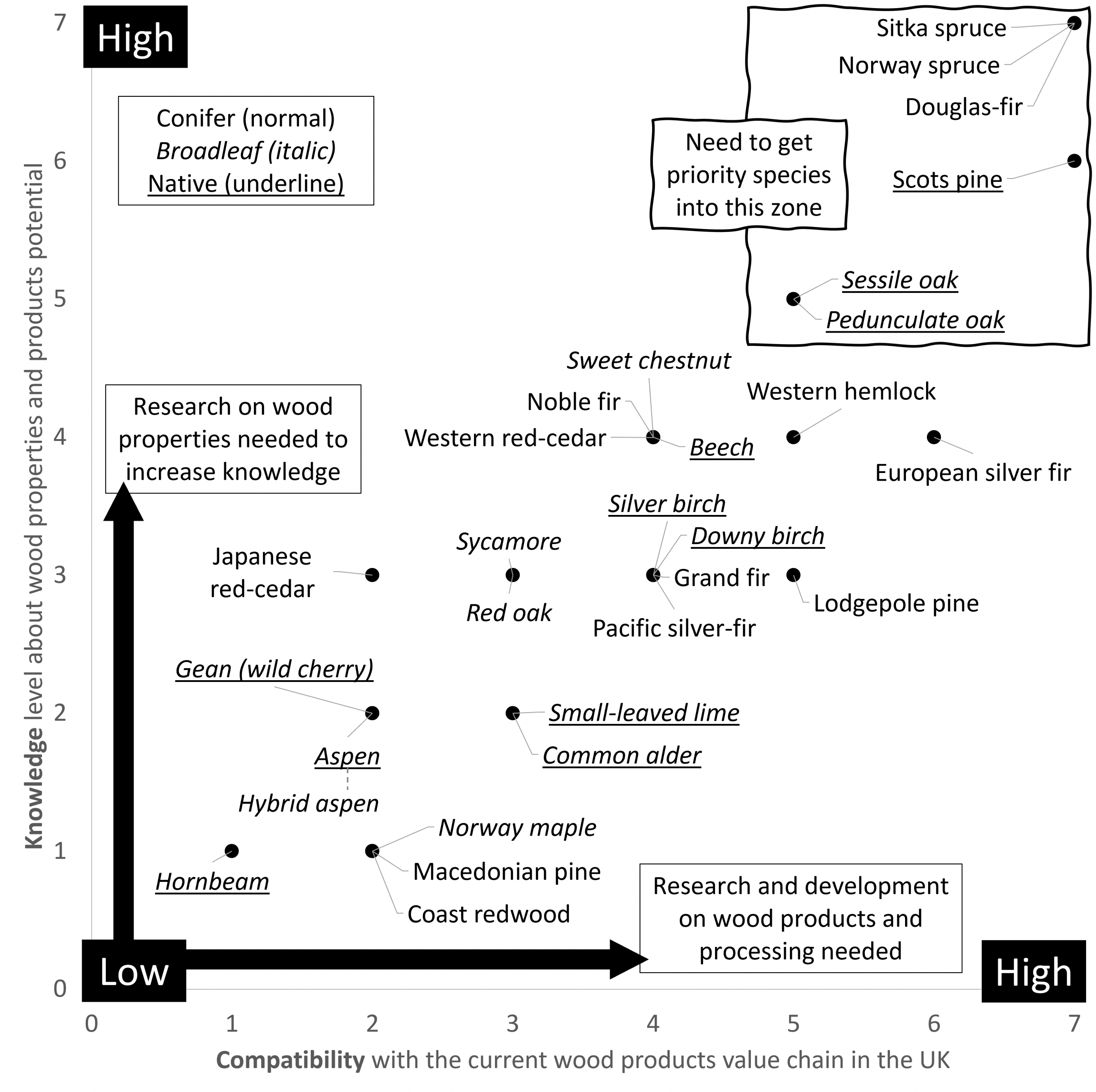
For some of these species we have very little information about the wood properties when grown in the UK. Some of the species would also need significant research and development work to develop new processing chains, new products and new markets (in the UK) as they are very different from the current mainstream commercial species. Since trees take quite a long time to grow, the industry has time to adapt – but this work needs to start soon to be well prepared – and also perhaps to decide on some priority within this priority list. With that said, the reason why we have species on this list that do not (currently) seem all that promising for the wood processing industry is that there were those other seven important criteria.
The figure below shows where the shortlisted species sit on the map of knowledge level and compatibility with the current UK wood value chain. By prioritising what we focus on for research we can aim to make it so that the way we use wood products supports the creation of the kinds of forests we want to have.
The UK’s commercial timber production is based predominantly on a small number of conifers with a single species (Sitka spruce, Picea sitchensis) making up about half of this. It is becoming increasingly appreciated that overreliance on a small range of species presents serious risks related to climate change, pests and pathogens. There are also important motivations to consider diversity of species and forest management for the benefit of nature, and the other non-timber functions that forests provide. An unlucky coincidence of threats impacting more than one of our current main commercial species could even lead to catastrophic forest ecosystem collapse (Tew et al. 2023). Countries from which the UK imports timber are also needing to change their species mix, for similar reasons.
There is no absolute measure of timber quality – it depends on intended use. Wood properties affect both performance in use and suitability for processing and manufacturing and both aspects are of importance here. These properties are influenced by species choice and growth conditions. The influence of forest management that is quite similar to the current practices (e.g. rotation length, spacing) on wood properties is well known for Sitka spruce. But we do not know well the effects of big changes in forest management (such as continuous cover forestry) on Sitka or any of the other main commercial conifers (not just the effect on properties, but importantly also the effect on correlations we rely on for strength grading of construction timber). Climate change will also change growth conditions (temperature, rain, wind). That means that even if we did stick with just using the same commercial conifers there would be some changes that need research. The wood changes over time (and so does what we use wood for).
Here is a quick outline of the situation for each of these shortlisted species in the UK (as of October 2025)
Sycamore: Some specialist markets. Quite high mechanical properties. Strength grading exists in the European system but not for UK grown. Wide range of uses. Drying and seasoning known. Good treatability. The subject of active or recent research in the UK. Low level of knowledge of UK grown wood properties.
Norway maple: Familiar in Europe for limited markets. Quite high mechanical properties. No strength grading in the European system. Potentially a reasonably wide range of uses. Drying and seasoning known. Good treatability. Virtually no knowledge about UK grown wood properties.
Common alder: Familiar in Europe for limited markets. Quite high mechanical properties. No strength grading in the European system. Potentially a reasonably wide range of uses. Drying and seasoning known, similar to spruce. Good treatability. Some current research in the UK. Virtually no knowledge about UK grown wood properties.
Silver birch: Familiar to the UK market as imported plywood. High mechanical properties. Strength grading will soon exist in the European system but not for UK grown. Wide range of uses. Drying and seasoning known. Good treatability. The subject of active research in the UK, Ireland and Sweden. Low level of knowledge about UK grown wood properties.
Downy birch: Familiar to the UK market as imported plywood. High mechanical properties. Strength grading will soon exist in the European system but not for UK grown. Wide range of uses. Drying and seasoning known. The subject of active research in the UK, Ireland and Sweden. Low level of knowledge about UK grown wood properties.
Hornbeam: Some small, very specialist markets. High mechanical properties. No strength grading in the European system. Limited range of uses. Drying and seasoning known. Good treatability. A small amount of old research in UK. A very low level of knowledge of UK grown wood properties.
Sweet chestnut: Some small-scale existing markets for fencing in UK, wider use in Europe and in UK historically. Reasonable mechanical properties. Can be visually strength graded in UK. Some small scale use in construction. Wide range of uses. Drying and seasoning known. Some natural durability. Some current research in the UK. Low level of knowledge of UK grown wood properties.
Beech: Familiar to the UK market, but mostly through imports. High mechanical properties. Strength grading exists in the European system but not for UK grown. Has potential for products like glulam, LVL and furniture, but might struggle to compete commercially with established production in Europe. Wide range of uses. Drying and seasoning well known. Good treatability. Some current research in the UK. Low level of knowledge of UK grown wood properties.
Aspen: Some specialist markets. Mechanical properties potentially similar to Sitka. Blue stain might be an issue. No strength grading in the European system. Potentially a reasonably wide range of uses. Drying and seasoning known. Good treatability. Some current research in the UK. Virtually no knowledge of UK grown wood properties.
Gean (wild cherry): Familiar in Europe for limited markets. Quite high mechanical properties. No strength grading in the European system. Potential for some markets. Drying and seasoning known. Some current research in the UK. Virtually no knowledge of UK grown wood properties.
Sessile oak: Familiar to the UK market; mostly through imports, but some home-grown. High mechanical properties. Can be visually strength graded in UK. Some small scale use in construction. Wide range of uses. Drying and seasoning well known. Some natural durability and good treatability. Some current research in the UK. Low level of knowledge of UK grown wood properties.
Pedunculate oak: Familiar to the UK market; mostly through imports, but some home-grown. High mechanical properties. Can be visually strength graded in UK. Some small scale use in construction. Wide range of uses. Drying and seasoning well known. Some natural durability and good treatability. Some current research in the UK. Low level of knowledge of UK grown wood properties.
Red oak: Familiar as in import. High mechanical properties. Strength grading exists in the European system but not for UK grown. Wide range of uses. Drying and seasoning known. Good treatability. Some current research in the UK. A very low level of knowledge of UK grown wood properties.
Small-leaved lime: Some specialist markets. Quite high mechanical properties. No strength grading in the European system. Potentially a reasonably wide range of uses. Drying and seasoning known, similar to spruce. Good treatability. Some current research in the UK. Virtually no knowledge of UK grown wood properties.
European silver fir: Familiar to the UK market, but mostly through imports. Blue stain might be an issue. Mechanical properties similar to Sitka. Strength grading exists in the European system but not for UK grown. Potential for CLT and glulam production. Wide range of uses. Drying and seasoning known. The subject of active or recent research in the UK. Low level of knowledge of UK grown wood properties.
Pacific silver-fir: Not familiar on the UK market, but mechanical properties likely very similar to Sitka. Strength grading exists in the European system but not for UK grown. Wide range of uses. Drying and seasoning known. The subject of active or recent research in the UK. Low level of knowledge of UK grown wood properties. Not mentioned in EN350 (natural durability and treatability).
Grand fir: Not familiar on the UK market, but mechanical properties likely similar to Sitka, but could be lower. Strength grading exists in the European system but not for UK grown. Potentially wide range of uses. Drying and seasoning known. The subject of active or recent research in the UK and Denmark. Low level of knowledge of UK grown wood properties.
Noble fir: Not familiar on the UK market, but mechanical properties likely very similar to Sitka. Strength grading exists in the European system but not for UK grown but there is a partial dataset. Potentially wide range of uses. Drying and seasoning known. The subject of active or recent research in the UK. Reasonable level of knowledge of UK grown wood properties.
Japanese red-cedar: Not familiar on the UK market. Mechanical properties much lower than Sitka. Strength grading exists in the European system but not for UK grown. Potentially a reasonably wide range of uses. Good treatability. The subject of active or recent research in the UK and Azores. Low level of knowledge of UK grown wood properties.
Norway spruce: Very well established markets in the UK, and processed and sold with Sitka – effectively is the same for the market. Wide strength grading possibility in the UK. Small scale commercial production of glulam and CLT in the UK. Wide range of uses. Drying and seasoning well known. Well researched in the UK. Good level of knowledge of UK grown wood properties.
Sitka spruce: Very well established markets in the UK. Sitka is the species to compare others to. Wide strength grading possibility in the UK. Small scale commercial production of glulam and CLT in the UK. Wide range of uses. Drying and seasoning well known. Well researched in the UK. Very good level of knowledge of UK grown wood properties.
Scots pine: Well established markets in the UK, but somewhat restricted by bluestain. Mechanical properties better than Sitka. Can be strength graded in the UK, but with limited options due to lack of modern data. Potential for glulam and CLT production. Wide range of uses. Drying and seasoning well known, similar to spruce. Some natural durability and good treatability. The subject of active or recent research in the UK. Reasonable level of knowledge of UK grown wood properties.
Lodgepole pine: Low familiarity in Europe. Mechanical properties potentially similar to Sitka. Strength grading exists in the European system but not for UK grown. Wide range of uses. Drying and seasoning known, similar to spruce. Good treatability. Some old research in UK. Low level of knowledge of UK grown wood properties.
Macedonian pine: Low familiarity anywhere. Mechanical properties possible similar to Sitka, but most likely lower. No strength grading in the European system. Potentially a reasonably wide range of uses. A very low level of knowledge of UK grown wood properties. Not mentioned in EN350 (natural durability and treatability).
Douglas-fir: Very well established markets in the UK. Mechanical properties better than Sitka, but very variable strength. Can be strength graded in UK with multiple options, although the dataset would ideally be bigger. Potential for CLT and glulam production. Wide range of uses. Drying and seasoning well known, similar to spruce. The subject of active or recent research in the UK. Good level of knowledge of UK grown wood properties.
Coast redwood: Low familiarity in Europe. Mechanical properties possible similar to Sitka. No strength grading in the European system. Potentially a reasonably wide range of uses. Drying and seasoning known, similar to spruce. Some natural durability. Virtually no knowledge of UK grown wood properties.
Western red-cedar: Familiar to the UK market, but mostly through imports. Mechanical properties lower than Sitka. Cannot yet be strength graded but there is a partial dataset. Used for cladding, but with potential for other uses. Drying and seasoning known. Some natural durability. The subject of active or recent research in the UK. Reasonable level of knowledge of UK grown wood properties.
Western hemlock: Not familiar on the UK market, but mechanical properties likely very similar to Sitka. Strength grading exists in the European system but not for UK grown but there is a partial dataset. Wide range of uses. Drying and seasoning well known, similar to spruce. The subject of active or recent research in the UK. Reasonable level of knowledge of UK grown wood properties.
We will be posting more on this topic as we are now working on a similar species prioritisation project for England.
For more on what we currently know see:
Gil-Moreno D, Ridley-Ellis D and McLean P (2016) Timber properties of noble fir, Norway spruce, western red cedar and western hemlock grown in Great Britain, Forest Research Research Note FCRN026, https://www.forestresearch.gov.uk/publications/timber-properties-of-noble-fir-norway-spruce-western-red-cedar-and-western-hemlock-grown-in-great-britain/
McLean P (2019) Wood properties and uses of Scots pine in Britain, Forestry Commission Research Report http://forestresearch.gov.uk/publications/wood-properties-and-uses-of-scots-pine-in-britain/
McLean P, Ridley-Ellis D, Price A and Macdonald E. (2024) Wood properties and uses of larch in Great Britain. Forest Research Research Report FRRP035. https://www.forestresearch.gov.uk/publications/wood-properties-uses-larch/
Moore J (2011) Wood properties and uses of Sitka spruce in Britain. Forestry Commission Research Report FCRP015. Forestry Commission, Edinburgh. https://www.forestresearch.gov.uk/publications/wood-properties-and-uses-of-sitka-spruce-in-britain/
Peters TD, Hardaker AR, Dauksta D, Newman G, Lellig C and Healey, JR (2021) Top five alternative conifer tree species in Great Britain. Cardiff: Welsh Government, GSR report number C160/2020/2021 https://woodknowledge.wales/wp-content/uploads/5-Alternative-conifer-species-final-corrected-EN.pdf
Price A, Ridley-Ellis D, Adams S, Lehneke S, Adams A and Macdonald E (2024). Timber properties of species with potential for wider planting in Great Britain. Forest Research Research Note FRRN045; https://www.forestresearch.gov.uk/publications/timber-properties-species-wider-planting/
Ridley-Ellis D and Cramer M (2024) Hardwoods in the United Kingdom – Considerations when looking to future planting and future value chains. Presented at International Scientific Conference on Hardwood Processing, Coimbra, Portugal. https://napier-repository.worktribe.com/output/3889494/hardwoods-in-the-united-kingdom-considerations-when-looking-to-future-planting-and-future-value-chains
Ridley-Ellis D, Gil-Moreno D and Harte AM (2022) Strength grading of timber in the UK and Ireland in 2021. International Wood Products Journal, 13(2), 127–136. https://doi.org/10.1080/20426445.2022.2050549