
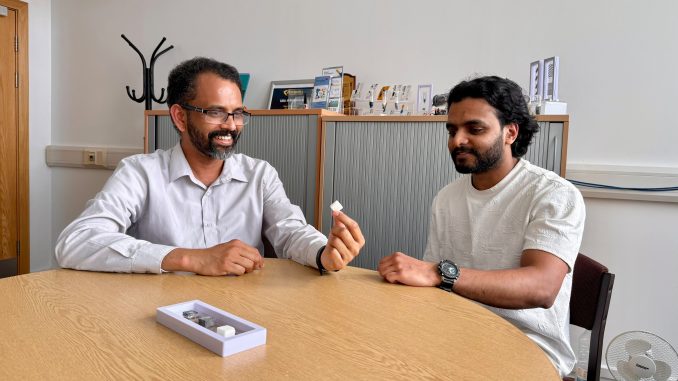
The researchers led by Associate Professor Libu Manjakkal showcase the university’s commitment to advanced electronics components device development for wearable health monitoring systems.
The study focusses on a multifunctional soft 3D electrode platform by growing ZnO nanoflowers on the surface and pore walls of a PDMS/MWCNT foam scaffold. Dr. Manjakkal said ‘starting from a simple sugar-cube template, we engineered a highly porous architecture that integrates energy storage, energy conversion, and bioinspired sensing functionalities within a single device’.
Mr. Jithin the lead PhD student of this work prepared ZnO nanoflowers on the surface and internal walls of the PDMS/MWCNT 3D structure. Based on these new electrochemical capacitors were developed and which exhibit multifunctional properties.
Prof. Luis Pereira and team from NOVA School of Science and Technology, NOVA University Lisbon, Portugal made significant contribution on materials characterisation of these multifunctional electrodes through excellent collaboration in this work.
Dr. Manjakkal said this research opens a new opportunity of bioinspired integrated sensing system with simultaneously sensing mechanical stimuli, generating electrical signals, and storing energy for next generation of wearable electronics and human-machine interaction.
Napier researchers Mr. febin Paul, Dr. Mustehsan Beg, Associate Professor Nazmi Sellami and Associate Professor Firdaus Muhammad Sukki also made significant contributions in this work.
Their investigation could be found in recently published Journal of Materials Chemistry A with titled ‘In situ growth of ZnO nanostructures on the pores and surface of soft 3D structures for energy storing, conversion and bioinspired sensing’ (https://doi.org/10.1039/d5ta08996d).
Leave a Reply