
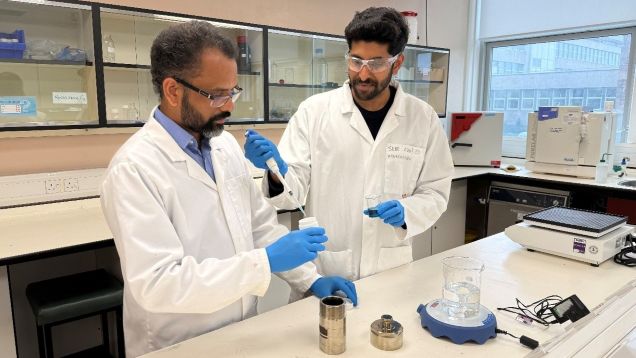
Researchers at Edinburgh Napier University have developed a new approach to energy storage that could power the next generation of wearable technology
Edinburgh Napier University (ENU) researchers have made a significant breakthrough in Zn-HHTP-based metal–organic framework (MOF) structures and compatible electrolytes for high-performance flexible and wearable energy storage devices.
Led by Associate Professor Libu Manjakkal, this research showcases Edinburgh Napier’s commitment to advancing sustainable technologies and highlights the innovative contributions of its researchers in the field of electrochemical energy storage.
Designed for wearable and flexible devices
Flexible energy storage devices are essential for emerging technologies such as wearable electronics, smart textiles, portable sensors, and self-powered systems. These applications require energy storage materials that are not only efficient but also mechanically adaptable.
Tackling key challenges in energy storage
To address the long-standing challenges of low active surface area and the limited operating potential window of aqueous energy storage systems for wearable applications, PhD researcher Febin Paul investigated a novel material design.
The study focuses on the preparation of a Zn-HHTP nanoflower-structured metal–organic framework (MOF) through controlled deprotonation during a solvothermal reaction.
Dr. Manjakkal explained:
“This synthesis approach enables the formation of a flower-like nanoscale architecture designed to improve electrochemical performance in flexible capacitor devices.”
Mr Febin added:
“The nanoflower morphology reported in this work offers a promising route to increase active surface area and enhance charge-storage behaviour while maintaining suitability for flexible device platforms.”
Looking ahead to real-world applications
The research team is now focusing on commercial opportunities for wearable, energy-autonomous sensing devices. This latest work further strengthens ongoing research efforts aimed at developing lightweight, flexible, and high-performance energy storage components for future electronics.
Dr Manjakkal, principal investigator on the project and an expert in electrochemical devices, said:
“This research opens a new direction for 2D material-based electrochemical devices that can be integrated into bendable, wearable, and compact electronic systems.”
Their investigation could be found in recently published Nano Energy Journal: ‘Zn-HHTP metal organic framework nanoflowers for high-performance flexible electrochemical capacitors’
This work reflects Edinburgh Napier University’s commitment to research excellence and real-world impact, driving innovation in sustainable technologies for future applications.