

Edinburgh Napier University (ENU) has recently welcomed 13 early-career researchers from Malaysia, Thailand, Viet Nam and Indonesia as part of two UK Government–funded International Science Partnership Fund (ISPF) British Council programmes. The fellows began their placements in April 2026, following a year of coordinated work across multiple Schools and Professional Services teams to secure and deliver the initiative.
Cross-university collaboration enabling international research
Successfully delivering a programme of this scale relied on coordinated collaboration across the University’s academic teams, research support, international operations, as well as ENU’s People Team (Recruitment), School Support Services and the Finance department. This joint effort ensured the fellows’ arrival, onboarding and research integration were delivered on schedule. The programme highlights ENU’s growing capability in managing complex international partnerships and supporting early‑career researchers from across the world.
Commenting on this, External Projects Manager Wendy Steven, from ENU’s Research, Innovation and Enterprise department, said:
“Delivering a programme of this size relies on many different teams working in step with one another. The way colleagues across Schools and Professional Services came together to support the fellows shows what Edinburgh Napier can achieve when we collaborate with a shared purpose. It’s a strong example of how we are building the infrastructure and expertise needed to manage complex international partnerships.”
The 2 projects funded were:
- ASCEND, Accelerating Transformative Technology for Sustainable Clean Energy Development
- Transformative Technologies for Healthcare and Environmental Resilience (TTHER)
Edinburgh Napier secured £900,000, in total for the 2 projects from the British Council, who manage the fund on behalf of the UK Government, Department of Science, Innovation and Technology (DSIT) through the ISPF Early Career Fellowships scheme. This was to fund 15 fellows, to date we have 13 onboard.
You can read further about these two projects below:
Transformative healthcare and environmental technologies
Led by Professor Hongnian Yu, with co-investigators, Professor Chan Hwang See and Associate Professor Dr Libu Manjakkal.

The Transformative Technologies for Healthcare and Environmental Resilience (TTHER) project is hosted by AI and Robotics for Healthcare (AIR4Health) team at Edinburgh Napier University. The project brings together nine early‑career researchers from Malaysia, Thailand and Viet Nam to work with ENU academics on next‑generation digital health and environmental monitoring solutions.
The AIR4Health team combines expertise in artificial intelligence, robotics, wearable sensing, digital health, rehabilitation and cyber-physical systems environmental monitoring. Through TTHER, researchers are developing applied technologies including AI‑enabled diagnostic tools, wearable and sensor‑based healthcare systems, remote monitoring platforms, and low‑cost environmental sensing devices.
Research themes include:
- Elderly fall detection
- AI-enabled fall-risk prediction using wearable inertial sensors
- Fall-prevention interaction design for people living with dementia and fall-prone older adults,
- Pre-impact fall prediction using multimodal sensing
- AI-enabled age-friendly tourism.
Together, these activities aim to strengthen health resilience, support independent living and advance digital health innovation in rapidly developing regions. The project also seeks to accelerate innovation in areas such as fall‑prevention technologies, personalised rehabilitation and data‑driven healthcare, while building long‑term research capacity across Southeast Asia.
 Commenting on this project, Professor Hongnian Yu said:
“Our vision is to position Edinburgh Napier University as a leading hub for AI and robotics in healthcare, advancing intelligent, human-centred, resilient, sustainable and trustworthy technologies for diagnosis, rehabilitation, remote monitoring, assisted living and healthy ageing. By integrating AI, robotics, wearable sensors, digital health and cyber-physical systems, we aim to support the development of Healthcare 5.0 — a future healthcare model that is personalised, inclusive, resilient and centred on human wellbeing.
“Welcoming our early-career fellows to Edinburgh Napier is an important step in strengthening digital health innovation across the UK and Southeast Asia. Through TTHER, we are developing technologies that can make healthcare more accessible, resilient and responsive to real-world needs, while also learning from the diverse expertise and perspectives our Fellows bring.
“The TTHER fellows will also have opportunities to explore wider collaboration with international research networks and partners, including the UK-ASEAN network on AI-enabled healthcare research and innovation using wearable technologies, the EU Intelligent Multi-Agent Robotic Systems project, and the EU project on Fostering Trust in AI-driven Healthcare: Secure and Unbiased Knowledge-Guided Generative AI.
“By working together, we can create solutions that genuinely improve people’s quality of life and build partnerships that last well beyond this programme.”
Fellows’ perspectives

Dr Arunee Promsri, Thai Research Fellow, said:
“Being selected for the TTHER Fellowship at Edinburgh Napier University is a valuable milestone in my academic journey. This opportunity enables me to advance my research in wearable sensor technologies, biomechanics and AI-driven approaches for fall-risk prediction — an area that is both scientifically challenging and highly relevant to ageing societies worldwide.
“Working within an interdisciplinary research environment has broadened my perspective on how engineering, data science and rehabilitation can be integrated to develop practical, real-world healthcare solutions. It has also strengthened my ability to translate complex biomechanical data into meaningful clinical insights, particularly for the early identification and prevention of falls.
“This work has strong potential for implementation in both clinical and community settings, including low-resource environments in Thailand, where accessible and preventive healthcare technologies can make a significant difference to older people’s quality of life.”
Dr Nhut Thanh Tran, Vietnamese Research Fellow, said:
“Participating in the TTHER project has been a significant milestone in my academic and professional journey. It has given me the opportunity to collaborate with international colleagues and leading academics in related fields, while broadening my perspective on new ideas, methods and approaches, particularly in healthcare-related research.
“My research motivation is closely connected to the Mekong Delta in southern Viet Nam, where many communities still have limited access to quality healthcare. Through the TTHER project, I hope to strengthen my research skills, build lasting international collaborations, and contribute to sustainable development in Viet Nam and beyond.”
Dr Ahsiah Binti Ismail, Malaysian Research Fellow, said:
“Being selected as a Research Fellow under the TTHER project at Edinburgh Napier University is a meaningful milestone in my academic and professional journey. It offers valuable opportunities for international collaboration, continuous knowledge exchange and interdisciplinary learning.
“I am excited to contribute to the project while expanding my expertise in applying artificial intelligence to real-world healthcare challenges within digital health. This experience enables me to learn from different disciplinary perspectives and deepen my understanding of how to design AI solutions that are practical, impactful and responsive to real-world needs.
“Working with international partners also helps ensure that the solutions we develop are technically robust, culturally responsive and adaptable across diverse healthcare systems.
“Through this fellowship, I hope to strengthen my contribution to my home country and support the advancement of more equitable healthcare outcomes across the region.”
Global clean energy research with regional impact
Led by Associate Professor Dr Firdaus Muhammad Sukki with co-investigators Associate Professor Dr Nazmi Sellami and Associate Professor Dr Stathis Tingas.

The ASCEND project brings together six researchers, three from Malaysia and three from Indonesia, to work with ENU academics on clean energy challenges affecting rapidly developing economies. Their work focuses on:
- Next generation solar photovoltaic (PV) technologies
- Hydrogen and ammonia as clean fuels for industrial decarbonisation
- AI enabled optimisation of energy systems
- Scalable, low carbon solutions for ASEAN countries
The project runs for one year, with outcomes expected to contribute to long-term research links and knowledge exchange through to April 2027.
Dr Firdaus Muhammad Sukki said:
 “I am truly excited to begin this new chapter with our early-career fellows as we embark on the ASCEND project together. This fellowship is not just about research, it is a remarkable opportunity for meaningful technology transfer, where cutting-edge innovations in solar energy, clean fuels, and AI-driven systems can be translated into real-world solutions for Malaysia, Indonesia, and beyond.
“What makes this journey even more enriching is the chance to learn from one another’s cultures. Understanding the values, perspectives, and ways of working of our south-east Asian partners will only strengthen our collaboration and ensure that the solutions we develop are truly relevant and impactful for the communities they are designed to serve. I look forward to every step of this adventure.”
Fellows’ perspectives
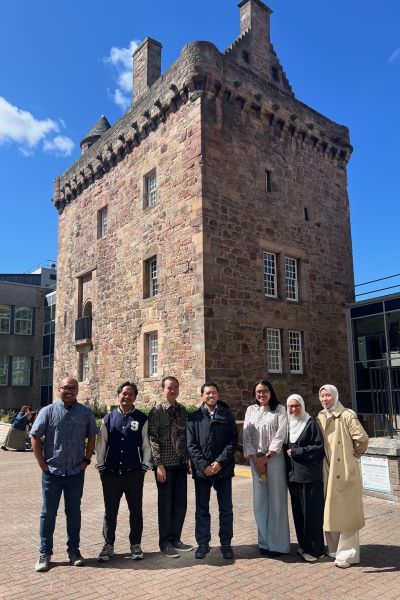 Dr Siti Hawa Abu Bakar, Malaysian Research Fellow, said:
“Being selected as part of the ASCEND fellowship is a dream realised. I am so excited to be here at Edinburgh Napier University, working alongside some of the brightest minds in the field on a project that genuinely matters. Exploring next-generation solar technologies and AI-driven energy solutions is not just academically thrilling, it is deeply personal. Malaysia has so much potential to lead the clean energy transition in south-east Asia, and I feel a great sense of responsibility to bring these innovations back home.
“This experience is already shaping the way I think about research, impact, and what is possible when nations work together. I am here not just to learn, but to contribute, to grow, and to help build a cleaner, more equitable energy future for my country.”
Dr Linda Hijriyah, Indonesian Research Fellow, added:
“My academic interests in research and education, particularly in sustainability, led me to join the ASCEND project, where interdisciplinary collaboration has broadened my knowledge.
“This experience has expanded my academic network across disciplines, creating opportunities for future collaboration and continued scholarly development within the global academic community. It marks a significant step toward undertaking more impactful work and contributing to sustainability in my home country, Indonesia and the wider region.”
Strengthening ENU’s international research profile
The arrival of the 13 ISPF fellows reflects Edinburgh Napier’s commitment to global collaboration and its growing role in supporting research talent from across the world.
It also demonstrates the impact of coordinated, cross departmental working, a key factor in securing and delivering programmes of this scale.
You can out more about British Council’s International Science Partnership Fund (ISPF) by visiting britishcouncil.org
Learn more about Edinburgh Napier University’s international research opportunities by visiting napier.ac.uk