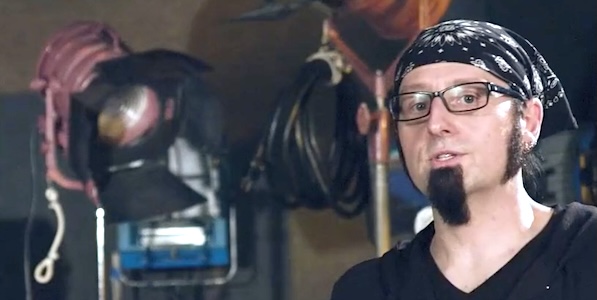
Why record everything?
Many sound designers spend years learning how to remove unwanted sounds from recordings. They search for quieter locations, better microphones, cleaner signal paths, and more controlled recording environments. During his online guest lecture for Edinburgh Napier University, sound designer, recordist, publisher, and author Ric Viers approached the problem from a rather different direction. Again and again, he encouraged students to record more, not less. More locations. More variations. More experiments. More sounds that might initially appear useless.
The advice runs against much conventional recording practice. Storage fills quickly. Editing becomes more demanding. Organisation becomes more complicated. Yet Viers argued that one of the greatest mistakes a sound designer can make is deciding too early what will or will not be useful. Throughout the lecture, he repeatedly returned to a simple idea: many of the most valuable sounds reveal their potential only later.
The immediate context for the discussion was the creation of commercial sound effects libraries. Viers guided students through the process he uses when developing libraries for Blastwave FX, beginning with the choice of a topic, category, or theme. Some libraries focus on a specific class of sounds, such as footsteps. Others are organised around broader concepts, such as a zombie apocalypse, requiring everything from impacts and gunfire to environmental ambiences, destruction effects, creatures, weather, machinery, and countless other elements. Yet selecting a theme was only the beginning.
Considerably more time, he suggested, is often spent researching than recording. Before microphones are unpacked, he studies films, television programmes, games, applications, and existing libraries to understand what has already been recorded, what is missing, and where opportunities may exist. Commercial sound libraries do not emerge from recording sessions alone. They emerge from identifying gaps. A successful library must offer something that people cannot already obtain elsewhere. Recording therefore begins with investigation. What sounds are difficult to find? Which sounds have become overused? Which categories remain poorly represented? Questions such as these help determine where effort should be directed.
Planning extends far beyond selecting a subject. Viers described the creation of extensive scavenger lists containing every conceivable sound that might belong in a library. The exercise draws heavily upon what he called blue-sky thinking, an approach in which ideas are generated before they are evaluated. Impractical suggestions are welcomed. Expensive suggestions are welcomed. Unlikely suggestions are welcomed. The purpose is not to determine whether an idea is immediately achievable. The purpose is to widen the range of possibilities. Viers argued that ideas often develop through association. A suggestion that cannot be pursued directly may still help identify a different route towards the same goal.
A recurring theme in the lecture was the cultivation of listening as a habit. Ideas for sounds are often collected long before any recording session begins. A strange resonance in a pipe. The texture of metal scraping against metal. An unusual mechanical vibration. A sound designer’s work, in his view, begins long before the recorder is switched on. Listening becomes a form of continuous observation. Ideas are captured in notebooks, mobile apps, or voice memos. Some notes describe specific sounds. Others record textures, qualities, or possibilities.
One example illustrated this way of thinking particularly clearly. While dealing with a blocked drain, Viers became fascinated by the sound produced as liquid moved through the pipework. Most people would simply hear a drain. Viers heard something else. The sound possessed qualities that might later become useful in an entirely different context. He immediately made a note to revisit the sound in the future. What interested him was not the object itself. It was the texture. The eventual application remained unknown. The possibility was enough.
This distinction between objects and textures appeared repeatedly throughout the lecture. Sound designers are often asked where particular sounds come from. Audiences frequently imagine a straightforward relationship between source and result. A door sound comes from a door. An engine sound comes from an engine. Viers described a different way of thinking. A useful recording is not necessarily valuable for what it is. It may be valuable for characteristics that become apparent only after editing, processing, layering, or transformation. Recording therefore involves collecting materials whose eventual use remains unknown rather than merely documenting objects.
Many lectures on sound design focus heavily on equipment. Microphones, recorders, plug-ins, and software frequently dominate discussions. Viers spent surprisingly little time discussing technology in isolation. When he addressed recording practice, attention remained focused on listening. Before recording in any location, he advocated standing still and listening carefully to the environment. Air conditioning systems, insect activity, traffic patterns, aircraft, electrical noise, and countless other factors become relevant once attention shifts from simply hearing a location to actively analysing it.
This process of scouting locations received considerable attention. Viers argued that many people move through environments without noticing their acoustic details. Recording requires a different form of awareness. Insects become important. Distant roads become important. Wind direction becomes important. Time of day becomes important. A location that appears perfect at one moment may become unusable an hour later. Successful field recording often depends less upon equipment than upon patience, observation, and preparation.
This concern with awareness also explains his insistence on monitoring continuously through headphones. Microphones do not hear the world in quite the same way people do. Wearing headphones while moving through an environment reveals details that might otherwise remain unnoticed. Interesting sounds are often discovered rather than sought. What appears unremarkable at first may become compelling when heard through a microphone. Recording therefore becomes an ongoing process of discovery rather than simply the execution of a predetermined plan.
A similar principle shaped his approach to recording itself. Whenever possible, he records multiple takes. Fast versions. Slow versions. Loud versions. Quiet versions. Different perspectives. Different performances. On one level, this provides insurance against technical problems. On another, it reflects a deeper belief about sound design. Sounds rarely remain confined to their original purpose. A recording made for one project may later become useful in another. A variation that seems unnecessary today may become exactly what a future project requires.
Experience had also taught him how easily apparently successful recording sessions can fail. During one project involving emergency vehicles, extensive access was arranged at a fire station. Recordings were captured, equipment functioned correctly, and everything appeared successful. Only later did the team discover that powerful sirens had physically affected the recording medium itself. Material that seemed secure had effectively been lost. The story was not presented as a technological curiosity. It explained why professional recordists often develop habits that appear excessive to newcomers. Additional takes, backups, and redundancy emerge from experience rather than paranoia.
A bee entered the Foley studio while Viers was working on an unrelated project. The original plan was simply to remove it and continue working. An intern suggested recording it instead. That decision eventually led to an entire library of insect sounds, combining recordings of flies, bees, crickets, and other insects with carefully performed Foley designed to represent insect movement. The significance of the story lies less in the insect itself than in the response. The opportunity was not planned. It appeared unexpectedly. Remaining open to such moments allowed a chance event to become the basis of a completely new collection.
Questions of organisation formed another important part of the lecture. Recording more sounds creates a practical problem. How can those sounds be found again months or years later? Viers discussed the importance of cataloguing, naming conventions, metadata, and library management. Collecting large quantities of material is only useful if that material remains accessible. A sound hidden inside thousands of poorly organised files may effectively disappear. The ability to locate recordings quickly becomes part of the creative process itself.
The same concern with organisation appeared in his discussion of large-scale sound design projects. One example involved the construction of a tornado sequence containing roughly 180 individual tracks. Projects of this scale quickly expose weaknesses in workflow. Tiny editing errors become difficult to locate. Artefacts become buried within hundreds of layers. Seemingly minor organisational decisions accumulate into major practical consequences. Preparation therefore serves creative goals. Time spent organising material makes experimentation easier later.
Recording occupied only part of the process. Viers repeatedly returned to what happens afterwards. Sounds are collected, edited, organised, and transformed. Recordings function as materials that can be combined, layered, stretched, pitched, and manipulated into entirely new forms.
One example involved the creation of a failing fluorescent light. Unable to find exactly the sound he wanted, Viers began experimenting with alternative sources. The eventual solution came from an unexpectedly small fragment of fruit being crushed. Through editing and transformation, the recording acquired the qualities required for the scene. The finished sound bore little resemblance to its source. Yet this was precisely the point. The identity of the source mattered less than the acoustic properties it contained.
The same logic appeared in Viers’ discussion of so-called bad recordings. Students often expect professional sound design to involve strict distinctions between useful and useless material. Viers challenged that assumption directly. During the discussion, he argued that there is rarely such a thing as a completely bad sound. Recordings that fail in one context may become valuable in another. Noise, distortion, clipping, and other imperfections can sometimes serve as raw material for later experimentation.
One example involved a recording that initially appeared unusable. Hidden within the material was the sound of a cat. Rather than discarding the recording, Viers began manipulating fragments of it through processing, layering, and transformation. Elements that seemed worthless in their original form became the basis of drones, textures, and entirely different production sounds. The value of the recording emerged through later use rather than immediate judgement.
Discussion of careers and commercial practice returned to the same issue. Students often assume that success depends upon following established models. Viers argued almost the opposite. He encouraged students to develop their own interests, methods, and creative identities. Distinctive approaches create opportunities. If everyone records the same sounds in the same way, there is little reason for anyone to choose one library over another.
Recording, editing, organisation, publishing, and marketing occupied much of the lecture.
Running through all of them was the same underlying concern: how to recognise useful material before its eventual value becomes obvious. Throughout the discussion, Viers repeatedly challenged the assumption that the usefulness of a sound can be determined immediately. A recording that appears unremarkable today may become the foundation of a future project. A failed recording may later prove valuable once new tools become available. A sound collected for one purpose may eventually find a completely different use.
Many people encounter the world as a collection of familiar objects and events. Viers encouraged students to listen differently. A drain becomes a source of textures. A mechanical vibration becomes source material for a creature or machine. A crushed piece of fruit becomes a fluorescent light. An unexpected insect in a Foley studio becomes the starting point for an entirely new library. A sound’s future use is often difficult to predict when it is first recorded.
Sound effects libraries occupy an unusual position within creative practice. They are archives of past recordings, though they are also collections of future possibilities. Every recording preserves an opportunity whose eventual use remains unknown. Viers’ argument was not simply that sound designers should record more sounds. It was that they should remain open to possibilities that have not yet revealed themselves. A recorder captures a sound at a particular moment. What that sound eventually becomes often remains an open question.