How do mobile games sound bigger than they are?
Many people associate game audio with large development studios, lengthy production schedules, and vast teams of specialists. The image is often one of blockbuster productions involving hundreds of developers working over several years. During his online guest lecture for Edinburgh Napier University, sound designer, field recordist, and Edinburgh Napier alumnus George Vlad offered a rather different perspective. Drawing on a career that has included audio for hundreds of mobile games, Vlad described a world in which sound designers are frequently asked to achieve ambitious creative goals under severe practical constraints. Development schedules may last only weeks. Budgets are often limited. Storage space can be measured in megabytes rather than gigabytes. Yet players still expect games to feel rich, engaging, and alive.
Across the lecture, Vlad repeatedly demonstrated that successful audio design is rarely about having unlimited resources. More often, it is about learning how to achieve more with less.
Vlad’s own route into the industry reflects this philosophy. Long before he entered formal education, he was fascinated by sound itself. Childhood memories centred on listening to objects resonate, experimenting with makeshift instruments, and becoming absorbed by the sonic characteristics of everyday materials. At the same time, video games became an equally important influence. These parallel interests eventually converged after several years spent working across Europe, saving money to build a small studio and gradually developing the skills needed to pursue audio professionally.
The path was far from conventional. Without immediate access to formal training, Vlad relied heavily upon experimentation, books, online communities, and practical experience. Early work editing podcasts and audiobooks gradually led to opportunities in games, particularly during the rapid growth of smartphone applications in the early 2010s. Later, after moving to Edinburgh in 2013, he enrolled on Edinburgh Napier University’s Sound Design programme, where formal study helped fill many of the gaps he had identified in his own knowledge. Rather than describing graduation as the end of a learning process, however, Vlad suggested that education had mainly revealed how much more there remained to learn.
Looking back, many of these experiences involved similar challenges. Whether teaching himself new skills, building a freelance business, or learning how to work within the realities of mobile development, progress depended less upon ideal circumstances than upon adaptability. This theme would recur throughout the lecture.
The realities of mobile game development provide a particularly clear illustration of this challenge. Unlike major console or PC titles that may take years to complete, many mobile games operate on remarkably compressed schedules. A developer might contact a sound designer only days before release, requiring dozens of sound effects and music assets within a very short period. Under these circumstances, efficiency becomes essential.
What emerged from Vlad’s description was a picture of sound design that differs considerably from popular perceptions of creative work. Inspiration certainly plays a role, though much of the process involves practical decision-making. Developers provide lists of required sounds, visual references, gameplay footage, or playable builds. From these materials, the sound designer develops an understanding of how the game should feel. This emphasis on feeling proved particularly important. Before focusing on individual sounds, Vlad explained that he first tries to understand the intended player experience. Should the game feel exciting, relaxing, humorous, energetic, or mysterious? These broader emotional goals help shape countless later decisions.
This approach reflects an important aspect of game audio more generally. Sounds do not exist independently. Their purpose is to support gameplay, reinforce feedback, communicate information, and contribute to the overall experience. A technically impressive sound that conflicts with the desired mood may ultimately be less effective than a simpler alternative.
Over the course of his career, Vlad has contributed audio to hundreds of games. Working at this scale demands a different way of thinking about sound design. Rather than approaching every project as a completely unique undertaking, practitioners develop workflows, libraries, recording practices, and decision-making strategies that allow them to work efficiently without sacrificing quality. Consistency, organisation, and adaptability become just as important as creativity.
The lecture provided numerous examples of how these principles operate in practice. Casual mobile games aimed at younger audiences often require sounds that are immediately understandable and emotionally positive. Designers frequently request what they describe as “cartoony” sounds, a term that may initially appear vague but which often carries fairly specific expectations. Sounds should be simple, clear, playful, and easily interpreted. Complex or highly realistic effects may actually prove less effective if they distract from the intended experience.
Such decisions become particularly important when working on long-term projects. Vlad described his involvement with Adventure Smash, a mobile title developed by PeopleFun, the studio founded by several of the developers behind Age of Empires. What began as a relatively modest project gradually expanded into a much larger undertaking involving thousands of individual sound assets.
One of the most interesting aspects of this discussion concerned iteration. Many sounds were revised repeatedly as the game evolved. New characters appeared. Design priorities changed. Playtesting revealed unexpected problems. Audio that seemed appropriate at one stage later required substantial modification. Rather than treating this as a failure, Vlad presented iteration as a normal and essential part of development.
Playtesting proved especially valuable. Watching players encounter a game for the first time often revealed issues that were invisible to the development team. After listening to the same sounds hundreds or even thousands of times, designers naturally become accustomed to them. New players bring fresh perspectives. Their reactions can highlight confusing feedback, excessive repetition, or sounds that no longer fit the overall direction of the game.
Listening to these examples, it became clear that game audio involves much more than creating sounds. It requires understanding how those sounds function within a larger interactive system. The effectiveness of an audio asset depends not only upon its quality but also upon when it appears, how frequently it occurs, and how players interpret it.
Technical constraints provide one of the clearest examples of this mindset. Mobile games often operate within strict memory limitations. Vlad described projects containing thousands of audio assets while occupying only a few dozen megabytes of storage. Achieving this requires more than compression. Designers must think carefully about how sounds are structured, reused, combined, and implemented. Rather than viewing constraints as obstacles, the lecture suggested that they often become catalysts for creativity. Limited resources encourage solutions that are more elegant, efficient, and flexible than those developed under less restrictive conditions.
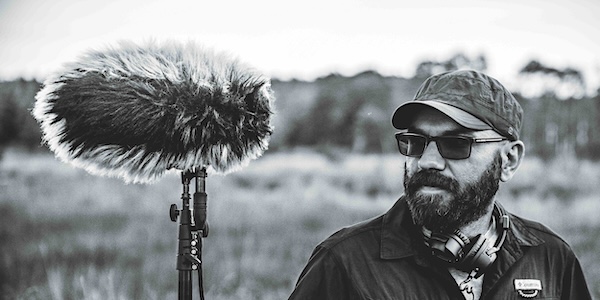
Alongside game audio, Vlad discussed another major aspect of his professional practice: field recording. Over the years he has become increasingly involved in recording natural environments, wildlife, ambiences, and unusual sound sources. Although these activities initially developed alongside his game work, they have gradually become an important creative outlet in their own right.
Field recording might appear separate from game development, though the lecture revealed numerous connections between the two. Recording environments, wildlife, machinery, weather, and unusual sound sources continually expands the palette available for future projects. A recording captured for no particular purpose may later become the foundation of a game sound effect, a commercial sound library, or an entirely different creative project. Field recording therefore functions not only as a creative activity in its own right but also as a long-term investment in future possibilities. This relationship between recording and design reflects the broader philosophy running throughout Vlad’s work. Resources are rarely available precisely when they are needed. Building libraries, developing skills, and collecting recordings creates opportunities that may not become useful until years later. Much of professional audio involves preparing for problems that have not yet appeared.
What was particularly striking was the way field recording complements game audio. Time spent outdoors often provides opportunities for reflection that are difficult to find within a studio environment. Vlad described discovering solutions to creative problems while sitting quietly in a car monitoring microphones placed hundreds of metres away. Distance from the immediate pressures of production sometimes creates the mental space necessary for new ideas to emerge. The discussion of recording techniques revealed another dimension of creativity. Recording is often presented as a technical process involving microphones, recorders, and acoustic environments. Vlad acknowledged the importance of these factors while emphasising that microphone placement, recording strategies, and listening perspectives can fundamentally alter the resulting material. Small changes in approach frequently produce dramatically different outcomes.
Perhaps the most interesting aspect of the lecture was the way it challenged simplistic distinctions between technical and creative work. Audio professionals are sometimes portrayed as belonging to one category or the other. Vlad’s experiences suggest that the reality is considerably more complicated. Technical decisions influence creative outcomes. Creative ambitions depend upon technical understanding. Success often emerges through the interaction between both.
Questions about freelancing reinforced this point. Building a sustainable career requires skills extending far beyond audio production. Client communication, project management, marketing, financial planning, networking, and professional development all become part of daily practice. Creative expertise alone is rarely sufficient.
Freelancing introduced another form of constraint. Unlike permanent employment, freelance work rarely provides complete stability or predictability. Projects arrive unexpectedly. Workloads fluctuate. Technologies change. Client requirements evolve. Vlad spoke candidly about periods of uncertainty throughout his career, though these experiences reinforced the same lesson visible elsewhere in the lecture. Long-term success depends less upon avoiding change than upon learning how to respond to it effectively.
Looking back across the lecture, what emerges most clearly is a picture of audio work defined by adaptability. Technologies change. Projects evolve. Clients revise their requirements. Storage limits impose restrictions. Budgets create compromises. Development schedules compress. Yet creative ambitions remain.
Throughout his career, George Vlad has repeatedly encountered situations in which the available resources were smaller than the desired outcome. Mobile games needed to feel larger than their budgets suggested. Limited memory had to support rich sonic worlds. Tight schedules still demanded professional results. Field recordings gathered in remote locations eventually found new purposes years later. Again and again, progress emerged through resourcefulness rather than abundance.
For students considering careers in game audio, this may be the lecture’s most valuable lesson. Technical knowledge matters. Creative ability matters. Yet neither guarantees success on its own. Professional practice involves solving problems, working within constraints, adapting to change, and finding opportunities where others might see limitations.
George Vlad’s career demonstrates that there is no single route into professional audio. His journey has included self-directed learning, formal education, freelance practice, field recording, game development, experimentation, and continual adaptation. Across all these experiences, one principle remained remarkably consistent. Creative work is rarely about having unlimited resources. More often, it is about recognising possibilities that remain invisible until constraints force new ways of thinking.