Why is data so quiet?
Modern life is shaped by data. Governments collect it. Businesses depend upon it. Scientists analyse it. Social media platforms generate vast quantities of it every second. Increasingly, decisions about healthcare, transportation, education, finance, climate, and public policy are informed by information that exists primarily as data. Yet despite its growing importance, most people encounter data in remarkably similar ways. We see charts, graphs, dashboards, spreadsheets, maps, and visualisations. We are expected to look at information rather than listen to it.
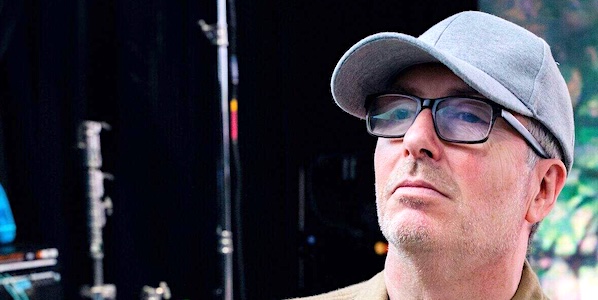
During his online guest lecture for Edinburgh Napier University, Hugh McGrory challenged this assumption. Drawing upon a career that has spanned animation, virtual reality, software development, data storytelling, and sonification, McGrory described a field that sits between sound, design, accessibility, and communication. Across a wide-ranging discussion that moved from GPS navigation to astronomy, podcasting, climate data, artificial intelligence, and urban infrastructure, he repeatedly returned to a deceptively simple question. If data is everywhere, why do we still experience almost all of it through our eyes?
McGrory’s route into sonification was anything but conventional. Beginning in computer animation and experimental digital media, he later worked with medical imaging researchers at Yale University, where he encountered scientific data in a completely new way. Rather than using cameras to create images, researchers were transforming data into visual representations that scientists could study and interpret. Later work in virtual reality continued this fascination with information and how people interact with it. Yet throughout these experiences, one issue kept resurfacing. Data communication was overwhelmingly visual. Even the language reflects this bias. The field is known as data visualisation. Information is generally assumed to become meaningful once it has been converted into something that can be seen.
For McGrory, this raises an obvious question. Why should vision carry so much of the burden? The field of sonification attempts to address this imbalance by exploring how information can be communicated through sound. Yet McGrory encouraged students to think beyond narrow academic definitions. The challenge is not simply turning data into audio. The challenge is deciding when sound might be a more useful way of communicating information. GPS navigation provides a useful example. Rather than forcing drivers to consult maps continuously, navigation systems deliver information precisely when it becomes relevant. A driver does not need every detail about the surrounding road network. They need to know when to turn left. Effective sonification follows the same principle. Its purpose is not to communicate everything. Its purpose is to communicate what matters. Throughout the lecture, McGrory repeatedly argued that the modern problem is rarely a lack of information. More often, it is an excess of information. The real design challenge lies in deciding what should reach people, when it should reach them, and how it can be communicated without demanding unnecessary attention.
This perspective places sonification within a much broader discussion about interface design. Many of the tools through which people still interact with information were developed for a world in which data was far less abundant than it is today. Screens, keyboards, menus, and dashboards remain remarkably successful technologies, though they are not always suited to situations in which people are moving through complex environments while simultaneously performing other tasks. McGrory pointed towards cities as a particularly interesting example. Vast quantities of public information now exist concerning transportation systems, environmental monitoring, infrastructure, weather, traffic, and public services. Much of this information could potentially support everyday decision-making, yet most people never encounter it. One reason is that visual interfaces demand attention. Looking at a screen competes with countless other activities. Sound offers different possibilities. It can accompany movement, coexist with visual tasks, and communicate information without constantly demanding that people stop and look elsewhere.
Questions of accessibility revealed why these issues matter so much. Much of McGrory’s work has involved collaboration with blind and visually impaired communities, experiences that challenged many of his assumptions about information design. Designers often assume that providing access to information is sufficient. The reality is considerably more complicated. Screen readers can successfully read large quantities of information aloud, though understanding the overall structure of that information remains difficult. McGrory compared this experience to attempting to complete a jigsaw puzzle without ever seeing the image on the box. Individual pieces are available, yet the broader picture remains difficult to grasp. A spreadsheet containing thousands of values can be read sequentially, though identifying patterns, relationships, and trends becomes far more challenging. Sonification offers one possible response to this problem. Rather than replacing detailed exploration, it can provide rapid overviews that help listeners understand the shape of information before investigating individual details.
These experiences also led McGrory to question some established assumptions within sonification itself. Many projects focus heavily on transforming data into sound while paying comparatively little attention to context. Listeners are often presented with unfamiliar sounds and expected to interpret them independently. For McGrory, this represents a significant limitation. Communication rarely functions through raw information alone. Context, explanation, and narrative play equally important roles. Podcasting, journalism, and storytelling all demonstrate how audiences use framing to understand unfamiliar material. Projects such as the BBC’s Audiograph series combine sonification with narration, allowing listeners to understand not only what they are hearing but why it matters. This approach shifts attention away from sonification as a technical exercise and towards sonification as communication. Sound becomes one element within a broader process of explanation rather than an isolated solution expected to function independently.
A particularly memorable example involved astronomy. McGrory discussed the work of a blind astronomer who uses sonification to explore stellar data, challenging assumptions about both astronomy and accessibility. At first glance, astronomy appears inseparable from visual observation. Popular images of galaxies, stars, and nebulae reinforce the assumption that astronomical knowledge depends upon sight. Yet the example revealed something much more interesting than accessibility alone. Rather than simply compensating for an inability to see, sonification provided an alternative way of engaging with information.
This distinction became important throughout the lecture. Discussions of accessibility sometimes assume that non-visual approaches exist primarily to reproduce experiences that sighted people already have. McGrory encouraged a different perspective. Listening is not merely a substitute for seeing. It is a different mode of perception with its own strengths and limitations. Patterns that may be difficult to recognise visually can sometimes become more apparent through sound. Temporal relationships, repetition, variation, rhythm, and change often lend themselves naturally to auditory interpretation. For this reason, sonification can function as more than an accessibility tool. It can become an analytical tool. Different sensory approaches reveal different aspects of information. A graph may highlight one set of relationships. A sonification may reveal another. Rather than competing with visualisation, the two approaches can complement one another. The question is not whether data should be seen or heard. The question is what becomes possible when both options are available.
Climate data provided another revealing case. Contemporary societies generate vast quantities of information about environmental change, though much of that information remains difficult for non-specialists to engage with meaningfully. Charts and graphs may communicate trends accurately, yet they do not necessarily encourage engagement. McGrory discussed projects that transform environmental datasets into musical or sonic experiences, creating opportunities for audiences to encounter information differently. Such approaches are not intended to replace scientific analysis. Rather, they create alternative routes into understanding. A sonification may not communicate every statistical detail, though it may encourage curiosity, emotional engagement, or reflection in ways that conventional visualisations struggle to achieve. Throughout the lecture, McGrory repeatedly returned to the idea that communication is not simply a matter of transmitting information. It is a matter of helping people connect with information in the first place.
Underlying many of these examples was a broader argument about innovation and interdisciplinary thinking. McGrory repeatedly suggested that some of the most interesting developments emerge when disciplines that rarely interact begin to overlap. He cited a definition of innovation that particularly resonated with him: innovation happens when things that are separate become mixed. Sonification itself reflects this principle. The field draws simultaneously upon sound design, music, journalism, accessibility research, user experience design, data science, software development, artificial intelligence, and communication studies. No single discipline possesses all the answers. Progress emerges through collaboration between people approaching similar problems from different directions. This perspective also explains why McGrory consistently framed sound as part of larger design conversations rather than as an isolated specialism. Questions about how people receive information, understand systems, and engage with the world are not purely visual problems. They are design problems.
These ideas become increasingly significant as emerging technologies continue to reshape everyday life. Artificial intelligence, conversational interfaces, spatial audio, augmented reality, and wearable computing all point towards futures in which information may become less dependent upon screens. While immersive visual technologies continue to evolve, audio already occupies a privileged position within contemporary life. Millions of people carry headphones throughout much of the day. Voice assistants have become commonplace. Podcasts reach global audiences. The infrastructure required for sophisticated auditory experiences already exists. For McGrory, the challenge is no longer technological feasibility. The challenge is learning how to design auditory experiences that are genuinely useful.
Looking back across the lecture, perhaps the most striking aspect was the extent to which sonification emerged as a human problem rather than a technical one. Questions about mapping data to sound, selecting parameters, or designing auditory displays certainly matter, though they consistently led back to larger concerns about accessibility, communication, attention, understanding, and engagement. Again and again, McGrory encouraged students to think less about sound as an isolated discipline and more about what sound can contribute when combined with other ways of understanding the world.
Data has become one of the defining materials of contemporary society. Increasingly, our institutions, technologies, economies, and daily lives depend upon it. Yet much of that information remains hidden behind interfaces designed primarily for looking rather than listening. For Hugh McGrory, this represents an enormous opportunity. Whenever information exists without sound, there is the possibility of creating new ways for people to experience, understand, and engage with it. More importantly, there is the possibility of discovering things that might otherwise remain hidden. Listening does not simply provide another route to the same destination. Sometimes it changes what can be found along the way.
Perhaps that is why his central question continues to resonate long after the lecture ends. In a world increasingly shaped by data, why should our ears be left out of the conversation?