How much can a sound become?
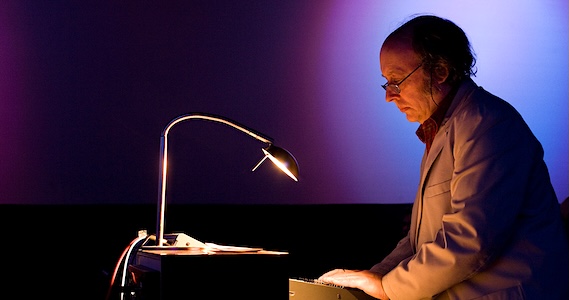
Most of us think of sounds as belonging to identifiable sources. A glass sounds like a glass. A bell sounds like a bell. A voice sounds like a voice. Recording technology allows sounds to be edited, layered, stretched, filtered, and transformed, though we often assume that their essential identity remains tied to the object that created them. During his online guest lecture for Edinburgh Napier University, composer, author, and software developer Trevor Wishart challenged this assumption repeatedly. Drawing on examples from his electroacoustic composition Imago, he explored how a single recorded sound can evolve into something entirely different, revealing possibilities hidden within the material itself.
The lecture centred on a piece whose title provides an important clue to Wishart’s thinking. Imago refers to the final stage of insect metamorphosis, the moment when an apparently unremarkable pupa becomes a butterfly. For Wishart, this process offered more than a title. It provided the conceptual foundation for the composition itself. The piece begins with an extremely modest source: two whisky glasses gently clinking together. From that brief event, lasting only fractions of a second, an entire musical world gradually emerges. Bells, birds, voices, gamelan-like textures, immense resonant structures, and oceanic soundscapes all grow from the same source material. The lecture therefore became an exploration of how transformation occurs, not only within music but within listening itself.
Wishart explained that his compositions often begin with two parallel motivations. One is technical. He wants a problem to investigate, a process to develop, or a question that requires experimentation. The other is poetic. There needs to be a broader reason for making the piece beyond demonstrating a particular technique. Neither is sufficient on its own. Technical ingenuity without expressive purpose quickly becomes sterile, while expressive intentions without any technical challenge provide little opportunity for discovery. Much of his work emerges from the interaction between these two impulses. The technical challenge creates opportunities. The artistic idea provides direction.
This relationship also helps explain why software occupies such an important place in his practice. During the lecture, Wishart reflected on the period when electronic composers often relied upon specialised hardware systems. Such equipment could be expensive, inflexible, and frequently superseded. Learning to program offered a different possibility. Rather than adapting ideas to the limitations of existing tools, it became possible to create processes tailored to specific creative questions. More importantly, software allowed entirely new forms of transformation to be explored. If a process did not already exist, it might be possible to invent it.
Yet what emerges most clearly from Wishart’s account is that invention is rarely the final objective. Again and again, he described composition as a process of exploration. Sounds are transformed not simply to produce novel effects but to discover possibilities hidden within them. Certain experiments fail. Others reveal unexpected directions. Some transformations produce results that could never have been predicted in advance. Listening becomes as important as designing. The composer is not merely constructing sounds. The composer is searching for relationships, behaviours, and opportunities that emerge through experimentation.
The opening of Imago illustrates this approach particularly clearly. The piece begins with isolated whisky-glass impacts separated by substantial periods of silence. The pace is deliberately restrained. Contemporary listeners, accustomed to rapid development, may initially wonder where the material is heading. Yet this simplicity serves an important purpose. If the work concerns metamorphosis, the listener needs to encounter the pupa before encountering the butterfly. The source material remains visible, or rather audible, long enough for its later transformations to carry meaning.
What makes the whisky glass such productive material is the complexity concealed within an apparently simple sound. Strike a glass and a resonance emerges. Listen more carefully and the sound reveals an intricate internal structure. The attack contains numerous frequencies that appear and disappear extremely rapidly. Ordinarily these details pass unnoticed. The event ends too quickly for individual components to be heard. By stretching the sound in time, however, hidden layers become accessible. Frequencies separate. Tiny fluctuations become audible. A sound that initially appeared straightforward begins to reveal unexpected richness.
One of the most memorable moments in the lecture emerged from a story about washing glasses. Wishart described noticing that repeated impacts between two heavy whisky glasses produced an unusual perceptual effect. As the impacts accelerated, there came a point at which they ceased to be heard as individual events. Instead, they fused into a continuous rising pitch. What began as a mundane domestic observation suddenly revealed a remarkable musical possibility. A sequence of impacts had become a tone. More importantly, it suggested a route through which one kind of sound might transform into another.
Experiences such as this appear repeatedly throughout Wishart’s creative process. New ideas often emerge from moments that initially seem insignificant. A process behaves differently than expected. A sound reveals an unanticipated quality. An experiment generates an unexpected result. The challenge is recognising which discoveries deserve further attention. Throughout the lecture, curiosity appeared less as a personality trait than as a working method. Creative progress depends upon noticing what others might ignore. As Imago unfolds, the whisky glasses gradually begin producing sounds that seem increasingly distant from their origin. Resonances expand into bell-like structures. Repeated transformations generate textures that suggest birdsong. Elsewhere, spectral manipulations create sounds with distinctly vocal qualities, as though fragments of speech are beginning to emerge from within the glass itself. None of these transformations completely abandons the original material. Traces of the source remain present, even as new identities begin to appear.
This ambiguity plays an important role within the work. Wishart is rarely concerned with creating perfect imitations. The objective is not to convince listeners that a whisky glass has literally become a bird or a human voice. Instead, he creates sounds that occupy a space between recognition and uncertainty. Listeners hear associations rather than direct representations. A transformed sound may suggest several different identities simultaneously. That tension between familiarity and strangeness gives many of the transformations their expressive character.
The lecture contained numerous examples of this process. Through synchronised transpositions, simple resonances begin forming complex harmonic structures. Spectral blurring allows sounds to emerge gradually from dense textures, creating the impression of material coming into focus. Distortions generate new timbral characteristics that feel organic rather than mechanical. Spatial movement contributes to the sense of evolution, allowing listeners to follow streams of sound as they separate, merge, and transform across the listening space. Each process extends the possibilities contained within the original material.
One particularly striking example involved a large gamelan-like passage that emerges later in the composition. Wishart was careful to explain that he had not set out with the intention of creating a gamelan ensemble from whisky glasses. The possibility emerged through experimentation. Once discovered, however, it became a major structural feature of the work. Earlier sections began functioning as anticipations. Later sections reflected upon what had been revealed. Relationships between different materials gradually became apparent. The composition developed not through the execution of a predetermined blueprint but through recognising patterns that emerged during the process itself.
A similar principle governs some of the work’s largest sonic landscapes. Through extensive transformation, the original material eventually produces textures that evoke oceans and breaking waves. These sounds are not realistic recordings of the sea, nor are they intended to be. Their effectiveness lies in the way they balance abstraction and association. Listeners recognise qualities that resemble waves while remaining aware that they are hearing something more complex. The illusion never becomes complete, and that incompleteness is part of its fascination.
Throughout the lecture, Wishart repeatedly returned to the importance of structure. Transformations alone are not enough. A composition requires relationships between events, phrases, sections, and larger formal shapes. To manage this complexity, he described working hierarchically. Individual sounds become events. Events become phrases. Phrases become sections. Sections become complete works. This approach allows material to remain flexible throughout development. Elements can be revised, expanded, condensed, or reorganised without losing their connection to the broader structure.
An equally revealing observation concerned sounds that might initially appear unsuccessful. Students often assume that every sound within a composition must be remarkable. Wishart suggested otherwise. Certain sounds function primarily as connections. They establish continuity, provide context, or prepare the listener for future developments. Their significance lies not in their individual impact but in their contribution to larger processes. The value of a sound cannot always be judged in isolation.
Looking back across the lecture, what emerges most clearly is not a philosophy of technology but a philosophy of listening. Software matters. Technical processes matter. Spectral transformations, distortions, interpolations, filters, and spatial manipulations all play important roles. Yet they ultimately serve a larger purpose. They create opportunities to discover possibilities hidden within sounds themselves.
For students of sound design, composition, and audio production, this may be the lecture’s most valuable lesson. Creativity is often imagined as the ability to invent entirely new ideas. Wishart’s work suggests something slightly different. New ideas may emerge through paying closer attention to existing ones. A familiar sound may contain far more than it initially reveals. The challenge is learning how to listen deeply enough, experiment patiently enough, and remain curious enough to discover what it might become.
In that sense, Imago is more than a composition about metamorphosis. It demonstrates a way of thinking about sound itself. Every sound contains unrealised possibilities. Given enough imagination, patience, and exploration, even the simplest of sources can become an entire world.