What does a tornado sound like?
At first glance, the answer appears simple. Tornadoes exist in the real world. Surely the task is simply to record one. Yet as supervising sound editor and sound designer Charles Maynes explained during his guest lecture for Edinburgh Napier University, film sound rarely works that way. A real tornado may produce a particular collection of sounds, though a cinematic tornado must also communicate scale, danger, movement, drama, and narrative significance. Audiences do not simply need to hear it. They need to believe in it.
Across a career spanning films including Twister, U-571, Spider-Man, Constantine, Flags of Our Fathers, Letters from Iwo Jima, After Earth, and Total Recall, Maynes has repeatedly confronted variations of the same challenge. Many of the most important sounds in cinema either cannot be recorded directly, no longer exist, or have never existed at all. Sound design therefore becomes an exercise in invention. The sound designer is not merely documenting reality. The sound designer is building believable realities from fragments of observation, experimentation, technology, and imagination.
What emerged most clearly from the lecture was the extent to which sound design resembles problem-solving. Every project arrives with its own collection of constraints. A tornado needs to feel enormous. A submarine needs to feel claustrophobic. A superhero requires a sonic identity unlike anything in everyday life. An alien creature must feel both unfamiliar and emotionally expressive. None of these challenges possesses an obvious solution. Instead, the work begins with questions.
Twister provided one of the lecture’s most revealing examples. The production arrived at a moment when visual effects technology was evolving rapidly, creating situations in which sound teams often found themselves designing for imagery that did not yet exist. Early visual effects sequences were frequently little more than rough placeholders. Yet audiences would eventually expect the tornadoes to feel immense, terrifying, and believable. Sound therefore had to help establish qualities that the unfinished visuals could not yet communicate.
Meeting this challenge required considerably more than recording wind. Field recording sessions captured useful source material, though the team quickly discovered that realism alone was insufficient. Various devices were constructed to generate unusual airflow sounds. Large materials were stretched across frames mounted to moving vehicles. Traditional wind machines inspired by classic Hollywood techniques were revisited. Recordings were distorted, layered, filtered, and manipulated. The objective was not documentary accuracy. The objective was creating an experience capable of convincing audiences that they were witnessing forces of extraordinary scale.
One particularly interesting aspect of Maynes’ discussion concerned distortion. Students are often taught to avoid it. Distortion is typically framed as a technical problem, something introduced by poor recording practice or overloaded equipment. Maynes described how sound designers frequently use distortion deliberately. When applied carefully, it can create the impression that a sound exceeds the limits of the playback system itself. Explosions become larger. Engines become more aggressive. Tornadoes become more violent. Distortion therefore functions not simply as an acoustic phenomenon but as a perceptual tool.
This concern with perception rather than literal accuracy appeared repeatedly throughout the lecture. Again and again, Maynes returned to situations in which audience expectations mattered more than objective realism. A real submarine may sound relatively quiet. A realistic recording of a futuristic vehicle may not exist. A supernatural creature offers no authentic reference point whatsoever. In each case, sound design becomes less about reproducing reality and more about creating experiences that feel believable within a particular cinematic world.
His discussion of U-571 illustrated this particularly well. Submarines present a curious challenge. The audience needs to understand pressure, confinement, machinery, vulnerability, and danger. Simply recording mechanical systems would not necessarily communicate these ideas effectively. Instead, designers searched for sounds capable of conveying psychological experience. One memorable example involved the Waterphone, an unusual instrument whose unstable resonances proved remarkably effective when combined with more conventional recordings. The resulting sounds were not literally part of a submarine environment, yet they contributed powerfully to the emotional reality of the space.
A similar philosophy guided work on Spider-Man. The web shooters presented a problem that sounds almost absurd when stated directly. What does it sound like when organic webbing launches from a superhero’s wrist, travels rapidly through the air, and attaches itself to a distant object? No real-world recording could provide an answer. The design process therefore began by breaking the action into components. The sound needed propulsion, movement, texture, speed, and impact. Recordings of water, stretched materials, vegetation, animal vocalisations, and numerous other sources were manipulated extensively before being combined into a coherent whole. By the time audiences encountered the finished film, the sound felt completely natural. Yet its construction depended upon materials that had little obvious connection to spiders.
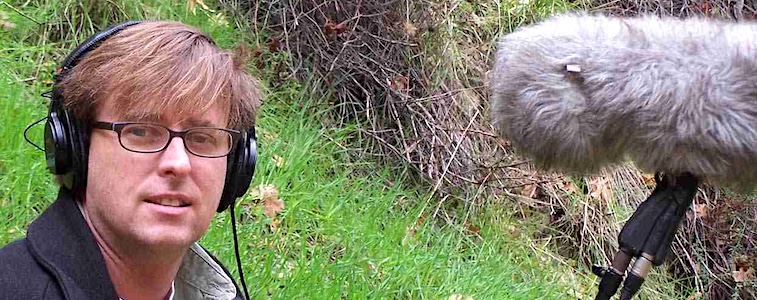
Throughout the lecture, Maynes repeatedly emphasised the value of field recording. Recording is not merely a method of collecting sounds. It is a way of discovering them. Unexpected opportunities arise constantly. A recording gathered for one project may become essential years later in an entirely different context. Environmental sounds, machinery, wildlife, crowds, and accidents all contribute to an expanding library of possibilities.
One particularly memorable story involved recording outdoors when an unexpected gathering of crows appeared. Their wing sounds were captured largely out of curiosity. Years later, those recordings helped shape supernatural creatures in Constantine. The connection was impossible to predict at the time. Yet examples such as this appeared repeatedly throughout the lecture. Sounds gathered for one reason often acquire entirely different purposes later. Creative practice depends upon recognising possibilities that may not become useful until years afterwards.
Perhaps the most striking aspect of Maynes’ career is the way these experiences accumulate. Techniques developed during one project often resurface elsewhere. A solution discovered while designing underwater sounds may later contribute to science fiction. An approach developed for machinery may prove useful for creatures. A distortion technique explored for a tornado may influence a futuristic vehicle. Sound designers gradually build libraries of methods, habits, and ways of thinking alongside their libraries of recordings.
This process becomes particularly important when working on projects involving entirely fictional technologies or environments. Films such as After Earth and Total Recall required audiences to accept worlds that had never existed. Every sound contributed to that act of persuasion. Vehicles, interfaces, weapons, machinery, and environments all required sonic identities capable of supporting the visual design. Sound therefore becomes part of world-building itself. The audience may never consciously analyse these details, though they contribute significantly to whether a fictional world feels convincing.
Collaboration occupied an equally important place throughout the lecture. Modern film sound emerges from the combined efforts of editors, designers, Foley artists, mixers, composers, directors, and numerous other specialists. Some of the films discussed involved enormous teams working across extended production schedules. Success depended not only upon technical skill but also upon communication. Sound design remains a creative discipline, though it is also a collaborative one.
Different directors engage with sound in different ways. Some respond primarily to emotional impact. Others focus on specific details. Some use music as the primary storytelling tool. Others give sound effects greater prominence. Sound designers therefore spend much of their careers adapting not only to technical challenges but also to different creative personalities. Building a soundtrack involves understanding people as well as understanding sound.
Looking back across the lecture, what emerges most clearly is a conception of sound design rooted in curiosity. Technology matters. Recording equipment matters. Software matters. Yet none of these things generates solutions independently. Every project introduces new questions. Every creative challenge requires experimentation. Every soundtrack becomes an exercise in balancing realism, perception, narrative, and imagination.
For students entering the field, this may be the lecture’s most valuable lesson. Sound design is often imagined as a search for the perfect sound. Charles Maynes’ career suggests something rather different. More often, the task is finding a convincing solution to a problem that nobody has solved before. Tornadoes, submarines, superheroes, alien worlds, supernatural creatures, and futuristic technologies may appear unrelated, though each ultimately presents the same creative challenge. The audience must be persuaded to believe in something beyond everyday experience.
Throughout the lecture, Maynes repeatedly demonstrated that such persuasion rarely emerges from a single recording, a particular piece of software, or a clever technical trick. It emerges from observation, experimentation, collaboration, and an ongoing willingness to explore unexpected possibilities. A recording captured years earlier may suddenly solve a new problem. An accidental discovery may become the defining feature of a sequence. A sound that initially appears unusable may eventually find its place within an entirely different project. The work progresses through a continual process of asking questions, testing ideas, and remaining open to surprise.
Perhaps this is why sound design remains such a distinctive creative discipline. Unlike many areas of production, it frequently begins where direct representation becomes impossible. No one can record the sound of Spider-Man’s web shooters. No one can capture the sound of a fictional technology that has never existed. No one can simply point a microphone at an imagined world. Instead, sound designers build these experiences from fragments of reality, shaping them into something audiences can recognise, understand, and believe. The challenge is not merely creating sounds. The challenge is creating possibilities for imagination.
For Charles Maynes, that challenge appears not as a limitation but as the reason the work remains endlessly fascinating.