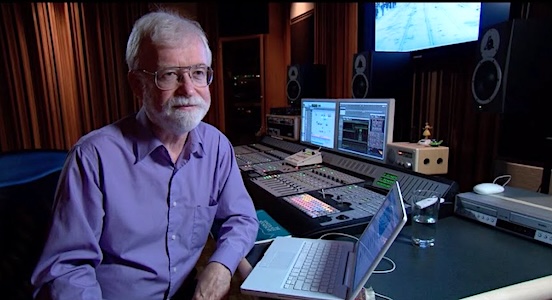
What happens when we listen to a place?
At first glance, the question appears surprisingly simple. Places are full of sounds. Traffic passes. Birds call. Church bells ring. Doors close. Voices drift across streets and public squares. Yet during his online guest lecture for Edinburgh Napier University, composer, researcher, and acoustic ecologist Professor Barry Truax suggested that listening to a place involves far more than cataloguing the sounds it contains. Throughout a wide-ranging discussion of soundscapes, field recording, acoustic communities, oral history, environmental awareness, and soundscape composition, he repeatedly returned to a central idea. Sound is never simply physical. It is social, cultural, historical, and environmental. To listen carefully to a place is therefore to learn something about the people who inhabit it, the history that shaped it, and the relationships that continue to define it.
Truax’s own involvement with these questions stretches back more than fifty years. Arriving at Simon Fraser University in 1973, he joined the World Soundscape Project, a pioneering research group founded by the Canadian composer R. Murray Schafer. The project emerged during a period of growing environmental awareness. Yet whereas many environmental discussions focused on landscapes, pollution, or conservation, Schafer and his colleagues became interested in the acoustic dimension of everyday life. Their concern was not simply with noise. They wanted to understand the sonic environments people inhabited and the ways those environments influenced perception, culture, memory, and community.
The term soundscape became central to this work. Although the word had appeared occasionally before Schafer popularised it, the World Soundscape Project gave it a more systematic meaning. A soundscape was not merely a collection of sounds. Nor was it simply an acoustic environment that could be measured scientifically. What mattered equally was how those sounds were perceived and understood by people living within that environment. The same physical sound might be experienced very differently depending upon context, culture, history, or personal association. Listening therefore became a study not only of acoustics, but also of human experience.
Vancouver provided the project’s first major laboratory. During the 1970s, members of the World Soundscape Project recorded extensively throughout the city, documenting harbour sounds, trains, ferries, bells, industrial activity, public spaces, and everyday life. At one level, the work resembled a large-scale field recording project. At another, it represented an attempt to understand how a city expressed itself acoustically. Recording became a form of investigation. What sounds defined Vancouver? Which sounds carried social meaning? Which sounds connected residents to their history? Which sounds were disappearing?
Several examples discussed during the lecture illustrated how these questions often led in unexpected directions. Vancouver’s harbour horns, train whistles, church bells, and the distinctive Canada Horn all emerged as sounds that many residents recognised immediately. Such sounds were not important solely because they were loud or distinctive. They mattered because they connected people to place. Schafer introduced the term soundmark to describe sounds possessing particular cultural significance within a community. The concept deliberately echoed the idea of a landmark. Just as certain buildings, monuments, or geographical features help define a place visually, particular sounds may help define it acoustically.
The Canada Horn provided an especially interesting example. Installed as part of Canada’s centennial celebrations in 1967, it performs the opening notes of the national anthem each day. Functionally, it operates like a signal. Symbolically, however, it occupies a rather different role. Many Vancouver residents know the sound immediately. It has become woven into everyday life. Listening to it therefore involves more than recognising a horn. It involves recognising a piece of collective identity.
What fascinated Truax was how such sounds often reveal broader histories. Discussions of harbour horns quickly lead towards transportation networks, migration, industry, and national development. Church bells raise questions about religion, settlement, and changing urban environments. Listening carefully to a city often reveals that sounds function as traces of social and cultural processes that remain largely invisible.
Many of the examples discussed during the lecture also demonstrated how soundscapes change over time. One recurring theme of the World Soundscape Project involved documenting sounds that were disappearing, being replaced, or acquiring new meanings. Steam whistles gave way to electronic signals. Traditional foghorns were replaced by automated systems. Bell sounds that once travelled across large parts of a city became increasingly difficult to hear amid expanding urban development. Such changes are rarely documented in conventional histories. Buildings receive preservation orders. Photographs enter archives. Yet sounds often disappear without attracting similar attention.
For Truax, this raises important questions about acoustic heritage. If communities value historic buildings, should they also value historically significant sounds? If a particular sound helps define a place, what happens when it vanishes? These questions do not always produce straightforward answers. Soundscapes are constantly changing. New sounds emerge while others disappear. Yet the discussion highlights an important shift in perspective. Once listening becomes a form of cultural enquiry, everyday sounds acquire a significance that might otherwise be overlooked.
The lecture repeatedly demonstrated how listening can reveal aspects of history that remain inaccessible through other methods. One approach developed by the World Soundscape Project involved collecting what they called earwitness accounts. Residents described sounds they remembered from earlier periods of their lives. These accounts were not always precise. Memory rarely functions with the accuracy of a recording device. Yet they offered valuable insights into how people experienced changing environments. Through such recollections, researchers gained access not only to lost sounds but also to the meanings attached to them.
One particularly memorable example came from the Scottish village of Dollar, one of several European communities studied by the project during the 1970s. There the researchers worked closely with David Graham, a former town clerk whose extraordinary memory allowed him to reconstruct entire soundscapes from decades earlier. Standing at locations throughout the village, Graham described railway sounds, station activities, signalling systems, machinery, voices, and routines that had long since disappeared. Listening to him was almost like hearing an acoustic map of the past being reconstructed in real time.
The significance of these accounts extended beyond nostalgia. Graham was not simply recalling sounds. He was recalling relationships, activities, routines, and forms of social organisation. The sounds mattered partly because they connected people to particular ways of life. Once again, listening became a route towards understanding communities rather than merely documenting acoustics.
Soundwalks developed as another way of exploring these relationships. Truax described soundwalks as listening walks in which participants move through an environment while paying deliberate attention to its acoustic characteristics. Although deceptively simple, the method encourages a profound shift in awareness. Many sounds that normally fade into the background become newly noticeable. Distances become easier to judge. Acoustic boundaries emerge. Patterns of activity reveal themselves. Places begin to sound different once listening becomes intentional.
Closely related were memory walks, in which participants revisited locations associated with earlier experiences. Returning people to familiar places often stimulated recollections that might otherwise remain inaccessible. A particular street corner, railway station, church, or public square could trigger detailed memories of sounds, activities, and social interactions. Context helped unlock memory. The environment itself became part of the research method.
What makes these approaches particularly interesting is that they position listening as an active practice rather than a passive process. Hearing happens continuously. Listening requires attention. Throughout the lecture, Truax repeatedly encouraged students to recognise how much of everyday life passes by acoustically unnoticed. Soundwalks, memory walks, and soundscape research all attempt to interrupt that habit and create opportunities for reflection.
The final part of the lecture turned towards soundscape composition, a form of creative practice closely associated with Truax’s work. Traditional musical composition often treats sounds as materials that can be organised independently of their original contexts. Soundscape composition adopts a rather different position. Environmental context remains central. The sounds retain connections to places, communities, and experiences from which they originate.
Truax described a continuum of approaches. At one end are relatively direct recordings that document environments with minimal intervention. At the other are heavily transformed compositions in which sounds are processed, stretched, layered, and reconfigured. What distinguishes soundscape composition is not the degree of manipulation but the continuing relationship between the work and its source context. Listeners are encouraged to recognise environmental references and reflect upon their meanings.
Soundscape composition also reflects a way of thinking about recorded sound that has influenced many areas of contemporary sound design. Environmental recordings are not treated simply as raw material waiting to be transformed beyond recognition. Their origins continue to matter. A harbour horn, a railway station, or a forest path carries associations that listeners may recognise even after considerable processing. Sound designers regularly make similar decisions when balancing realism with interpretation. Recordings can be edited, layered, stretched, or filtered, yet they often retain traces of the places and experiences from which they came. Truax’s work encourages designers to consider not only how a sound functions within a composition, but also what relationships it continues to carry with the world beyond the loudspeaker.
This emphasis on context creates an interesting contrast with many traditions of Western art music. Rather than treating context as background information, soundscape composition places it at the centre of the creative process. Environmental, social, historical, and psychological associations become part of the material with which the composer works. A harbour horn is never simply a sound. It carries histories of transportation, labour, geography, and identity. A church bell carries different associations. A train whistle carries others. The composer works not only with acoustic properties but also with layers of meaning.
Truax illustrated this approach through examples drawn from Vancouver. Familiar sounds appeared first in recognisable forms before gradually being transformed through processes such as time stretching. The effect was not simply aesthetic. Transformation encouraged different forms of listening. Sounds that normally function as signals became objects of reflection. Their internal textures emerged. Musical qualities became apparent. At the same time, their connections to place remained intact.
Underlying the entire lecture was a broader concern with acoustic ecology. Listening, in this context, is not merely a technical skill or an artistic technique. It is a way of understanding relationships between people and environments. Paying attention to sound reveals aspects of culture, history, memory, community, and ecology that often remain hidden. It encourages reflection upon what societies choose to preserve, what they allow to disappear, and how environments continue to shape experience.
More than fifty years after the World Soundscape Project began, many of the questions raised by Truax and his colleagues remain unresolved. Cities continue to change. Technologies alter how people communicate, travel, and work. Familiar sounds disappear while new ones emerge. Yet sound rarely occupies the same position within public discussions of heritage and preservation as buildings, monuments, or landscapes.
Throughout the lecture, Truax returned repeatedly to sounds that had vanished, sounds that survived, and sounds that communities continued to recognise as part of their identity. Harbour horns, church bells, railway sounds, industrial signals, and everyday activities all carried meanings that extended beyond their immediate functions. They connected people to places, histories, and shared experiences. Once lost, many could not easily be recovered.
Soundscape research therefore asks a question that is both simple and surprisingly difficult. What should be remembered acoustically? Photographs preserve appearances. Written records preserve events. Recordings, memories, soundwalks, and earwitness accounts preserve something different. They preserve traces of how places were experienced by the people who lived within them.
For Truax, listening is valuable partly for this reason. It draws attention towards aspects of culture and environment that often pass unnoticed. A soundscape is not merely what a place sounds like. It is one way of understanding how a place has been lived, remembered, and shared.