How do you tell a visual story when the audience cannot see anything?
The question sits at the centre of audio drama. Characters move through spaces. Doors open and close. Crowds gather. Vehicles arrive. Relationships develop. Entire worlds emerge. Yet none of these things can be shown directly. There is no camera to establish a location, no lighting to direct attention, and no visual performance to reveal emotion. Everything must be communicated through sound.
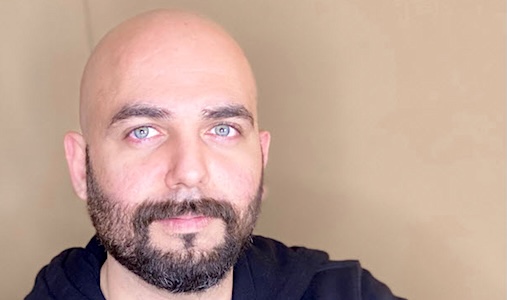
During an online guest lecture for Edinburgh Napier University, alumnus Karim Beidoun explored this challenge through examples drawn from a career that has spanned radio, podcasting, and large-scale audio drama production. Having worked on more than 150 episodes of drama for BBC Arabic before becoming CEO and Head of Content at Hakawati, one of the leading podcast networks in the Middle East and North Africa, Beidoun offered a detailed account of how narrative worlds can be built entirely through listening. What emerged throughout the lecture was a striking observation. Audio drama is not simply theatre without pictures. It requires its own way of thinking about storytelling.
Many of the creative teams involved in the BBC Arabic productions initially approached drama through habits developed in film and television. Writers imagined scenes visually. Directors thought in terms of camera positions and visual composition. Actors relied upon physical performance. Yet audio drama quickly exposed the limitations of these assumptions. A listener cannot see a gesture. A facial expression disappears completely. Costumes, scenery, lighting, and visual spectacle cease to exist. Techniques that appear essential in visual media suddenly become irrelevant. New solutions have to be found.
This challenge became particularly significant during the development of the BBC Arabic drama project. Producing more than 150 episodes created practical pressures that demanded efficient workflows and consistent creative decisions. According to Beidoun, around eighty-five percent of each episode was effectively performed live during recording. Rather than constructing every scene through extensive post-production, actors, directors, and sound teams worked together to create performances that already contained much of the final dramatic shape. The result was a process that often resembled theatre, though with an important difference. The microphone became the audience.
This apparently simple observation transforms almost every aspect of performance. In film, an actor’s relationship with the camera determines how a scene is perceived. In audio drama, that role is occupied by the microphone. Distance matters. Position matters. Movement matters. A character speaking directly into a microphone creates a very different impression from a character speaking several metres away. Walking towards a microphone changes the perceived relationship between characters. Turning away alters emotional emphasis. Physical movement becomes part of the storytelling process. Beidoun described how actors gradually learned to think about microphones not merely as recording devices but as narrative tools. A performer might physically move around the recording space to create the illusion of travelling through an environment. Multiple actors could position themselves carefully to establish relationships within a scene. Changes in distance could suggest intimacy, conflict, uncertainty, or power. Listeners never see these movements taking place, though they experience their consequences. The result is a form of performance that remains deeply physical despite the absence of images.
This idea extends beyond acting. One of the most interesting themes running throughout the lecture concerned the relationship between sound and space. Audio drama constantly faces a problem that visual media solves almost instantly. How does the audience know where they are? A film can establish a location through a single shot. Audio drama has no such luxury. Environments must be communicated indirectly through acoustics, ambience, movement, and carefully selected details. A refugee camp, for example, cannot simply be shown. Instead, listeners encounter fragments that encourage them to construct the space themselves. Distant voices. Wind moving through temporary structures. Children playing nearby. Footsteps crossing uneven ground. Vehicles arriving and departing. None of these sounds individually explains the location. Together, however, they create an impression of place. The listener begins assembling an environment from acoustic evidence.
Throughout the lecture, Beidoun repeatedly returned to the importance of this imaginative participation. Audio drama succeeds partly because listeners become active collaborators in the storytelling process. Images are not delivered fully formed. They are constructed internally. A scene therefore exists simultaneously in two places: within the production itself and within the imagination of the audience. Different listeners may visualise the same environment differently, though all are guided by the same sonic information.
This collaborative relationship helps explain why realism in audio drama can be surprisingly complicated. Beidoun discussed examples where literal accuracy did not always produce the most convincing dramatic result. A gunshot recorded exactly as it sounds in reality may fail to meet audience expectations shaped by decades of cinema and television. Real environments may contain details that distract rather than support narrative clarity. Sound designers therefore find themselves navigating a space between documentary realism and dramatic communication. The objective is not necessarily to reproduce reality exactly. The objective is to create experiences that audiences recognise and understand. Authenticity remains important, though authenticity is often perceptual rather than literal. A sound may require adjustment, enhancement, or simplification in order to communicate effectively within a narrative context. Audio drama constantly balances realism against intelligibility.
Questions of storytelling also influenced Beidoun’s discussion of directing. Directors working in visual media often focus heavily on what appears within the frame. Audio drama requires a different form of attention. Rather than asking what the audience sees, directors must ask what the audience hears and, perhaps more importantly, what they imagine. Beidoun described situations in which directors were encouraged to close their eyes and listen rather than relying upon visual assumptions. Decisions that appeared obvious on paper often changed once they were evaluated as purely auditory experiences.
This shift in perspective gradually leads towards a different understanding of sound design itself. Throughout the lecture, Beidoun repeatedly suggested that audio drama sound designers occupy a role remarkably similar to cinematographers. Cinematographers guide attention through framing, movement, focus, and composition. Audio drama practitioners achieve comparable objectives through sound. Ambiences establish environments. Movement reveals relationships. Perspective shapes understanding. Distance communicates emotional meaning. Although the tools differ, the underlying objective remains surprisingly similar. Both disciplines guide audiences through narrative worlds.
One consequence of this approach is that audio drama demands particularly careful listening. Small details often carry significant narrative weight. A door opening in the background may reveal the presence of a new character. Changes in room acoustics may indicate movement between locations. A subtle environmental sound may establish context more effectively than direct exposition. Listeners become sensitive to information that might pass unnoticed in visual media. Sound is no longer supporting the story. Sound becomes the primary vehicle through which the story exists.
Seen in this light, many of the practical challenges discussed throughout the lecture begin to look different. Microphone technique is not simply a recording concern. Blocking actors around a studio is not merely a logistical necessity. Ambiences do more than create atmosphere. Decisions about movement, distance, performance, and acoustics all contribute to a single objective: helping listeners construct a coherent mental image of a world they cannot see.
This helps explain why Beidoun repeatedly described audio drama as requiring a different way of thinking. Writers learn to write for ears rather than eyes. Directors learn to listen rather than watch. Actors learn to perform for microphones rather than cameras. Sound designers become responsible for many of the functions that visual media normally assign to cinematography, production design, and editing. The challenge is not reproducing techniques borrowed from film or television. The challenge is understanding what audio can do on its own terms.
Looking back across the lecture, what emerges most clearly is that audio drama succeeds when listeners become active participants in the storytelling process. Environments are suggested rather than shown. Characters are heard rather than seen. Spaces emerge from collections of sonic details rather than visual images. The audience completes the process, assembling those fragments into people, places, and events.
Audio drama does not show listeners a world.
It gives them the materials to imagine one.