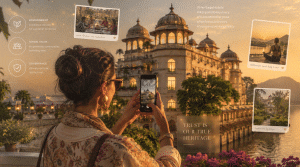
 In a world where people often choose hotels through what they see online, a photograph is no longer just a photograph. A guest’s Instagram post of a hotel room, a festival meal, a wellness retreat or a heritage building can quietly say a great deal about what people value, what they trust and what they expect from hospitality brands.
A new open-access study in Business Strategy and the Environment, co-authored by CBISS member Associate Professor Sujoy Bhattacharya, explores this changing landscape. The research looks at how user-generated content on Instagram can help hospitality businesses understand their environmental, social and governance, or ESG, reputation in real time.
The study focuses on the Indian Hotels Company Limited, one of India’s major hospitality groups and the owner of brands including Taj, Vivanta, SeleQtions and Ginger. Using 7,823 public Instagram posts, the research team analysed images, captions and hashtags to uncover how guests and online audiences communicate ideas about luxury, culture, safety, wellness and sustainability.
What makes the study interesting is that it moves beyond the usual focus on written reviews or survey responses. Many businesses still rely heavily on formal ESG reports, customer feedback forms or annual brand audits. These remain important, but they can miss the everyday signals that customers are already sending through social media. A guest may not use the word “sustainability”, but they may post about local heritage, wellness, nature, safety or community experiences. These images and captions can become small but powerful clues about how a brand is being understood.
The research used a mix of artificial intelligence and data analysis tools to study the posts. Images were labelled using Google Cloud Vision API, while captions and hashtags were analysed for sentiment and meaning. The team then grouped the content into themes such as room types, facilities, activities, festival promotions, hotel news and property images.
The findings show that ESG communication in hospitality is not always presented through direct statements about sustainability. Instead, it often appears through stories. Cultural festivals, heritage buildings, wellness activities, safety messages and community-facing images all helped shape how people interpreted the brand.
Social themes were especially visible. Posts linked to cultural heritage, festivals, wellness and guest experience generated strong engagement. These themes matter because hospitality is not only about accommodation; it is also about place, identity, memory and belonging. For a hotel group with historic properties and a strong cultural presence, these visual stories become part of the brand’s social value.
Environmental themes appeared more gradually but became important over time. Images connected to nature, wellness, eco-tourism and outdoor experiences helped signal a broader move towards sustainability-driven hospitality. This suggests that customers increasingly connect travel and hospitality with well-being, responsible experiences and a closer relationship with the environment.
Governance themes appeared differently. They tended to emerge during moments of crisis or concern, especially around safety, trust, transparency and security. This is important because it shows that online content can act as an early warning system. When people begin to associate a brand with risk, uncertainty or reputational concern, these signals may appear first in the language and imagery of social media.
For hospitality leaders, the message is clear: ESG reputation is not built only through official reports or corporate campaigns. It is also built through the images, captions and hashtags shared by guests, visitors and online communities. These everyday digital traces can reveal whether a brand’s sustainability message feels credible, whether its safety promises are trusted and whether its cultural storytelling resonates with people.
The study also offers a wider lesson for businesses beyond hospitality. In a digital economy, organisations need to listen more carefully to visual and social signals. A company may believe it is communicating sustainability effectively, but the public may be interpreting the brand in a different way. By analysing user-generated content, businesses can better understand this gap and respond more quickly.
For CBISS, the research speaks directly to our interest in business innovation, sustainability and responsible use of technology. It shows how AI-enabled tools can support more responsive and evidence-based decision-making, while also raising important questions about interpretation, ethics and trust.
The future of ESG communication will not be shaped by corporate messaging alone. It will also be shaped by what people see, share and discuss online. For hospitality brands, and for many other sectors, the challenge is no longer simply to say the right thing about sustainability. The challenge is to make sure that customers experience it, recognise it and believe it.
This research reminds us that the public is already telling businesses what matters. The question is whether businesses are listening closely enough.