Tag Archives: women

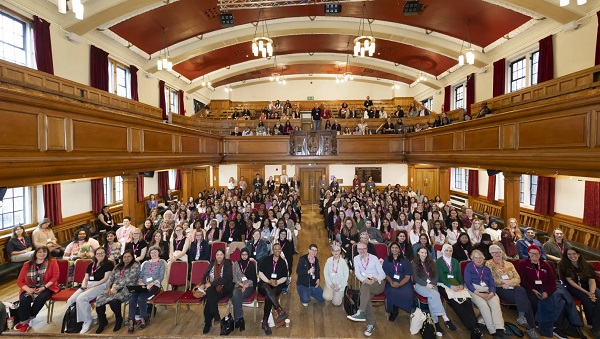
Attendees at BCS Women Lovelace Colloquium 2025

BCS Women Lovelace Colloquium 2025

Clara shares their experience of their second BCS Women Lovelace Colloquium

What is the Lovelace Colloquium?

This year, two Edinburgh Napier Cyber Security students had their posters accepted to speak at BCS Women Lovelace Colloquium 2025 in Glasgow. The day consisted of industry speakers, poster-presenting sessions and sponsors’ stalls.

The Lovelace Colloquium was created by BCS Women in 2008 and is specifically for women and gender minorities in computing and related degree courses. The basis of the conference is to create a place for women and gender minorities in tech to come together and meet each other to present and discuss computing. There is a massive issue with the gender gap in computing (82% of computing students are male according to HESA data for 2022-23). Women and gender minorities face several barriers to thriving in their careers.

This conference brings women and gender minority students together, with a focus on the content we are learning, researching, or interested in. The conference partners with universities and aims to provide poster speakers the opportunity to attend, with as few barriers as possible. Travel and hotels, if needed, are covered by the conference or university. This year around 275 students attended.
Attendees at BCS Women Lovelace Colloquium 2025

My experience

This was my second year at the conference, so I knew a bit more about what to expect. Last year I had the most amazing time meeting so many interesting people and learning about a range of tech topics. This year, I presented on my dissertation, with a slight pivot to an area I didn’t get to fully explore in my dissertation. The poster is titled: Perceptual image hashing future in disinformation detection. I got to see so many posters and probably only saw a third of them in any depth. I learned some exciting things and talked to some people building off some incredible concepts.

I was able to attend the pre-conference social this year with my friend Joyee, who also presented a poster – Scroll, save, repeat: a digital hoarders’ game. We were able to talk to so many lovely people and also did a quiz on some historical gender equality facts. Did you know that, before 1975,  women weren’t allowed to open a bank account in solely their own name!

The speakers were so inspiring – Sharon Moore was the opening keynote and she talked about the importance of continually learning, keep learning about interesting things that you enjoy learning about. My favourite quote from her talk was “let go of confidence and find courage instead”. I strive for this in my life with my own mantra of ‘do it scared’. The second speaker was Bara Tirumasaletti, who looked at where and how technology and business strategy intersect. The third speaker was Carol Rennie Logan, who outlined why early career jobs that might be ‘boring’ can teach you an incredible amount and set you up with a strong foundation of skills. The final speaker was Dr Ilyana Hirskyj-Douglas who showed us her research into developing interactive computer systems for animals. Her research has so far shown that having for animals to have some autonomy over their lives and environment reduces stress behaviour. It also indicates that dogs do truly have best friends and a rich social network. I really enjoyed this talk especially at the end – it staved off my tiredness of the day and I got to see loads of cute dogs and parrots talking through a video call.

I read so many posters from improving digital literacy in the Deaf community, to a concept utilising Minecraft mods to teach physics and maths at Key Stage levels to using machine learning to identify financial fraud. See the abstract book for all the abstracts and speakers’ bios.

Why should you apply?

I strongly recommend to any women or gender minorities in computing or related at university to take advantage of this opportunity! Attending the colloquium both years allowed me to consolidate the network of people I met the previous year, exposed me to so many areas of research and the constant innovations happening in them. The speakers gave some sage advice on being yourself regardless of the work environment you find yourself in, and if something doesn’t work – then have the power to walk away.

There was employers from varying companies, organisations with the aim of assisting job applications/ CV building, and some universities promoting their postgraduate technology programmes. There was also a panel where we got to ask questions to a variety of people in academica, the industry and non-profits.

While this year, I did my poster on my dissertation, there are categories for each stage of university so you can apply at any stage of your university career. The networking opportunities, not just with employers but with other women and gender minorities in the field is invaluable. I left the conference feeling recharged and ready to tackle anything coming my way.

The conference has been steadily growing since 2008 so for the first time, next year’s conference in Bath will be two days long. I’m graduating this year so sadly won’t be able to attend as a poster presenter but I hope to attend as a general attendee.

By Clara O’Callaghan
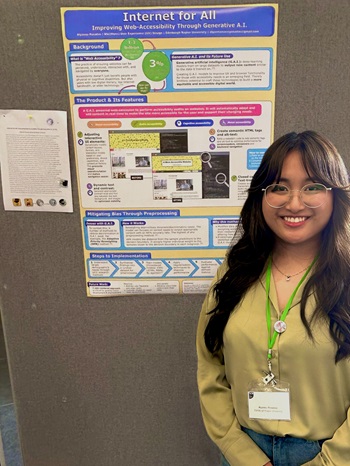
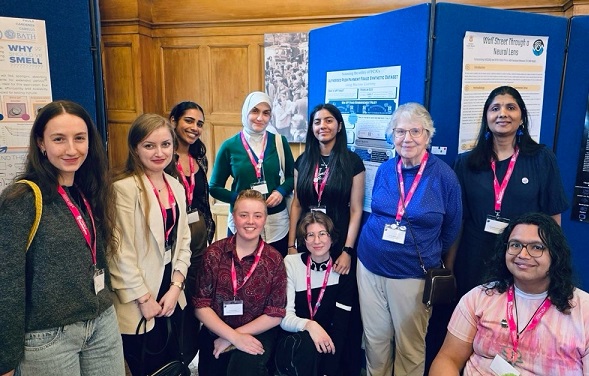
Alyanna with Internet for All poster

BCSWomen Lovelace Colloquium 2024

About the BCSWomen Lovelace Colloquium

This year two Edinburgh Napier students got their poster accepted to speak at the Lovelace Colloquium. This conference was created in 2008 and is specifically for women and gender minorities in computing and related degree courses. Every year a university in the UK hosts this one-day event full of incredible people in tech. The day consists of speakers, poster-presenting sessions and a social afterwards. The idea is to create a place for women and gender minorities in computing to come together, not with gender as the focus, but to present and discuss computing in an open space. We all know the issue of the gender gap in computing (around 20% of students in tech are women). We face imposter syndrome, misogyny, and a multitude of things to battle to be able to thrive in our careers. This conference also strives to allow speakers to attend without barriers, so travel and hotels, if needed, are paid for by the conference or by the university. This year there were over 250 women and other gender minorities there. Clara and Alyanna describe their conference below.

Lovelace Participant Experience: Clara O’Callaghan

I went to the conference after having my poster about digital forensics in private browsing accepted. It was my first academic poster and I was quite nervous to meet everyone and scared that I wouldn’t be able to answer the questions people asked. However, when I got there, the atmosphere was so lovely and I felt comfortable around all these amazing people. The posters I got to see were absolutely incredible and I kept getting into long discussions on a poster and talking for half the time slot. I probably only saw about a quarter of the posters in depth. I was on crutches during the event and the organising team were lovely and kept checking in that I was doing okay. The speakers were really interesting and I learned about robotics and AI bias as well as what Ocado does and how they operate their warehouses. Very futuristic! While it was predominantly women, there were a fair few non-binary people and as a non-binary person I never felt uneasy about it. Overall, I had the most amazing time and will definitely be going back next year – especially as it’s just in Glasgow!

Lovelace Participant Experience: Alyanna Posadas

For my poster, I decided to focus on optimising web accessibility in real-time using generative AI. This was my first time presenting a research poster at an event like this, and I absolutely loved it! I came away from the event learning a lot of interesting things from both speakers and students, connecting with my top choice employer, and making new friends in industry. The best part of the day was listening to the research done by other participants. The subject matter varied wildly, and a lot of it concerned things I was completely unfamiliar with. It made me realise how much of a bubble I was in when it came to computer science! Overall, I loved taking part in the event and am grateful to be a part of it.

Why should you apply?

I strongly recommend to any women or gender minorities in university to take advantage of this opportunity as well! The colloquium increased my confidence in myself and my own skills, and got me more excited about the future of computing as a whole. It exposed me to many different research areas and the great innovations happening within them. I talked to a lot of amazing people and was able to build real connections that day.

The events of the day were incredibly valuable as well. There were employers from big and small companies, companies that assist with job applications, and universities promoting their postgraduate programmes. The speakers discussed various subjects, but I found it all very valuable. The topics ranged from current trends facing the industry, working at a specific company, or advice about how to land your dream job. There was also a panel where we got to ask questions. And it was great to hear career advice from people who could speak on their experiences being a woman or gender minority, or the struggles of breaking into tech.

It was also the first time I got to research a subject matter I had a lot of passion and interest for in such great detail. It gave me an excuse to reach out to professors and professionals online to ask about generative AI, data processing, web accessibility so I could learn more. This helped me build connections and made me feel less intimidated by my field. Many university students, especially Masters or Honours Project students, are already completing an in-depth research dissertation. It’d be very easy to apply your own project to this conference and take advantage of the networking opportunities present (e.g., employers) and connect with other women and gender minorities in the field! I’ll definitely be taking part in it next year, especially as it’s in Glasgow nearby!

More pictures and reports from the Colloquium

Sally Smith at Computershare event

Tech sector needs more women in leadership roles

Women are under-represented in leadership roles…especially in the tech sector

We know that women are underrepresented in computing courses at schools, colleges and universities, so it’s no surprise they are underrepresented in tech sector leadership roles.

In fact, Tech Nation revealed that 77% of tech director roles are filled by men.

For those women that do decide on a well-paid career in tech, 50% leave before they are 35, so many don’t progress to leadership roles. Of course, this is a problem: diversity in decision-making is better and engineered products are more inclusive, plus women can miss out on high pay and status.

Why the drop out? Researchers found sexism to be the principal reason for leaving the sector. They say women encountered a hostile and unwelcoming climate. Research has also found that women either move away from technical work or adapt by becoming one of the boys to fit in with  a masculine (bro) culture.

Our own research, however, found women in IT leadership positions had found work that chimed with their personal values. For example, they found satisfaction in helping end users. These are great jobs, great careers. So how do we prevent women leaving the sector?

Things that work

  • inclusive and friendly job adverts,
  • family friendly policies at work,
  • inclusive work environments,
  • mentors and role models.

If you are getting started in tech, don’t be deterred by job adverts, look for mentoring programmes, start social/ informal events at work (it doesn’t all have to be about beer and pizza).

If you are already a leader in tech, think about what you might be able to influence – and offer to mentor.

17 women in tech

Case studies of women working in tech

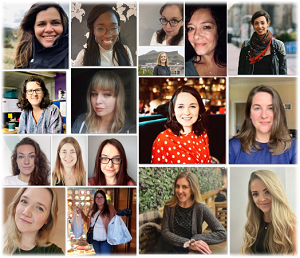
We asked women working in tech and digital, including apprentices, about their journeys into tech, what they do, and what they like about it. Here are our first 17 profiles.

The profiles were collected in 2021 and 2022 – we know that many of these women have moved forwards in their career since then, with graduations and promotions. Congratulations.