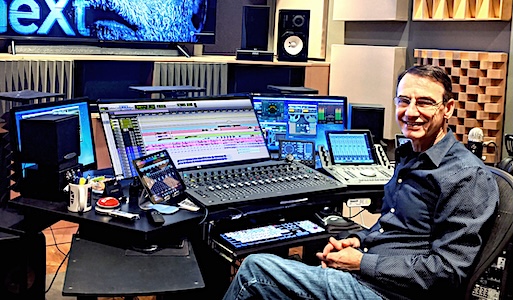
How do you mix television sound under pressure?
A television soundtrack may contain hundreds of dialogue recordings, sound effects, Foley performances, backgrounds, ADR takes and music stems, all competing for space within a mix that must remain clear, emotionally convincing and technically suitable for broadcast. The audience should never become aware of that complexity. They should simply understand every line, believe every environment and remain absorbed in the story. During his online guest lecture for Edinburgh Napier University, re-recording mixer Frank Morrone explored the craft behind achieving that apparent simplicity. Drawing upon a career in film and television that began in 1979, and projects including Lost, The Strain, Sleepy Hollow and Criminal Minds: Beyond Borders, he revealed a discipline shaped equally by technology, organisation, collaboration and judgement. Throughout the session, one principle emerged repeatedly. The most effective mixing workflows allow enormous technical complexity to disappear behind the story.
Morrone began by tracing a career that developed across several different areas of professional audio. His earliest work took place in music studios, recording jazz and orchestral film scores before following those recordings into the dubbing theatre and becoming increasingly interested in the way complete soundtracks were assembled. A move into post-production allowed him to work across dialogue editing, music editing and Foley recording before concentrating upon re-recording mixing. That breadth of experience shaped the collaborative philosophy running throughout the lecture. Unlike a music recording session, where one engineer may remain closely involved from recording through to the final mix, film and television sound brings together work created by many different specialists. The dub stage is where those contributions finally meet. Successful mixing therefore depends upon understanding not only the material itself, but the people, processes and decisions that produced it.
Television makes this collaboration particularly demanding. Morrone described an industry in which track counts have continued to increase while schedules and budgets have become progressively tighter. Sophisticated surround mixes must be created rapidly, and emerging formats add further complexity without removing the need to support conventional playback systems. His response is not simply to work faster. It is to design workflows that remove unnecessary decisions from the mixing stage. As soon as he joins a project, he communicates with the supervising sound editor about track requirements and provides a starting template so that incoming material already fits an established structure. Organisation begins before the mixer enters the room. Under severe time pressure, the ability to find, control and compare material immediately becomes part of the creative process itself.
This reveals something deeper about Morrone’s understanding of expertise. His templates, early conversations with sound editors, knowledge of production microphones, preparation of alternative takes and habit of printing completed passes all anticipate problems before they are allowed to interrupt the mix. The same thinking extends beyond the dubbing theatre. He considers how broadcast processing will react to dynamics, how a mix will translate to domestic systems and how material created for one format will behave when heard through another. Professional experience, in this sense, is not simply the ability to solve problems quickly. It is the ability to recognise where problems are likely to emerge and construct a workflow in which many of them have already been addressed before they become urgent.
The scale of Lost provided a striking illustration. Morrone showed the students sessions containing extraordinary numbers of elements, including dozens of tracks dedicated to the Smoke Monster alone. Its identity emerged from a deliberately ambiguous combination of animal voices, pneumatic machinery, roller-coaster wheels and other contrasting sources, creating something that resisted being understood as either entirely organic or entirely mechanical. Those effects existed alongside hard effects, backgrounds, Foley, production dialogue, ADR, group recordings and substantial music deliveries. The technology available at the time imposed strict limits upon voices and processing, requiring careful decisions about resource allocation as well as creative balance. Complexity could not simply be solved by adding more processing. The session itself had to be organised so that the mixers could navigate it instinctively.
Custom fader layouts and VCA groups became essential to that process. Morrone described arranging controls so that principal dialogue could immediately be balanced against ADR, group recordings and music, while different categories of material remained independently accessible. Music sources could be separated from score, while dialogue in different languages could be isolated for international deliverables. Every layer of organisation reduced the time between hearing a problem and solving it. This became especially important during pilot season, when mixers might receive unusually elaborate material without first having time to develop a workflow around the programme. A sufficiently flexible template must already be capable of accommodating whatever arrives. Preparation, in this context, creates the conditions in which creative decisions can still be made under pressure.
The production of Lost also demonstrated the tension between creative ambition and delivery requirements. Morrone recalled the exceptional resources devoted to the programme, including a large pilot budget and Michael Giacchino’s insistence upon recording a live orchestra for each episode. Yet the soundtrack still had to survive the restrictions of television broadcast. The team therefore created a more dynamic version for DVD before producing a contained broadcast mix designed to survive transmission processing. A similar approach was later adopted on The Strain. The distinction mattered. A mix can remain technically within specification and still behave poorly when subsequent broadcast processing responds to excessive dynamics. Re-recording therefore requires mixers to think beyond the dubbing theatre. They are mixing for every system through which the programme will eventually reach its audience.
Dialogue occupied the centre of Morrone’s approach. His first objective is always to preserve the production performance wherever possible. When ADR has been recorded, he wants to know why. A line replaced for performance reasons presents a different problem from one replaced to solve a technical fault. If the director wanted a different performance, Morrone respects that decision while keeping the original available as an alternative. If the problem was technical, he first explores whether the production recording can be repaired. Modern restoration tools have dramatically expanded what can be rescued, reducing the need to replace performances that may possess subtleties difficult to recreate months later in an ADR studio.
When ADR is necessary, matching involves far more than applying equalisation and reverb. Morrone keeps production dialogue available alongside the replacement so that he can compare transitions directly, matching tone, acoustic environment, pacing and performance. He prefers to receive several strong takes and recordings from both boom and lavalier microphones, recognising that the microphone apparently closest to the production perspective is not always the easiest to integrate. Understanding which microphones and wireless systems were used during production can also provide valuable clues, particularly where transmission systems have imparted their own sonic characteristics. ADR matching consequently becomes a process of reconstructing relationships rather than searching for a single corrective setting.
Technology has transformed that work, though Morrone repeatedly warned against allowing powerful restoration tools to encourage excessive processing. Noise reduction, spectral repair, ambience matching, EQ matching and dereverberation can rescue material that would previously have required replacement. Yet he deliberately removes less noise than might appear necessary when dialogue is heard in isolation. Once backgrounds, effects and music return, much of the remaining noise may be perceptually masked. Processing that sounds impressively clean in solo can leave dialogue lifeless and constricted in the finished mix. Morrone therefore keeps copies of original material and sometimes returns to less processed versions during the final mix. The objective is not the cleanest possible dialogue track. It is dialogue that remains natural and convincing within the complete soundtrack.
His attitude towards restoration reveals a broader philosophy of technology. Morrone began working with magnetic tape, a Cat 43 noise reduction unit and a notch filter, and he clearly values the extraordinary capabilities available to contemporary mixers. Yet greater technical power has not removed the need for judgement. In many respects, it has increased it. The ability to remove more noise does not mean that more noise should be removed, just as the ability to place sound almost anywhere within an immersive field does not mean that every available position should be used. New tools expand the range of possible decisions. They do not determine which decisions are appropriate. Throughout Morrone’s lecture, technical capability remained subordinate to perception.
This distinction between isolation and context became one of the lecture’s most important ideas. Morrone described television mixing as beginning with dialogue and music, establishing the foundation against which the effects mixer can develop backgrounds and action. Once those elements come together, the mixers decide what should drive the scene. Some moments belong to music, others to effects, while still others require a more subjective perspective or a deliberate reduction of material. Experienced mixing partners develop an almost instinctive understanding of one another’s decisions. If an effect obscures a line during an early pass, Morrone knows that a trusted colleague will create space for it during refinement. Collaboration is therefore more than the division of tracks between two people. It is a shared process of deciding where the audience should listen.
The idea that sounds must be judged in context reaches far beyond balancing dialogue against effects. Dialogue that appears too noisy when soloed may become entirely convincing once the world of the scene surrounds it. ADR that attracts attention after twenty repeated comparisons may pass unnoticed when the audience encounters it once within a continuous performance. Group recordings that sound absurd under isolated scrutiny may perform their role perfectly when placed at the correct distance behind principal dialogue. Morrone’s examples repeatedly challenged the assumption that individual elements should be perfected independently. The meaningful unit of evaluation is ultimately the audience’s experience of the scene. A soundtrack succeeds through relationships between sounds rather than the isolated perfection of its components.
Normally, the priority within those relationships remains dialogue. Morrone described it as both the foundation of the mix and the principal carrier of storytelling. His concern with intelligibility, however, extends beyond maintaining a technical hierarchy between dialogue, music and effects. It is fundamentally about preserving attention. His most revealing test is not a meter reading but a listener asking what somebody has just said. At that moment, the audience member has been pulled out of the story and required to think about the failure of the soundtrack. Clear dialogue therefore supports immersion precisely by avoiding attention to itself. The better the mix communicates, the less the audience needs to think about the process of communication.
Yet the rule is not absolute. For one sequence in The Family, a child was being used as bait to attract a kidnapper in a crowded shopping centre. The environment needed to feel genuinely busy, yet the available collection of separate crowd recordings and reverberant elements never created a convincing whole. Morrone took a six-channel recorder into a real shopping centre, captured the food court from different perspectives and brought the recordings back into the mix. The result allowed the environment to crowd the dialogue slightly, which was precisely what the scene required. Clarity remains fundamental, but realism sometimes depends upon controlled difficulty.
The shopping-centre sequence illustrates an important tension within Morrone’s approach. His practice is built upon strong principles, but those principles do not become inflexible rules. Dialogue normally takes priority, except when allowing the environment to interfere with it makes the dramatic situation more believable. Restoration should preserve intelligibility, except when excessive cleaning destroys naturalness. Acoustic simulation is valuable, except when recording the real physical relationship between people and space produces a more convincing result. Expertise therefore involves knowing the rules well enough to understand what they protect, then recognising the moments when the needs of the scene justify bending them.
This willingness to leave the dubbing theatre and record real spaces appeared repeatedly throughout the session. Morrone discussed impulse responses, convolution reverbs and carefully developed presets for rooms, vehicles and other environments, all of which provide useful starting points for worldizing sound. Yet he remained pragmatic about their limitations. A real location does not necessarily sound like the space suggested by the finished image, and even a carefully captured impulse response may require additional reflection, delay or reverberation before it feels convincing. Cars present an especially difficult problem, combining strong early reflections from glass with highly absorptive surfaces elsewhere. Experience gradually produces a library of useful starting points, though listening still determines the final result.
Sometimes no simulation is as convincing as returning to the physical situation itself. Morrone described a scene in which a group of foster children were supposed to be creating chaos upstairs while a conversation took place below. Studio-recorded group voices did not reproduce the peculiar combination of footfalls, structural transmission and reflections travelling down a staircase into another room. His solution was direct. He gathered children on the upper floor of a house, recorded from downstairs and captured the complete acoustic event as it occurred. No increasingly elaborate chain of processing was required. The physical relationship between performers, building and microphone provided what the scene needed.
The pressures of television production make such judgement particularly important. Morrone compared television mixing to boot camp. Schedules leave little room for hesitation, and mixers must develop workflows capable of producing strong results quickly. Once a scene has been successfully mixed, he prefers to print it rather than trusting that automation will remain untouched throughout later work. Accidental writes, changed sends and technical errors can occur even in experienced hands. Printing completed work provides security and allows later changes to be punched into established stems. Efficiency does not mean rushing blindly. It means reducing the opportunities for avoidable problems to consume the limited time available.
Long sessions also introduce a more human limitation: hearing fatigue. Morrone described working on the highly dynamic soundtrack of The Strain, where sustained exposure to loud material forced him to think deliberately about auditory recovery. His solution was simple but important. He left the room for short periods, walked and allowed his ears to recover while his mixing partner continued working. The two mixers could alternate demanding passes, giving each other opportunities for rest without stopping the session. After decades of mixing, one of the useful discoveries was not another plug-in or processor, but the value of leaving the chair for ten minutes. Professional listening depends upon recognising the limits of the listener.
Morrone’s discussion of client relationships revealed another dimension of the re-recording mix that students may rarely encounter in technical demonstrations. Mixers are working with directors, producers and other clients who may have strong preferences that differ from their own. Morrone described situations in which clients wanted music loud enough to compete with dialogue. His responsibility was to explain the likely consequences, demonstrate how the mix translated at lower levels and on smaller monitors, and search for a compromise that preserved the client’s intention while protecting intelligibility as far as possible. The mixer offers expertise, but does not own the programme. Knowing which decisions are worth challenging and which require accommodation is part of the craft.
His description of deciding whether an issue represents a “hill to die on” reveals a sophisticated understanding of professional authority. Expertise does not give the mixer unlimited control over the work, nor does collaboration require the abandonment of professional judgement. The mixer must advocate for the audience, explain likely consequences and make alternatives audible, while recognising that the final creative intention belongs to the client. Professional judgement therefore includes negotiation. Sometimes expertise means defending a decision. Sometimes it means finding a compromise that neither side initially imagined. Occasionally, it means implementing a choice that remains contrary to personal taste while ensuring that it works as successfully as possible.
Technical fluency plays an important role in maintaining those relationships. When a client requests a change, Morrone wants to make it immediately, play it once and continue. Searching through tracks or repeatedly troubleshooting a familiar process changes the atmosphere of the room and interrupts attention to the programme itself. A well-designed session keeps the conversation focused upon storytelling and communication. The deeper the mixer’s command of the tools, routing and session layout, the less those systems intrude upon the creative discussion.
This is another form of transparency. Morrone repeatedly returned to the idea that technology should disappear from the client’s experience, yet transparency does not mean that technology has become unimportant. The opposite is closer to the truth. Considerable technical knowledge is required to make complex systems feel immediate. Templates, custom layouts, routing, monitoring, printed stems and intimate familiarity with the workstation create an environment in which a creative request can become an audible result without breaking the flow of the session. Mastery becomes visible through the absence of friction.
The growth of immersive sound has expanded this challenge further. Morrone described mixers as working between extremes, from Dolby Atmos and sophisticated home theatres to stereo playback and mobile devices with earbuds. His philosophy was to begin with the best mix possible in the most capable format, then ensure that it translates successfully into simpler ones. Immersive technology may offer extraordinary spatial possibilities, but Morrone remained cautious about using novelty without considering perception. In particular, he defended dialogue remaining anchored to the centre. Moving voices between speakers can alter timbre and create distracting changes that audiences may notice without understanding their source. New formats create possibilities, though they do not invalidate principles developed through decades of listening.
His argument about dialogue placement is particularly revealing. Audiences do not need to identify the technical source of a problem in order to experience discomfort. Morrone described viewers sensing that something was wrong when dialogue moved around an immersive field, even when they could not explain precisely what disturbed them. This places an unusual responsibility upon the mixer. Professional listening must sometimes diagnose experiences that ordinary listeners can feel but cannot name. The purpose of expertise is not to dismiss those responses as technically uninformed, but to understand the perceptual conditions that produced them.
The same concern for translation shaped his approach to low frequencies. Subwoofers vary enormously between listening environments, and domestic listeners frequently adjust them far beyond calibrated levels. Morrone therefore warned against depending entirely upon the LFE channel for the weight of a soundtrack. Low-frequency energy can also be carried through the main channels, creating a result that remains powerful across a wider range of playback systems. His experience of hearing a domestic subwoofer struggle with low-frequency material from Sleepy Hollow reinforced the point. A soundtrack must survive real listening environments, not merely sound impressive on a perfectly calibrated dubbing stage.
As the discussion widened, Morrone considered the future possibility of mixes that adapt more intelligently to different devices and contexts. Streaming, immersive audio, virtual reality and personalised playback were already creating pressure for soundtracks to function across radically different systems. Yet his underlying philosophy remained remarkably consistent. Whatever the format, begin with the strongest possible mix, preserve the storytelling hierarchy and understand how human perception responds to the result. Technology changes quickly. The responsibility to guide attention and communicate narrative does not.
Questions from the students returned the discussion to practical preparation. Morrone strongly supported editors delivering material that is already sensibly balanced before it reaches the stage. Dialogue editors who use clip gain to create consistent levels save valuable mixing time, while backgrounds and effects arriving close to useful operating levels allow the mixer to begin creatively rather than first correcting avoidable problems. He described requesting particular editors for demanding productions precisely for this reason. Good preparation is noticed. In a professional environment where a pilot may need to be mixed in only a few days, the person who consistently delivers well-organised, intelligently balanced material becomes someone mixers actively want on the next project.
His discussion of ADR offered another deceptively simple lesson about perception. Morrone sometimes works on difficult replacement lines privately through headphones while the effects mixer is making a pass. The client then hears the finished line only once in context rather than listening to it repeated dozens of times during adjustment. Repetition directs attention towards the repair and teaches the listener exactly where to expect it. The same awareness shaped his humorous rule about never soloing loop group in front of a client. Background conversations that work perfectly as part of a scene may sound absurd when isolated and scrutinised. What matters is not whether every element survives examination on its own, but whether it performs its intended role in the scene.
These examples reveal that Morrone is not simply mixing sound. He is managing attention, expectation and knowledge. Once listeners have been taught where an edit exists, they may hear it differently. Once an element has been isolated, they may judge it according to criteria that have little relevance to its actual purpose. Perception is shaped not only by acoustic information, but by what listeners have been encouraged to notice. Part of the mixer’s craft therefore lies in protecting the audience’s experience from unnecessary awareness of the mechanisms used to construct it.
Yet group recording could also become a powerful storytelling tool. On Criminal Minds: Beyond Borders, episodes moved between international locations while much of the production remained based in Los Angeles. Carefully performed local-language group recordings, combined with music and other environmental elements, became essential to establishing each location convincingly. Here, group material could be brought forward rather than hidden. There was no universal rule governing how loudly an element should be mixed. Its appropriate level depended upon what the scene needed to communicate.
By the end of the session, Morrone’s account of re-recording mixing had moved far beyond faders, plug-ins and delivery specifications. The technology matters enormously, as do templates, routing, restoration tools, monitoring and control surfaces, but those things serve a larger process. A mixer must understand performance, storytelling, perception, collaboration, translation and the subtle politics of working with clients under pressure. The session may contain hundreds of tracks, yet the audience should hear a coherent world rather than the complexity required to construct it. Morrone’s lecture revealed a craft built upon anticipation, contextual judgement and the careful management of attention. Preparation preserves the possibility of creativity under pressure. Technical knowledge allows technology to disappear from the conversation. Rules provide essential foundations, while experience reveals when the needs of a scene require them to bend. Great television sound is not created by making every element impressive or every recording perfect in isolation. It emerges from understanding what the audience needs to hear, recognising what they should never need to notice, and making hundreds of individual decisions feel like one continuous experience.