How does a crowd find its voice?
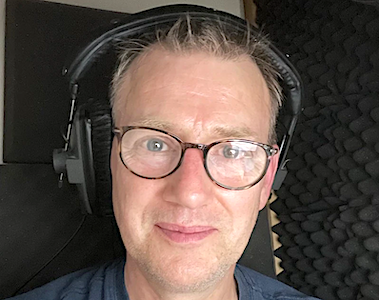
When audiences watch a film or television programme, their attention naturally settles upon the principal actors. Far less notice is taken of the countless background voices that transform a collection of images into a believable social world. Conversations drifting through a restaurant, murmured discussions in an office, distant arguments in a crowded street or the indistinct atmosphere of a busy marketplace all contribute to the impression that life continues beyond the central characters. Remove those voices, and even the most carefully photographed scene can feel strangely artificial. During his online guest lecture for Edinburgh Napier University, David Monteath returned to the University as a Sound Design alumnus to explore the specialised craft of crowd ADR. Drawing upon more than three decades working as an actor and voice artist, he demonstrated that believable crowd performances depend upon observation, improvisation and an understanding of dramatic context rather than simply recording large numbers of voices. One principle underpinned the discussion. Context is king.
Rather than replacing the dialogue of principal actors, crowd ADR creates the sense that an entire world exists beyond them. A small group of performers may become the customers in a restaurant, the spectators at a football match, the passengers waiting on a railway platform or the crowd gathered in a courtroom. Individual conversations overlap, reactions ripple through the group and emotional responses emerge at precisely the right moments, creating the impression that every person visible on screen possesses a life extending beyond the immediate story. Audiences rarely notice these performances consciously, yet they immediately recognise when they are missing. Scenes that lack convincing crowd performances often feel unexpectedly empty, regardless of how carefully they have been photographed or edited.
Monteath repeatedly challenged the assumption that this work consists simply of creating background noise. Crowd ADR is first and foremost a form of acting. Every performance responds to the circumstances of the scene, the relationships between characters and the emotional atmosphere established by the director. People waiting quietly in a hospital corridor behave differently from supporters leaving a football stadium. Conversations in an expensive restaurant differ from those heard in a busy café, while voices surrounding a royal procession carry a very different energy from those accompanying a political protest. Every reaction, interruption and fragment of conversation exists to support the dramatic reality of the scene rather than to attract attention in its own right. Authenticity emerges from understanding how people genuinely behave in different situations, not from making scenes louder or busier.
This emphasis upon dramatic context shaped every practical discussion throughout the lecture. Monteath encouraged students to think beyond individual words and instead consider the circumstances in which those words are spoken. Before deciding how loudly to speak, how quickly to react or even what might be said, performers first need to understand where they are, who surrounds them and what is happening within the story. The same phrase may require entirely different delivery depending upon whether it takes place in a library, an airport, a football ground or the middle of a battlefield. Successful crowd performers therefore begin by observing people. Everyday behaviour, casual conversations, shared laughter, hesitation, disagreement and excitement all provide material that can later be adapted naturally within the recording studio. The objective is not to invent behaviour, but to recognise and recreate it convincingly.
Perhaps the most revealing insight from this opening part of the lecture concerned the relationship between realism and audibility. Many beginning sound designers instinctively assume that important sounds should always be heard clearly. Monteath argued for almost the opposite approach. Successful crowd ADR often succeeds precisely when audiences remain largely unaware of it. Background voices should usually be felt rather than heard, contributing movement, texture and emotional energy without competing with the principal dialogue. Monteath returned repeatedly to the idea that audiences should sense the presence of a living world long before they consciously identify individual voices. Crowd ADR achieves its greatest success not when listeners admire the performance, but when they accept the world on screen without ever questioning how it came to life.
One of the most valuable themes running through the lecture concerned the difference between sounding natural and sounding believable. These ideas are not always identical. Performers working in crowd ADR rarely speak at the same level they would use in everyday conversation, yet exaggeration can become equally unconvincing. Monteath described the continual process of judging how voices should sit within the perspective of the scene. A performer passing close to the camera requires a different vocal presence from someone crossing the background several metres away, while conversations taking place outdoors demand a different energy from those occurring in confined interior spaces. Every decision depends upon dramatic perspective rather than fixed performance rules. Context, once again, determines everything. For sound designers, these distinctions become equally important during editing and mixing. A crowd recording that sounds entirely convincing in isolation may feel unexpectedly prominent once placed alongside production dialogue, Foley and ambience. Perspective therefore emerges through the relationship between every element of the soundtrack rather than through any individual recording considered on its own.
This attention to perspective extends beyond volume alone. Monteath discussed the subtle adjustments people make instinctively when speaking in different environments. Outside, voices naturally rise in level before settling into an appropriate projection as people unconsciously judge the surrounding space. He compared this process to a form of echolocation. Speakers continually test their surroundings, modifying projection almost instantly until their voice feels appropriate for the environment. Recording inside a studio removes many of the environmental cues that normally guide these unconscious adjustments, requiring performers to recreate them deliberately. The challenge is not simply to speak more loudly for an exterior scene, but to reproduce the natural behaviour that accompanies speaking outdoors. Audiences rarely analyse these details consciously, though they recognise immediately when they feel unconvincing. Successful crowd ADR therefore depends upon recreating patterns of human behaviour rather than merely increasing vocal intensity.
The physical demands of crowd ADR also proved far greater than many students had expected. Scenes involving panic, conflict or large-scale action often require sustained shouting over many hours, placing considerable strain on performers’ voices. Monteath reflected upon sessions in which actors had pushed themselves to the point of temporary vocal exhaustion, particularly when recording intense battle scenes. Curiously, he observed that shouting repeatedly inside a recording studio often proves more tiring than raising the voice naturally outdoors. In everyday life, people instinctively project according to their surroundings. Within the artificial environment of a studio, performers can find themselves holding unnecessary tension in the throat in ways that feel surprisingly unnatural. Maintaining vocal health therefore becomes an important professional skill alongside acting itself. It also reflects another aspect of professional sound design that audiences rarely consider. Recordings capable of conveying fear, excitement or urgency often depend upon performers sustaining physically demanding work throughout lengthy recording sessions while preserving consistency from one take to the next.
The discussion of large battle sequences illustrated another revealing aspect of the profession. Crowd performers may spend an entire day creating layers of screams, reactions and movement for scenes involving hundreds or even thousands of people, fully aware that much of their work will eventually disappear beneath music, sound effects and the principal action. Monteath recalled recording material for a major battle sequence in Game of Thrones, where hours of physically demanding vocal performances ultimately became almost imperceptible within the finished soundtrack. Rather than expressing disappointment, he presented this as an inevitable consequence of professional sound design. The objective was never for individual performances to stand out. Their purpose was to contribute energy, scale and credibility to the scene, even if audiences remained almost entirely unaware of their presence. The irony is that some of the hardest work in post-production often becomes the least conspicuous in the finished mix.
Monteath’s recurring phrase, “Context is king,” captures this philosophy particularly well. Every vocal decision derives from the dramatic situation rather than from the performer. Voices rise or fall according to the surrounding environment, emotional reactions emerge in response to the unfolding action and every fragment of conversation exists to reinforce the illusion that life extends beyond the principal characters. Successful crowd ADR is therefore measured not by how clearly individual voices are heard, but by how convincingly they allow audiences to believe in the world unfolding around them. Like many aspects of professional sound design, its greatest achievement lies in remaining almost invisible while making the fictional world feel entirely real.
The lecture concluded with a discussion that moved beyond recording techniques and towards the broader decisions that shape professional sound design. One student described the challenge of creating the atmosphere for a bank robbery scene. Adding more and more voices had seemed the obvious solution, yet the result quickly became cluttered and distracted from the drama. Monteath’s response illustrated once again why crowd ADR depends upon judgement rather than quantity. Real crowds rarely behave as a single, unified group. Even in moments of fear, surprise or excitement, different people react at different times and in different ways. Some remain silent, others whisper, a few call out, while many simply watch events unfold. Attempting to represent every visible person with an equally prominent vocal performance often produces a soundtrack that feels less realistic rather than more so. Believability emerges through carefully judged variation, allowing individual reactions to appear and disappear naturally instead of competing continuously for the listener’s attention.
This observation extends well beyond crowd ADR. Throughout post-production, sound designers continually decide what deserves the audience’s attention and what should remain part of the wider acoustic environment. A convincing soundtrack is not created through the accumulation of detail, but through the careful organisation of that detail into a coherent dramatic experience. Crowd performances occupy a role similar to ambience, Foley and environmental sound. They establish context, scale and emotional texture without constantly demanding attention. Their purpose is not to demonstrate how much work has been carried out, but to convince audiences that the world extending beyond the principal characters already exists. Like every other element of a soundtrack, their success depends upon supporting the story rather than competing with it.
Towards the end of the lecture, discussion turned to the growing influence of artificial intelligence within the voice industry. Monteath acknowledged that AI is already beginning to affect areas such as commercial voice-over, where some clients have started experimenting with synthetic voices. He regarded crowd ADR rather differently. While aspects of the work may eventually become automated, authentic crowd performance depends upon subtle variations that emerge naturally whenever people work together. Voices change over the course of a recording session as performers become tired. Emotional intensity shifts between takes. Individual personalities influence rhythm, timing and vocal colour in ways that are difficult to predict or reproduce consistently. These variations might appear inconvenient from a purely technical perspective, yet they contribute directly to the richness, unpredictability and authenticity that audiences instinctively recognise as human. Technology will continue to evolve, though observation, collaboration and performance remain at the heart of believable sound design.
For sound design students, perhaps the most valuable lesson lay in the way Monteath described his profession. Crowd ADR may appear to occupy the margins of post-production, hidden beneath dialogue, music and sound effects, yet it influences how audiences perceive almost every scene they watch. Every murmur in the background of a restaurant, every distant conversation in a station concourse and every carefully judged reaction during a moment of crisis contributes to the illusion that life continues beyond the frame. These performances do not simply fill silence. They create social spaces that feel inhabited, allowing viewers to concentrate on the story without questioning the reality of the world surrounding it.
Throughout the lecture, Monteath returned repeatedly to one deceptively simple principle: “Context is king.” Crowd ADR succeeds not through memorable performances or individually recognisable voices, but through creating the impression that every environment extends beyond the limits of the frame. Every carefully judged laugh, argument, whispered conversation and fleeting reaction reinforces a believable social world without distracting from the principal narrative. For sound designers, this represents a broader lesson that reaches far beyond dialogue replacement. Successful audio is rarely measured by how noticeable it becomes. More often, it is measured by how completely it allows audiences to believe in the world they are experiencing. Crowd ADR exemplifies that philosophy. It remains one of the least visible aspects of professional sound design, yet it is also one of the crafts that most quietly transforms moving images into convincing places inhabited by believable people.