Science fiction sound often risks becoming trapped inside its own history. Audiences become familiar with particular cinematic vocabularies so thoroughly that certain sounds gradually begin standing in for entire ideas. Futuristic interfaces shimmer with recognisable electronic textures, spacecraft doors release carefully sculpted hydraulic movements, while machines hum with tones inherited from decades of earlier films. Many of these sounds remain compelling, though repeated use can gradually create a strange effect. Instead of sounding like imagined futures, science fiction sometimes begins sounding primarily like other science fiction.
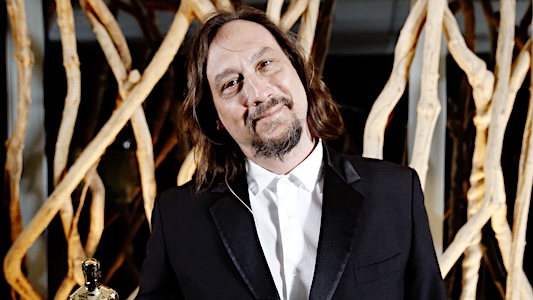
Nicolas Becker’s guest lecture explored a rather different approach to sound design. Across discussions of Foley, experimentation, recording techniques, embodiment, resonance, acoustics, and material behaviour, a common principle gradually surfaced. Convincing futuristic sound may depend less upon inventing unfamiliar noises than reconnecting audiences with physical experiences they already understand through memory, vibration, pressure, texture, and the body itself. One of Becker’s central arguments was that audiences do not believe science fiction worlds merely through novelty. Completely unfamiliar sound can quickly become emotionally abstract. Futuristic environments instead become convincing once they remain anchored to recognisable sensory experience. Pressure, resonance, vibration, friction, breath, and spatial instability all carry meanings audiences already understand physically, even within worlds they have never encountered before.
Becker described discovering Foley at the age of fifteen before immediately recognising that it brought together many different interests simultaneously. Cinema, movement, physical performance, listening, material experimentation, and interaction all converged within the practice. Yet one observation from early in the lecture became particularly revealing. He explained that he does not primarily create sound out of fascination with sound alone. What interests him more deeply involves the way sound transforms images.
A sound placed against an image does not merely accompany what audiences already see. Something else emerges through the relationship between them. Becker described this as creating a kind of “third image”, neither entirely visual nor entirely sonic. Foley therefore ceases to become simple illustration. Sound does not simply confirm that a door closed or that footsteps occurred. Instead, sound reshapes how physical movement, material presence, scale, emotion, weight, fragility, and tension are perceived altogether. The image viewers believe they are watching is partly constructed through listening.
This relationship becomes especially complicated within science fiction. Historical films already require reconstruction of worlds no longer accessible, though futuristic films involve constructing environments that have never existed at all. Such projects force sound designers into unusual territory. Audiences must believe experiences they have never directly encountered. A recurring theme throughout the lecture was that realism does not necessarily emerge through imitation of previous films. Instead, he suggested that audiences connect most strongly with sounds grounded in bodily memory and sensory experience. Sound becomes convincing once it resonates with sensations people already recognise, even if they cannot consciously identify why.
Discussion of Gravity formed one of the clearest examples of this philosophy. Space immediately creates a problem for sound design. Vacuum prevents conventional sound transmission, meaning many familiar cinematic approaches become difficult to justify physically. Rather than treating this limitation as an obstacle, Becker approached it as an opportunity to rethink how listening itself might function.
Traditional cinema frequently treats sound as external observation. Audiences hear worlds from an impossible perspective positioned outside events themselves. Becker’s approach repeatedly collapses this distance. Listening becomes embodied rather than observational. He began considering what astronauts would still perceive internally. A pressurised suit transmits vibration. Bodies conduct sound through tissue and bone. Contact with vibrating surfaces produces sensation physically before it becomes recognisable as hearing. Becker therefore started attaching hydrophones directly onto his own body while performing sounds physically through different materials and surfaces. His body effectively became an acoustic filter.
The resulting sounds possess a striking quality precisely because they feel simultaneously internal and mechanical. Vibrations seem to emerge from within the listener rather than arriving externally from a distant cinematic environment. Becker connected this partly to experiences such as immersion underwater or entering an anechoic chamber, where external sound becomes reduced enough that internal bodily activity suddenly becomes perceptible. Heartbeats, blood movement, breathing, pressure, and friction begin dominating perception once surrounding acoustic information disappears.
Much of Gravity therefore became less about designing conventional spacecraft sound and more about constructing a sensory relationship between bodies, pressure, vibration, and isolation. Rather than relying primarily upon inherited science fiction conventions, Becker searched for sounds grounded in experiences audiences already carry unconsciously within themselves. The objective was not reproducing what futuristic machines might literally sound like. Instead, the work repeatedly explored how bodies might experience impossible environments from within.
This emphasis upon embodiment extended throughout the lecture. Becker frequently described recording less as a technical procedure than as a physical interaction with material. He spoke about “digging” into sound through microphones, surfaces, and objects almost like an animal searching for prey. Recording becomes exploratory rather than merely documentary. Instead of searching for predefined results, he experiments with materials, microphones, resonances, distortions, and spaces until unfamiliar possibilities begin emerging.
Hydrophones, geophones, gyroscopes, seismic sensors, underwater acoustics, resonant structures, and sympathetic vibrations appeared throughout the lecture not as isolated technical curiosities but as expressions of a broader way of thinking about sound. Across these examples, Becker continually sought sound behaviours rooted in physical phenomena rather than cinematic shorthand.
Microphones themselves therefore stop functioning merely as neutral capture devices. Different recording systems become ways of translating material behaviour into perception. Certain microphones approximate human hearing more naturally, while others emphasise transient aggression, resonance, spatial instability, or harmonic complexity differently. Technical systems therefore shape how audiences physically inhabit cinematic space.
One particularly revealing example involved Becker’s rejection of familiar mechanical science fiction aesthetics built around gears, motors, and obvious physical contact. While developing robotic and futuristic sounds, he instead searched for systems involving minimal friction or direct interaction between moving parts. Gyroscopes, magnetic stabilisation systems, and no-contact mechanisms became especially attractive precisely because they produced movement without conventional mechanical aggression.
This pursuit of unfamiliar material behaviour also led Becker towards geophones originally designed for oil exploration. Such devices normally detect vibrations travelling through the earth itself. After modifying them into recording devices for creative use, Becker discovered that they produced unusual forms of mechanical distortion unlike conventional electronic processing. Explosions, impacts, and vibrations acquired strange physical textures that felt simultaneously abstract and believable.
What matters here is not novelty for its own sake. Throughout the lecture, he expressed dissatisfaction with science fiction sound becoming trapped inside references to earlier films. Once audiences unconsciously begin recognising cinematic conventions instead of connecting with physical sensation, realism weakens. He described this particularly clearly while discussing the enormous influence of Star Wars. Those films established an extraordinarily influential sonic vocabulary, though Becker noted that many later science fiction works gradually began imitating these established sounds rather than rediscovering material reality independently. Eventually futuristic worlds risk sounding less like futures than accumulated echoes of earlier cinema.
Projects such as Gravity, Arrival, and Ex Machina interested him partly because they attempted moving away from these inherited vocabularies towards something more physically grounded. Becker argued that the real world already contains astonishing sonic material if designers remain willing to search for it. Lakes, seismic activity, industrial systems, underwater acoustics, resonant structures, pressure systems, wind, and vibration all contain textures far stranger than many artificially synthesised science fiction effects.
Memory consequently became another major theme throughout the lecture. Becker repeatedly suggested that audiences respond most strongly once sound reconnects them with experiences they have already encountered physically, even if only indirectly. Rather than reminding viewers of earlier films, he aims to reconnect them with sensations stored within their own perceptual histories. Sound therefore stops functioning merely as representation. It begins activating remembered forms of bodily knowledge.
These ideas shape even seemingly small technical decisions. Becker discussed reconstructing recording conditions with extreme precision, carefully considering acoustic environments, microphone placement, reflections, surfaces, and physical obstacles. A person walking behind furniture should sound physically constrained by that furniture. A room should behave according to its dimensions and materials. Exterior movement requires different transient behaviour than interior movement. Ribbon microphones become useful outdoors partly due to their softer transient response and spatial characteristics. These decisions emerge from a broader commitment to sensory plausibility rather than abstraction.
Experimentation itself therefore occupies a central position within Becker’s practice. Constraints, unusual recording processes, collaborative exploration, and conceptual frameworks all become mechanisms for discovering unfamiliar sonic relationships. He repeatedly described projects less as standardised workflows than prototypes requiring entirely different approaches each time.
Such an approach has increasingly pushed his work beyond conventional Foley stages altogether. Rather than always recording inside controlled studio environments, Becker often seeks real locations whose acoustics already contain the physical characteristics required by the film. Castles, industrial structures, resonant chambers, unusual landscapes, and environmental spaces become active collaborators within the recording process itself.
Collaboration more generally emerged as another important dimension of his work. Becker repeatedly described involving musicians, engineers, scientists, architects, landscape designers, instrument builders, and conceptual artists within projects. Sound design becomes a form of interdisciplinary experimentation instead of isolated post-production labour. Conversations with geophysicists led towards seismic recording experiments. Underwater acoustic research informed approaches to resonance and transmission. Work with conceptual artists encouraged treating every project as a unique prototype requiring its own conceptual logic and constraints.
One of the more compelling aspects of the lecture involved Becker’s refusal to separate technical experimentation from artistic thinking. Microphones, recording formats, resonances, distortions, acoustic physics, and bodily sensation never appeared merely as engineering problems. Technical systems instead became methods for reshaping perception itself.
Curiosity emerged throughout the lecture as a driving force behind his practice. He described continual experimentation with new technologies, new collaborators, new recording situations, and unfamiliar physical systems. Yet beneath this openness sits a remarkably coherent underlying philosophy. Sound becomes meaningful once it reconnects audiences with material experience rather than cinematic habit.
Perhaps this explains why Becker’s science fiction work often feels unusually tactile. Machines appear heavy, spaces feel pressurised, vibrations seem physically present, while futuristic environments retain connections to recognisable sensory reality. Audiences may never consciously identify the specific recording techniques involved, though they respond to the bodily logic underneath them.
Science fiction frequently concerns imagined futures, impossible environments, and unfamiliar technologies. Becker’s lecture repeatedly suggested that convincing audiences of these worlds may depend less upon escaping physical reality than listening to it more carefully. The future begins feeling believable once sound reconnects viewers with the textures, pressures, resonances, and vibrations they already understand through lived experience.
Rather than constructing futures entirely from abstraction, Becker instead builds impossible worlds from sensations audiences have carried within themselves all along.