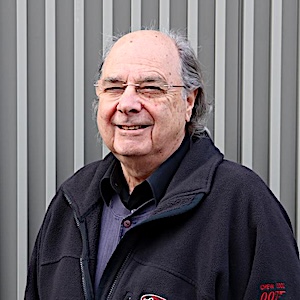
Graham Hartstone, a highly respected dubbing mixer and former head of post-production at Pinewood Studios, shared his expertise in an online guest lecture. Drawing on his extensive career in film sound, which spans decades and includes work on major productions, he offered a wealth of insights into the art and technical precision of rerecording sound for film.
The Evolution of Sound and Its Role in Storytelling
Hartstone’s career began in 1961 as a cable operator, progressing through various roles in sound before ultimately leading the dubbing team at Pinewood. His experience includes working on iconic films such as the James Bond series and collaborations with directors like Stanley Kubrick and Ridley Scott. He reflected on the shift from analogue mixing techniques to the expansive digital tools available today, discussing how technological advancements have changed the sound mixing process.
Throughout his career, Hartstone emphasised that sound must serve the narrative, with careful attention to dialogue clarity, atmospheric cohesion, and the interplay between sound effects and music. He discussed the importance of premixing, highlighting how dialogue, effects, and Foley must be balanced to create a seamless final mix. Foley, he stressed, should blend naturally rather than draw attention to itself. Using Aliens as an example, he described how even background movements were carefully crafted to maintain immersion without overwhelming the primary action.
Collaborations, Challenges, and International Versions
Hartstone shared experiences working with directors who had strong opinions on sound, such as James Cameron and Stanley Kubrick. Kubrick was known for personally directing foreign language dubs to maintain creative control, often insisting that his own team handle translations to ensure consistency across different languages. Hartstone recalled how Kubrick’s meticulous nature extended to every aspect of post-production, with dialogue edits often requiring multiple iterations to match the director’s high standards. Kubrick even insisted on making foreign dubs sound as close to the original English version as possible, ensuring that voice tone and performance retained the same impact.
James Cameron was similarly demanding, particularly about technical precision in sound. Hartstone shared an example from Aliens, where Cameron required the sound of motion trackers to be carefully crafted to enhance suspense. He recalled how Cameron would repeatedly review sound effects, adjusting subtle details to make sure they perfectly complemented the tension of each scene. This attention to detail extended to mixing explosions and gunfire, where Cameron wanted the audience to feel every impact without overwhelming the dialogue.
The challenges of working on large-scale productions also included meeting tight deadlines and working with evolving edits. Hartstone noted that in films like Blade Runner, changes were often made up to the last minute. He shared how the iconic ambient soundscape of Los Angeles in Blade Runner was built from unused Alien sound elements, giving the city a layered, futuristic atmosphere. He also recounted how Ridley Scott requested late-stage changes to music and sound effects after test screenings, requiring the mixing team to make quick adjustments to balance the soundtrack effectively.
For international versions, Hartstone explained that dialogue premixes had to be prepared well in advance of final mixes to allow time for translation and dubbing. On GoldenEye, special care was taken to ensure the foreign dubs matched the English version’s intensity, particularly during action sequences. His team provided detailed mixing notes, ensuring that foreign versions retained the same dynamic range and impact. He also explained the additional complexities of preparing mixes for different distribution formats, including airline and television edits, which required removing or replacing strong language while maintaining natural speech flow.
Practical Techniques for Mixing
Hartstone provided a wealth of practical advice for sound mixers, focusing on achieving clarity, balance, and impact.
Dialogue Mixing and Clarity
He advised using high-pass and low-pass filters to enhance dialogue clarity, suggesting a high-pass filter at around 80Hz to eliminate unwanted low-end rumble and a low-pass filter at around 9kHz to reduce sibilance. He explained that dialogue should be prioritised in the mix, ensuring that off-screen lines remain intelligible by adjusting levels and adding subtle reverb to match distance perception.
Hartstone also discussed the importance of perspective in dialogue mixing. He emphasised that the audio should match the framing of the shot—voices should not shift unnaturally in relation to the camera’s viewpoint. For example, close-up dialogue should be crisp and intimate, while wide shots should have a more open sound, reflecting the environment. When working with ADR (Automated Dialogue Replacement), he recommended blending it with the original production sound by matching room acoustics and microphone placement to avoid inconsistencies.
Balancing Sound Elements and Surround Mixing
Hartstone stressed the importance of dynamic balance between different sound elements. He warned against overusing compression, explaining that while it can help smooth out levels, excessive compression can make a mix sound unnatural. Instead, he recommended using automation and manual level adjustments to retain natural dynamics, especially for dialogue-driven scenes.
For surround mixing, Hartstone advised positioning ambient sounds carefully to avoid distracting the audience. Dialogue and primary sound effects should remain anchored in the front channels, while environmental sounds and subtle atmospheric elements should be spread across the surround channels. He suggested that surround effects should be used sparingly in dialogue-heavy scenes but can be more pronounced in action sequences to enhance immersion.
Layering Explosions and Action Sequences
Hartstone shared techniques for mixing action-heavy films, particularly regarding explosions and gunfire. He explained that layering sound elements helps create depth and realism. For an explosion, he suggested layering three key components: a bass-heavy thump for impact, a mid-range crack for texture, and high-end debris for detail. He recommended ensuring that these layers are carefully mixed so that the low end does not overpower dialogue and other important sounds.
He also discussed the importance of spatial placement for action scenes. For instance, gunfire should have directional placement in the mix to match the on-screen perspective. He recalled how, on James Bond films, the team carefully panned gunfire and bullet ricochets to follow the action, adding realism and depth to chase and fight sequences.
Checking Mixes Across Different Playback Systems
To ensure consistency, Hartstone recommended testing mixes on multiple playback systems, from large cinema screens to nearfield monitors. He suggested switching between full surround and stereo playback to detect phase issues or missing elements. He also noted that checking the mix at lower volumes can help identify problems with clarity, as important dialogue or sound effects may get lost when played at lower levels.
Additionally, he highlighted the importance of attending final screenings to verify the mix in the intended playback environment. He recalled how, during a Blade Runner premiere screening, last-minute mix adjustments were needed to correct sound balance issues, reinforcing the importance of checking the final product under real-world conditions.
Final Thoughts
Graham Hartstone’s lecture provided a detailed exploration of film sound design, offering valuable lessons for professionals and enthusiasts alike. His expertise underscored how vital a well-crafted soundtrack is in shaping the audience’s experience, blending technical precision with creative storytelling.