All posts by sukanlayasawang

Women in Enterprise 2025: What the Data Tells Us—and What Scotland Must Do Next

Scotland is experiencing a notable shift: more women than ever before are starting businesses, with women now representing 54% of all start-ups. Yet beneath this encouraging headline lies a challenging reality: women-led businesses are not surviving or scaling at the rates needed to strengthen Scotland’s economy.

The new Study of Women in Enterprise 2025, funded by the Scottish Government and published by Women’s Enterprise Scotland (WES), shows that despite high start-up activity, the entrepreneurial pipeline is leaking badly. The economic cost is substantial. If Scotland matched the United States’ proportion of established women-led businesses, it would add £17 billion annually to the economy.

CBISS is proud to have played a role—Professor Sukanlaya Sawang contributed to this research, bringing academic expertise in innovation, entrepreneurship, wellbeing, and women’s economic participation.

What is Women’s Enterprise Scotland (WES)?

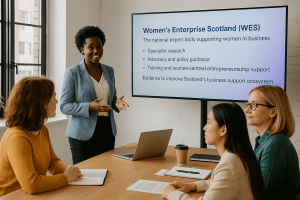
Women’s Enterprise Scotland (WES) is the national expert body dedicated to advancing women’s entrepreneurship across Scotland. It plays a pivotal role in shaping the business landscape by conducting specialist research, providing policy insight and advocacy, and offering training and tailored support designed specifically for women-led enterprises. Through its evidence-led approach, WES works to strengthen and reform Scotland’s business support ecosystem so that it better reflects the realities, needs, and ambitions of women in enterprise. The Study of Women in Enterprise 2025 is one of its most comprehensive and far-reaching assessments to date, offering a detailed picture of the conditions facing women-led businesses and the structural changes required to help them thrive.

Key Findings from the 2025 Study
1. Scotland Has a Start-up Boom—but a Sustainability Crisis

  • 54% of start-ups are women-led
  • Yet 61% drop out of the pipeline after start-up
  • Only 20% of employer businesses are women-led (a declining trend)

This mismatch reveals a structural issue: women can start businesses, but the ecosystem makes it difficult to stay in business.

2. Structural Inequalities Continue to Undermine Progress

  • Persistent barriers include:
  • Rising costs:
  • 78% could not recover increased business costs
  • 41% recovered none of the increases

Funding inequality: women start with 53% less capital and receive minimal equity investment

Discrimination is worsening:

  • 68% experienced discrimination in 2025 (double the 2016 figure)
  • Unpaid care continues to be a major constraint, affecting time, wellbeing, and business growth

Health impacts:

  • 74% report increased stress

Many start businesses because health conditions limit traditional employment options

3. Business Support Is Misaligned with Women’s Needs

The report shows a clear mismatch between what women expect and what they receive:

  • 58% say mainstream business support does not meet their needs

Only:

  • 17% received expected start-up support
  • 10% received help to establish their business
  • 19% received growth support

Digital and AI support is particularly limited—78% say digital investment would help, yet only 15% accessed such funding

Strong demand for women-centred support:

  • 71% would use women-specific services
  • 64% say a Women’s Business Centre would help

Why This Matters: The Economic Case

Women-led businesses contribute significantly to Scotland’s local and national economy. Yet their growth is restricted by:

  • Undercapitalisation
  • Lack of coordinated growth support
  • Insufficient digital and net zero support
  • Limited access to mentors, networks, and role models
  • Persistent bias and discrimination
  • Addressing these structural issues would unlock substantial economic, social, and community benefits.

Key Recommendations from the Report
1. Establish a National Network of Women’s Business Centres

  • Five centres across Scotland by 2028, including rural/island provision, offering:
  • Specialist women-centric advisers
  • Tailored growth programmes
  • Digital and hybrid support to widen access
  • This model mirrors successful approaches in the US and Canada.

2. Launch a Dedicated £20 Million Equity Fund for Women

A women-focused equity fund to support up to 50 businesses in the first two years and reduce the severe gender gap in investment.

3. Mandatory Gender-Disaggregated Data

All public funding and business support programmes should report:

  • Applications
  • Approvals
  • Outcomes

This transparency is essential for tracking progress.

4. Structured Mentorship and Role Model Programmes

  • Train and match mentors to 300 women-led firms
  • Support 100 women to act as visible role models each year
  • Ensure representation across age, race, disability, rurality, and sector

5. Address the “Missing Middle” of Growth-Stage Firms

  • Pilot programmes and grants for mid-stage businesses, including:
  • £500k in growth programmes
  • £2m in dedicated grants
  • Flexible loan repayment aligned to revenue cycles

6. Care, Wellbeing, and Pension Support

  • Childcare and eldercare subsidies for business owners
  • Retirement planning and auto-enrolment options for the self-employed
  • Wellbeing metrics embedded in all business support
  • Programmes to address burnout, stress, and sustainable growth

7. Digital, AI, and Net Zero Support

  • Targeted digital and AI literacy programmes
  • Improved access to digital and innovation funding
  • Increase net zero funding directed to women-led firms to 20% by 2027 and 50% by 2030

CBISS Reflection: Why This Matters for Scotland’s Future

At CBISS, we are committed to advancing inclusive innovation, sustainable enterprise, and a fairer economy. The findings of this report reinforce three truths:

  • Women’s entrepreneurship is a national economic priority, not a niche issue.
  • Long-term, women-centred support is essential for business survival and growth.
  • Better data, wellbeing support, and equitable funding can drive systemic change.

CBISS Recommendations for Policymakers and Industry

Based on the study’s findings and our ongoing work supporting inclusive enterprise, we recommend:

1. Treat Women’s Business Centres as essential economic infrastructure

  • Multi-year investment—not year-by-year funding—is vital.

2. Prioritise digital and AI readiness for women-led SMEs

  • Ensure support is accessible, relevant, and linked to future industry demands.

3. Integrate care and wellbeing into entrepreneurship support

  • A sustainable pipeline requires care-aware, health-aware policies.

4. Ensure accountability via transparent gender-disaggregated data

  • This is a foundational requirement for equitable economic growth.

Final Thought

Women are starting businesses in record numbers. They bring innovation, resilience, and community impact. But without structural change, too many will continue to drop out of the entrepreneurial pipeline.

The Study of Women in Enterprise 2025 gives Scotland a clear roadmap.
CBISS stands ready to support its implementation and to help build a thriving, inclusive, and sustainable entrepreneurial ecosystem—one where women not only start businesses, but stay, grow, and lead.

Can Workplaces Become a Lifeline? New Research Shows Untapped Potential for Social Support in Construction Industries

A study published in the Journal of Construction Engineering and Management, by Centre for Business Innovations & Sustainable Solutions (CBISS) Director, Professor Sukanlaya Sawang and her colleagues at Queensland University of Technology, Australia (Dr Rebecca Langdon, Professor Lisa Bradley, Professor Cameron Newton),  explores the role of social capital and social support in the mental health of infrastructure workers. The research highlights a crucial opportunity for infrastructure organisations to play a more active role in supporting distressed workers. Infrastructure sectors such as construction, mining, and energy experience disproportionately high levels of psychological distress and suicide risk. The paper reports alarming figures: close to 30% of workers surveyed fell into the severe psychological distress category, and suicide rates in infrastructure remain significantly higher than national averages.

What the Research Found

The study’s key insight is both surprising and deeply concerning:

Distressed workers actually reported having more social connections than non-distressed workers – yet they were receiving less meaningful support when they needed it.

In other words, having lots of contacts (social capital) does not guarantee access to real support. Many workers with high distress are not leveraging their networks to get emotional, practical, or informational help.

One finding particularly relevant to employers is that some distressed workers were more likely to turn to work colleagues than to partners or family members for support, especially for emotional or companionship needs. This opens a significant window for organisational intervention.

Why This Matters

The research reinforces that traditional approaches focusing only on individual coping skills or resilience training are insufficient. Prior studies have already shown that isolated resilience programmes do little to shift mental health outcomes in construction workers.

Instead, the authors argue for a multi-level intervention strategy that includes:

  • workplace-level environmental changes,

  • individual-level support, and

  • access to treatment pathways.

This paper contributes to the second layer—building support through peer relationships.

Reflection

This research challenges common assumptions that “people just need to reach out more” or “bigger networks equals better support.” The evidence suggests that many distressed workers feel unable—or unwilling—to draw support from those closest to them, possibly due to:

  • fear of burdening family,

  • lack of emotional communication skills,

  • stigma around vulnerability,

  • long working hours and time spent away from home.

Workplaces where workers spend most of their time may therefore be one of the most viable environments to intervene. The construction site, depot, workshop, or engineering office could become a protective space rather than a risk environment.

What Can Industry Do? Practical Recommendations

Based on the evidence presented, there are several actionable steps organisations can take:

1. Invest in peer-support capability

Training programmes such as mental health first aid, connector training, or peer-listener models can equip workers with skills in empathy, active listening, and identifying risk. This doesn’t replace therapists—it opens the door to them.

2. Build structured social connection opportunities

Simple practices such as planned team check-ins, buddy systems, and safe spaces for discussion can break down barriers that stigma reinforces.

3. Recognise the role of supervisors

Supervisors and managers should be supported to develop psychologically safe communication skills—not just technical leadership.

4. Consider flexible policies supporting work-life balance

Many workers struggle because they are physically and emotionally distant from family support networks. Adjusting rostering and remote work patterns where possible may improve coping capacity.

5. Monitor outcomes, not participation

Tick-box wellbeing initiatives without cultural change risk worsening stigma. Evidence-based evaluation is key.

Looking Ahead

Industrial environments pride themselves on safety. Yet mental health safety is often treated differently from physical safety. This research makes clear that if workplaces develop stronger support mechanisms through colleague relationships, they could significantly reduce distress and ultimately save lives.

At CBISS, we believe this work offers an opportunity to rethink how organisational cultures nurture belonging, connection, and humanity—particularly in high-risk sectors. Social capital already exists in abundance. Now we need to ensure it is activated and accessible.

When ‘Flexibility’ Stops Feeling Like a Choice: Reflections on Greece’s 13-Hour Workday Debate

AI Generated Picture

A new law in Greece now allows private-sector employees to work up to 13 hours a day, promoted as a modern model of flexibility and economic growth. In a recent article, Dr , our CBISS Theme Lead for Business Innovation and Future Workforce, discusses how this reform risks dismantling the long-established eight-hour working day and highlights the broader implications for labour rights and wellbeing across Europe.

Although presented as voluntary and fairly compensated, the change threatens to normalise extreme working conditions. Greece already records the highest working hours in Europe — around 1,900 hours per year, significantly more than in the UK or Germany — yet wages and productivity remain low. Instead of addressing stagnant pay and weak bargaining power, the policy effectively stretches time rather than income, placing additional pressure on workers.

Survey findings show overwhelming resistance: 94% of workers support shorter working hours without pay cuts, and 60% oppose the 13-hour day outright, with many pointing out that “voluntary” becomes meaningless under economic hardship.

This trend extends beyond Greece. Rising unpaid overtime in healthcare, intense logistics and warehouse schedules, and calls from parts of the tech sector for 60-hour workweeks reflect a wider shift: the slow and quiet normalisation of overwork in the name of flexibility and productivity.

The key question becomes:
What kind of future of work do we want to build?
A future built on exhaustion — or a future rooted in dignity, wellbeing and meaningful time?

CBISS: Building a Different Vision of Work

At the Centre for Business Innovation & Sustainable Solutions (CBISS) at Edinburgh Napier University, research focuses on shaping fair, ethical and sustainable work futures. CBISS works with partners across sectors to:

  • rethink work and productivity beyond long-hours models

  • explore responsible innovation and AI-enabled workforce transformation

  • strengthen fair work, equity and wellbeing across communities

  • turn evidence into practical frameworks and policies

The Greek case is a timely reminder of why these conversations matter — and why research, dialogue and public engagement are essential.

For readers interested in the full analysis of the legal, social and economic implications, the complete article can be read here.

CBISS Research Forum-Facilitation and Ethics in Digital Products

CBISS warmly invites you to join our CBISS Research Forum
🗓 Wednesday 26 November
⏰ 13:00 – 14:00
📌 CRL 1/07
 
 
“Facilitation and Ethics in Digital Products”
At the Centre for Business Innovation & Sustainable Solutions (CBISS), we champion responsible, human-centred innovation. As digital products increasingly shape behaviour and influence decisions, the question of how we design ethically has never been more critical.
We are delighted to host a research forum session exploring:
How do we remain ethical when designing digital products people want to use?
How do we balance behavioural insight with respect for users’ autonomy?
In a world coloured by fact-resistant social media and rising digital manipulation and scams, ethical and transparent digital design is essential. We must facilitate meaningful conversations to ensure we are building products that truly serve both users and organisations.
This talk will introduce the Digital Ethics Compass, developed by the Danish Design Center, offering a practical framework for navigating ethical dilemmas throughout product development.
Speaker
Anne Cathrine Wind Fallesen – Copenhagen School of Design and Technology (Københavns Erhvervsakademi)
Anne  brings broad experience across organisations including IBMSystematicBonnier Publications, and the Danish Agency for IT & Learning, where she has led agile transformation, product development, and team motivation. She is also the author of “Developers Are Also Humans”.
Why Attend
  • Learn practical strategies to embed ethics into digital design
  • Strengthen facilitation practices across product and research teams
  • Connect with colleagues in an open and collaborative research forum

CBISS Research Forum: The Future of Work: Strategies, Contradictions, and Innovation

The Future of Work: Strategies, Contradictions, and Innovation
📅 Date & Time: Wednesday 19th November 14.00-16.00
📍 Location: CRL_2/05 Craiglockhart Campus
Event Overview
What will the future of work look like in the face of accelerating technological change, shifting institutions, and workers’ struggles to shape their organisations? This forum brings together leading international scholars to explore how labour, markets, and innovation collide—creating both contradictions and opportunities.
Across two thought-provoking talks, we will explore:
  • How workers’ collective strategies challenge and reshape organisations under pressure from capital and institutions.
  • How long cycles of economic change, from steam power to artificial intelligence, have redefined labour and the structures of capitalism.
Together, these perspectives offer a fresh lens on the contested strategies and transformative forces that will shape the next stage of work and innovation.
The CBISS Research Forum is part of our mission to engage world-leading researchers here in Edinburgh, creating a space for dialogue, knowledge exchange, and cross-border collaboration. By connecting diverse perspectives, CBISS aims to spark innovative ideas and long-term research partnerships that address pressing global challenges.
Speakers
Jon Las Heras
Senior Lecturer, University of the Basque Country
PhD, University of Manchester | Research in Critical Management Studies, Labour Sociology, Industrial Relations
Talk: A Future Without Conflict? Labour’s Strategies and the Contradictions of Work
Jon will examine how labour movements—from cooperatives to trade unions—struggle to democratise production and representation while navigating the relentless discipline of markets and institutions. Drawing on his latest research, he argues that contradictions are not dysfunctions but the very terrain where workers forge strategies, test power, and reshape organisations.
Nikolaos Chatzarakis
Assistant Professor of Economics, The New School for Social Research (New York) & Trinity College Dublin
PhD in Political Economy, Aristotle University of Thessaloniki | Author of Economic Growth and Long Cycles: A Classical Political Economy Approach (Routledge, 2024)
Talk: A M-K-S Analysis of the Future of Work and Technology
Nikolaos takes the long view, tracing how innovations—from the steam engine to AI and 3-D printing—have repeatedly reshaped labour productivity and economic institutions. Using a Marx-Keynes-Schumpeter framework, he models the cycles of capitalism and asks: What might the next phase of development look like? What institutions and labour relations will define it?
Why Attend?
  • Engage with leading voices on labour, innovation, and economic transformation.
  • Gain insights into how contradictions, crises, and creativity shape the evolving world of work.
  • Explore what the next era of capitalism might mean for organisations, workers, and societies.
  • Join CBISS in building an international research community that drives collaboration, innovation, and impact.

CBISS Research Forum: Minority Entrepreneurship & Social Change

CBISS partnered with Institute for Small Business and Entrepreneurship (ISBE)–European Council for Small Business and Entrepreneurship (ECSB) Collaborative Workshop on Minority Entrepreneurship & Social Change
10 October 2025 | 10:00–16:00 (GMT) | Edinburgh Napier University, Sighthill (2D 04)
Lunch included
How do minority entrepreneurs drive real social change—for better and sometimes for worse? Join us for a dynamic, interdisciplinary workshop co-hosted by the Institute for Small Business and Entrepreneurship (Entrepreneurship in Minority Groups) and the European Council for Small Business and Entrepreneurship (Social Change Group).
What’s inside:
⚡ Lightning talks with Professor Sukanlaya Sawang, Professor Natalia Vershinina, Dr Sophie Alkhaled, and Dr Deema Refai
💬 World Café discussions on challenges, frameworks, and methods
🚀 Collaborative sprint to shape new research ideas with impact
🤝 Networking to spark partnerships and funding opportunities
🧭 Reflections & next steps (including potential special issues)
Who should attend?
 Researchers exploring entrepreneurship through gender, ethnicity, religion, race, disability, refugee and other marginalised lenses—and anyone interested in how entrepreneurship transforms economies, communities, and institutions.

The 5th CBISS Business Leadership Forum: Making the Circular Economy Work – Bridging Policy, Business and Technology

We are excited to invite you to our upcoming forum:
“Making the Circular Economy Work – Bridging Policy, Business and Technology”
📅 Date & Time: Wednesday 8th October 2025, 13:00–16:00
📍 Location: Edinburgh Napier University, Craiglockhart Campus (Room CLR 2/07)
Hosted by the Centre for Business Innovation and Sustainable Solutions (CBISS) in partnership with Edinburgh B Corp, this event brings together leaders from Scottish Government, pioneering businesses, and digital innovators to explore practical pathways to a circular economy. Expect lively discussion, real-world case studies, and networking with a community committed to building a sustainable future.
Programme Highlights:
🔹 Welcome and Opening Remarks – Associate Professor Miles Weaver, CBISS Theme Lead
🔹 Scotland’s Policy Roadmap for a Circular Economy – Maurice Golden MSP
🔹 Embedding Sustainability in Everyday Products – Eilidh O’Connor, Vegware
🔹 How Digital Tools Can Support Circular Business – Barry O’Kane, HappyPorch
🔹 Leveraging B Corp Certification for a Circular Scotland – Jayne Saywell, Black Skies Blue / Edinburgh B Corp 500
🔹 Panel Discussion (Policy, Business & Technology) – Practical insights on how to overcome barriers and scale solutions
🔹 Networking Session – Connect with fellow leaders and innovators
💡 Why attend?
  • Gain insider perspectives on Scotland’s policy direction
  • Hear from businesses successfully embedding circularity into their models
  • Explore how digital tools and certifications like B Corp can drive real change
  • Build your network across policy, academia, and industry
👉 Places are limited – join us to be part of the conversation shaping Scotland’s sustainable future.

The 4th CBISS Business Leadership Forum: Shaping Scotland’s Circular Economy

Hosted at Edinburgh Napier University’s Centre for Business Innovations and Sustainable Solutions (CBISS), and led by our Circular Economy, Sustainable Consumption and Supply Chains theme lead, Professor Eoin Plant-O’Toole PhD , this focused and practical session will explore how Scotland can take the lead in driving a sustainable, circular future.
Over two hours, you’ll hear from leading voices, including:
 ✅ Leah Gallacher – The Scottish Government Circular Economy Division, setting the broader Scottish CE context
 ✅ Sophie Rippinger – Freelance Circular Economy Advisor & Dr Alex Speakman – NHS Lothian, sharing practical applications of the Earth Centred Business Design Framework with EVA Biosystems
 ✅ Colin Brown – Sustainability Connects, on embedding sustainability in practice
You’ll gain:
 🌱 Insights into Scotland’s circular economy strategy
 🌱 Practical tools and frameworks like Earth Centred Business Design
 🌱 Real-world examples you can apply in your own organisation
The event will close with a networking session – your chance to connect with professionals, policymakers, and innovators who are committed to creating a sustainable future for Scotland.
📅 Date: 16th September
 📍 Venue: Craiglockhart Campus, Edinburgh Napier University (Room 3/09)
 ⏰ Time: 10:00 – 12:00
✨ Whether you’re a business leader, policymaker, academic, or student – this is your opportunity to gain practical tools, fresh perspectives, and valuable connections.
👉 Secure your spot and be part of the conversation on how Scotland can accelerate its transition to a sustainable, circular economy.

The 3rd CBISS Leadership Forum: Responsible AI Symposium

This symposium brings together key voices from both the public and private sectors, with keynote speakers from local Scottish agencies such as The Scottish AI Alliance and FinTech Scotland,JP Morgans, alongside international experts from Japan, where AI technology is at the forefront of national innovation strategies.
The event will also showcase some of the latest research and technological developments from Edinburgh Napier University and our partners, offering practical insights for SMEs seeking to adopt AI for business growth. We hope the symposium will also spark new research collaborations and industry partnerships.
Provisional Keynote Topics Include:
  • Why trust, ethics and inclusion matters?
  • From Regulation to Innovation: Shaping Ethical AI for Financial Inclusion
  • Conscious AI – Mission (Im)Possible?
  • Trustworthy AI in Multimodal Systems: Bridging Cognitive Data and Practice
Please note: keynote topics are tentative and may be subject to change.
The programme includes panel discussions and plenty of time for networking and idea exchange, with a shared commitment to advancing responsible AI in practice.
This event is funded by UKRI and the British Council, and delivered in partnership between Musashino University (Japan) and Edinburgh Napier University the Business School and Centre for Business Innovations and Sustainable Soultions (CBISS).
We look forward to welcoming you!
Note: Cancellation Policy
If you are no longer able to attend the symposium, please let us know as soon as possible so we can offer your place to someone on the waiting list. We kindly ask that cancellations be made at least 2 days in advance, where possible.
Thank you for your understanding and cooperation.
Please RSVP for catering purpose (lunch and breaks are included)
📅 Tuesday, 9th September 2025; 9.00-14.00
📍 Rivers Suite Craiglockhart Campus, Edinburgh Napier University

Shaping Resilient Futures: How Data on Good Work Can Guide Policy

At CBISS, we are proud to celebrate the recent contributions of our member and them lead Eleni Papagiannaki to the Good Work Monitor Time Series – an ambitious and impactful project led by the Institute for the Future of Work (IFOW). This work sits at the intersection of policy, data, and human-centred innovation, offering vital insights into how good work—and access to it—shapes social and economic resilience across the UK.

Why Good Work Matters More Than Ever

Access to good work is not just about employment. It’s about dignity, fair pay, supportive conditions, personal autonomy, and opportunities for growth. As Eleni and the IFOW team highlight, good work offers a vital buffer against social, health, and economic shocks—and equips communities to adapt to disruptive forces like AI and automation.

While UK employment levels remain relatively steady according to the latest ONS data, the quality of work varies significantly across the country. Through longitudinal analysis from 2009 to 2024, the Good Work Monitor paints a clear picture: geographic inequalities are widening, and the polarising effects of the Covid-19 pandemic and technological change risk becoming entrenched.

Key Insights from the Monitor

Eleni’s work on this project has helped bring attention to some crucial findings:

  • Regional Disparities Persist: Areas like London continue to show high professional job concentration and median pay—but also signs of work intensification and poor work-life balance. In contrast, Scotland appears to offer a more balanced picture, with weaker links between pay and unsatisfactory hours.

  • Technology’s Uneven Impact: Rather than bridging gaps, accelerated tech adoption may have worsened regional inequalities, benefiting already high-performing areas and leaving others behind. This raises questions about how AI and automation can be harnessed to create—not destroy—equitable opportunities.

  • Pay and Productivity Challenges: Real wages remain low across many regions when adjusted for cost of living. At the same time, productivity growth is highly concentrated in the South East, raising concerns about unequal innovation spillovers from the so-called “golden triangle”.

From Data to Action: Policy Recommendations

What sets this work apart is not just the diagnosis of the problem, but the practical pathways it suggests:

  • Better Metrics for Better Policy: The Good Work Monitor and the Disruption Index should form the foundation of a more consistent, evidence-based approach to good work, productivity, and technological change—across all UK nations and regions.

  • Place-Based Investment Strategies: Funding for skills and jobs must be targeted where they are most needed, and local authorities should be empowered with better data to design tailored responses.

  • Recentring Growth on Human Capabilities: Rather than focusing solely on technological capability, the Industrial Strategy should place greater emphasis on human values, agency, and job quality—ensuring that innovation and inclusivity go hand-in-hand.

  • Learning from Scotland and Beyond: The strong performance of Scotland in the Monitor offers lessons for how joined-up policy approaches can create more resilient regional economies. In contrast, policy in England and Wales should work towards more coherent skills and capabilities frameworks that prioritise long-term access to good work.

CBISS and the Future of Work

At CBISS, we believe in research that informs real-world change. Eleni’s work exemplifies our mission—connecting data, policy, and innovation to address urgent societal challenges. Her contribution to the Good Work Monitor supports a broader vision: one where future work is shaped by fairness, sustainability, and the active inclusion of all communities in technological progress.

We look forward to continuing this conversation—and to working with researchers, policymakers, and communities to shape a future of work that leaves no one behind.


Explore the Interactive Good Work Monitor: access here