
Monthly Archives: February 2026

The Hidden Cost of Constant Pivots

Founders love the word pivot.

It signals agility. Adaptability. Strategic intelligence. In startup culture, changing your business model isn’t a red flag — it’s often a badge of honor.

But what if frequent reinvention is quietly slowing your growth?

A research by CBISS member Professor Sukanlaya Sawang and her colleagues suggests exactly that. In a three-year longitudinal study tracking nearly 600 young firms, they examined how business model renewal affects performance over time — and how a founder’s mindset shapes the outcome.

Their findings complicate one of entrepreneurship’s most celebrated narratives: while high-performing firms do tend to change more, repeated business model renewal can actually decelerate growth.

In other words, adaptation helps — until it doesn’t.

The Paradox of Renewal

At first glance, the data confirms what we expect. Companies that perform well early on are more likely to tweak and refine their business models. Success creates confidence. Momentum fuels experimentation.

But over time, a different pattern emerges.

Firms that repeatedly altered their business models experienced slower growth trajectories — both in perceived performance and in actual profit growth.

Why would that happen?

Because change is expensive. Not just financially, but cognitively and organizationally.

Every meaningful shift resets execution. Teams realign. Resources move. Customers adjust. Learning curves restart. Strategic focus diffuses. Even well-intentioned change can interrupt the compounding effect of steady execution.

The issue isn’t renewal itself. It’s recurrence.

As Sawang and her co-authors show, more change does not automatically mean faster growth.

The Psychological Variable No One Talks About

What makes this research especially compelling is its psychological lens.

Drawing on regulatory focus theory, the study distinguishes between two types of entrepreneurial mindsets:

  • Promotion-focused founders, driven by growth, gains, and opportunity.

  • Prevention-focused founders, driven by security, risk management, and loss avoidance.

Both groups engage in business model renewal. But the consequences differ.

The Promotion Trap

Promotion-oriented founders see stronger initial boosts from change. They move boldly, pursue opportunity, and aim high.

Yet over time, their growth rates slow more sharply.

Why?

Because bold change requires bold investment. Radical shifts demand capital, attention, and time. And promotion-focused leaders tend to set ambitious performance expectations — sometimes so ambitious that incremental gains feel disappointing.

The result: high effort, high ambition, slower perceived momentum.

Ironically, the very mindset associated with entrepreneurship — opportunity-seeking and risk-taking — may amplify the growth slowdown that follows repeated renewal.

The Prevention Buffer

Prevention-focused founders, by contrast, make more incremental changes. Their expectations are measured. Their adjustments are cautious.

They don’t see dramatic early spikes in performance. But they also avoid the steep slowdowns.

Their mindset appears to buffer them against overextension. By prioritizing stability and minimizing downside risk, they preserve execution continuity.

Rethinking the “Always Pivot” Narrative

Startup culture celebrates motion. Investors praise adaptability. Accelerators preach iteration.

But Sawang and her colleagues’ research invites a more nuanced view.

Yes, renewal can drive improvement. But too many shifts can interrupt compounding growth.

The most effective founders may not be the ones who pivot the most. They may be the ones who understand when to stabilize — and allow execution to mature.

A Better Set of Questions

Instead of asking, “Should we pivot?” leaders might ask:

  • Are we solving a genuine strategic constraint — or reacting to impatience?

  • Is this renewal building on momentum or resetting it?

  • Are our expectations distorting how we interpret progress?

  • Is our mindset driving disciplined adaptation — or restless reinvention?

Adaptability remains critical. Markets evolve. Technology shifts. Customers change.

But disciplined adaptation — anchored in psychological self-awareness — may outperform constant reinvention.

The takeaway is clear:

Growth is not just a function of strategy.

It is also a function of mindset.

And sometimes, the greatest threat to performance isn’t standing still.

It’s moving too often.

Access a full text article here
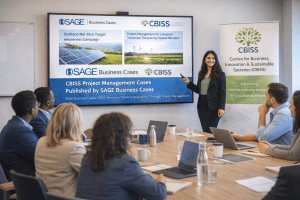
Driving Net Zero Through Project Management

We are proud to share that two project management business cases authored by CBISS members have been published by SAGE Publications as part of the internationally recognised SAGE Business Cases collection.

These cases go beyond documenting student projects — they demonstrate how structured project management can drive meaningful sustainability outcomes in real-world settings.

We are especially pleased to recognise Aartee Geshwaree Huzooree and Melina Doargajudhur, CBISS members and co-authors of these publications, whose work reflects the Centre’s commitment to impactful, practice-oriented research and responsible management education.

Why This Matters Beyond Academia

Although developed for teaching purposes, these cases are highly relevant to industry, public sector organisations, and sustainability leaders.

Both cases focus on sustainability initiatives aligned with Scotland’s Net Zero ambitions and explore:

  • Stakeholder engagement across multiple interest groups

  • Budget constraints and risk management

  • Communication strategy and awareness-building

  • Planning and execution under time pressure

  • Measuring impact and evaluating project outcomes

These are not abstract theoretical discussions. They mirror the real challenges organisations face when navigating ESG targets, climate commitments, governance pressures, and organisational change.

For industry leaders and project professionals, these cases offer:

  • Insight into how emerging professionals approach sustainability challenges

  • Practical examples of applying project management frameworks to environmental initiatives

  • Lessons in cross-functional collaboration and stakeholder alignment

  • A clear reminder that successful sustainability transformation requires structured delivery — not just ambition

In many organisations, sustainability goals falter not because of lack of intent, but because of weak execution frameworks. These cases illustrate how disciplined project governance, risk management, and stakeholder coordination can bridge the gap between strategic commitment and measurable impact.

The Prestige of SAGE Business Cases

Publication within SAGE Publications signals academic rigour, global visibility, and strong pedagogical value. SAGE Business Cases are widely adopted by universities and business schools internationally, providing classroom-ready materials grounded in real-world complexity.

By featuring within this collection, these cases will support teaching, executive education, and professional development across global institutions.

This milestone strengthens CBISS’s international research footprint and reinforces our contribution to responsible management education and sustainability leadership.

What These Cases Tell Us About the Future of Project Management

At CBISS, we see these publications as part of a broader conversation about the evolving role of project management in society.

Three key reflections emerge:

1. Sustainability is now a core project competency.
Project managers increasingly operate in environments shaped by ESG reporting, carbon reduction targets, regulatory scrutiny, and stakeholder accountability.

2. Experiential learning builds industry-ready capability.
Real-world sustainability challenges provide deeper learning than purely theoretical instruction, strengthening analytical, leadership, and problem-solving skills.

3. Collaboration drives transformation.
Whether in universities or corporations, sustainability outcomes depend on coordinated action across diverse stakeholders, departments, and external partners.

For organisations, these cases can serve as valuable discussion tools for leadership development programmes, sustainability workshops, PMO reflection sessions, and strategy alignment exercises. They provide structured scenarios that encourage teams to critically examine execution risks, governance mechanisms, communication strategies, and impact measurement approaches.

From Research to Real-World Impact

These publications reinforce CBISS’s role as a hub for research at the intersection of:

  • Business

  • Innovation

  • Sustainability

  • Project leadership

We invite industry partners, practitioners, and researchers to connect with CBISS, explore collaboration opportunities, and engage with our growing portfolio of sustainability-focused scholarship.

By bridging academic insight and practical delivery, we continue working toward more sustainable societies — not only through ideas, but through structured, accountable action.

Business case: Scotland Net Zero Target Awareness Campaign

Business case: Project Management for a Greener Tomorrow: The Journey Toward Net Zero

CBISS Research in Action: New Sage Business Case

Centre for Business Innovations and Sustainable Solutions (CBISS)  is delighted to highlight a significant research achievement by CBISS member, Mahinda Yapa Mudiyanselage and Onoh Nkiruka Patricia whose latest work has been published in Sage Business Cases—a globally respected platform used by universities and business schools worldwide.

The case, The Edinburgh Tram Megaproject: Challenges of Delivering Sustainable Urban Infrastructure, examines one of the UK’s most high-profile infrastructure projects and offers rich insights into the real-world challenges of delivering sustainability in complex, large-scale developments.

About the Case

The Edinburgh Tram Project was launched as a flagship sustainable transport initiative, intended to reduce car dependency, lower emissions, and support long-term urban development. However, despite these ambitions, the project experienced substantial delays, cost overruns, and governance challenges before eventually becoming operational.

This case takes students and practitioners inside those challenges. Rather than focusing only on financial performance, it explores how project delays affected the three pillars of sustainability:

  • Environmental – increased congestion, emissions, and pollution during prolonged construction

  • Social – disruption to daily life, reduced transport access, impacts on health and local businesses

  • Economic and governance – cost escalation, public trust, accountability, and reputational damage

By doing so, the case moves beyond traditional project management narratives and reframes “delay” as a sustainability issue, not just a scheduling or budgeting problem.

Why This Case Matters

What makes this Sage Business Case particularly impactful is its emphasis on governance, risk management, and stakeholder engagement in megaprojects. Drawing on empirical evidence and professional perspectives, the case highlights how weaknesses in decision-making structures, communication, and risk identification can magnify social and environmental harm—even in projects designed to be sustainable.

For students, the case develops critical skills in:

  • evaluating trade-offs between cost, time, and sustainability,

  • analysing infrastructure projects through an ESG lens,

  • understanding how public trust and legitimacy are shaped by project outcomes.

For practitioners and policymakers, it offers timely lessons on how large infrastructure investments can better align ambition with delivery.

The CBISS Contribution

This publication reflects CBISS’s commitment to applied, interdisciplinary research that speaks directly to real-world challenges. By contributing to Sage Business Cases, Mahinda Yapa Mudiyanselage has helped ensure that CBISS research reaches classrooms, executives, planners, and future decision-makers across the globe.

It also reinforces CBISS’s role in advancing scholarship that connects:

  • infrastructure and sustainability,

  • management and governance,

  • policy, practice, and societal impact.