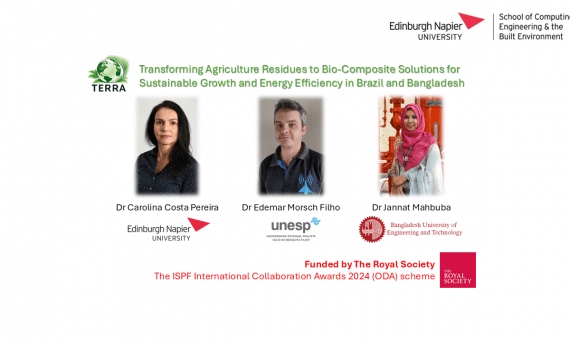
Transforming Agriculture Residues to Bio-Composite Solutions for Sustainable Growth and Energy Efficiency in Brazil and Bangladesh

Many countries, like Brazil and Bangladesh, struggle with inefficient energy use and limited access to clean energy sources (Bangladesh) leading to high electricity bills, unreliable power grids, and unhealthy cooking practices. Brazil and Bangladesh hold significant potential for solar technologies to tackle their energy challenges and Agriculture plays a key role in both economies, generating significant waste. TERRA project proposes to transform agriculture waste into Shape-Stabilized Phase Change Materials(SSPCMs). The SSPCMs could be explained as a thermal battery, that absorbs and stores excess heat, like sunlight or waste heat, and then releases it later for various uses: hot water, cooler buildings, or even cleaner cooking solutions.
Read More

Sustainable Evaluation of Latent Heat Thermal Energy Storage Materials in Domestic Applications"

This project will evaluate and compare the environmental impact and real sustainability of some of the most technically promising PCMs integrated into a hot water tank for domestic LHTES application. The results of this research will increase the understanding of the environmental impact of the “nano-enhanced” PCMs materials to support decision-making and policymaking in the transition to a circular economy.

Read More

Accelerating the discovery and characterisation of new energy storage materials

This multidisciplinary project aims to accelerate the discovery and development of innovative and sustainable multi-component and heterogeneous materials. It necessitates a collaborative approach utilising complementary expertise. The project's primary focus is advancing fundamental knowledge through the characterization of these materials.

Read More

Celebrating our collaboration!

Over the past month, we have been working intensively on TERRA – “Transforming Agriculture Residues to Bio-Composite Solutions for Sustainable Growth and Energy Efficiency in Brazil and Bangladesh”. This exciting project, funded by the ISPF – International Collaboration Awards 2024 (Brazil and South Africa) and supported by the Royal Society, brings together a dynamic international team:

Read More