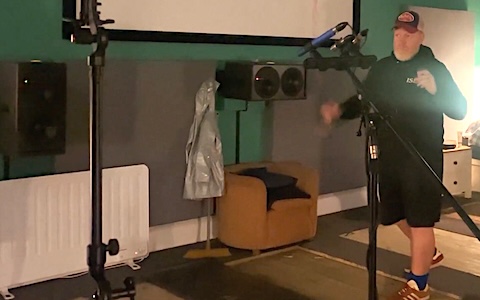
How do you perform a world through sound?
A character crosses a room, adjusts a coat, places a glass on a table and sits down. Nothing about the sequence appears extraordinary, yet its soundtrack may contain dozens of carefully performed details. Every footstep must carry the correct weight. Fabric must move with the body rather than merely rustle somewhere in the background. The glass must sound appropriate for its size and surface, while the chair should respond convincingly to the character’s movement. None of these sounds is likely to attract conscious attention, yet without them the scene can feel strangely empty. During his online guest lecture for Edinburgh Napier University, veteran Foley artist Jason Swanscott explored the extraordinary craft behind these apparently ordinary sounds. Drawing upon almost three decades of work across film, television and games, he revealed Foley as something far richer than synchronising footsteps and props to pictures. It is a form of performance in which movement, character, materials, objects and physical spaces are interpreted through sound. Throughout the session, one idea repeatedly emerged. Foley does not simply reproduce what can be seen on screen. It performs the physical behaviour of an entire world.
Swanscott began by establishing the three principal elements of Foley: movement, footsteps and spot effects. This distinction provides a useful practical framework, though each category immediately reveals the interpretive nature of the work. Movement concerns the subtle sounds produced as characters shift their bodies and clothing. Footsteps recreate their interaction with the ground. Spot effects encompass the countless objects they touch, lift, open, close, carry and manipulate. Together, these tracks restore a physical presence that may be missing from production recordings or require greater definition within the finished soundtrack. Their purpose is not to make the soundtrack busier. They make bodies, materials and objects feel as though they occupy the world shown on screen.
Movement often begins with fabric, but choosing a material is only the first decision. A suit jacket does not behave like a tweed coat, while cotton, silk and heavier period fabrics each possess different textures and patterns of movement. Swanscott watches how the character moves and performs those movements through the selected material. A slight adjustment in a chair requires a different gesture from somebody running, fighting or struggling into a coat. Sound follows action rather than existing as a continuous layer of generic clothing noise. The artist watches the body, interprets its movement and recreates its acoustic consequences.
Footsteps make the relationship between sound and performance even clearer. Correct shoes and surfaces matter enormously. Foley stages therefore contain collections of footwear and recording surfaces capable of representing different periods, occupations, characters and environments. Leather-soled shoes suggest a different person from combat boots or high heels, while wood, gravel, tile and cobblestone each change the relationship between the performer and the ground. Owning the appropriate shoe and standing on the appropriate surface, however, does not guarantee a convincing footstep. The Foley artist must perform the character. Weight, pace, hesitation, confidence, exhaustion and emotional state all influence the rhythm and physical force of movement. A footstep can communicate who the character is and how they are moving through the scene.
Spot effects extend this performance across the material world. A hand lifts a glass, a door opens, a weapon is drawn or an object falls onto a surface. Some actions can be recreated using objects similar to those shown in the image. Others require considerable invention. A sword may acquire additional metallic resonance to give its movement greater presence. A body impact may emerge from materials whose physical origins bear little resemblance to the action on screen. Swanscott’s task is to produce the sound that makes the visible action believable, regardless of whether the studio prop resembles its apparent source.
One of the most interesting themes running through the lecture concerned the difference between physical truth and perceptual truth. Real events do not always produce the sounds audiences expect from them. A literal recording may appear weak, ambiguous or dramatically inappropriate once placed against an image. Foley therefore occupies a curious territory between reality and expectation. The artist frequently uses an object that is physically wrong to create a sound that feels perceptually right.
Familiar examples are entertaining precisely through the unlikely relationship between source and result. Celery and cabbage can provide organic fractures and breaks. Bananas and watermelons can contribute the resistance and wetness required for sounds involving cutting flesh. Water, washing-up liquid and wallpaper paste can create viscous materials for blood and other bodily effects. Wet newspaper and other organic materials may provide textures required for medical and forensic scenes. Real offal can also be used, yet Swanscott’s examples demonstrate that literal materials hold no automatic claim to greater credibility. Screen reality is constructed through judgement rather than fidelity to the original source.
This becomes especially apparent in genres where audiences possess strong expectations about events that few people have experienced directly. A cinematic punch must communicate weight and violence immediately. Different materials and performances can be combined to create that impression of force. Leather, boxing gloves, weighted impacts and other layers contribute qualities that the image appears to demand. Listeners perceive a body being struck even though the sound may have been constructed from objects with entirely different identities. Foley succeeds when attention remains on the event rather than the materials used to create it.
Different productions also demand distinct styles of performance. A period drama such as Emma requires attention to the weight and behaviour of long dresses, delicate gloves, heeled footwear, polished floors and carefully handled objects. Its physical world is controlled and refined, so the Foley performance must support that quality. An action film such as Kick-Ass demands something entirely different. Fights require aggressive bodily performance, impacts, falls, furniture movement and layers of activity that communicate speed and force. Horror presents another challenge, where small sounds can become disproportionately important. A creaking surface, distant movement or restrained scrape may contribute more tension than an obviously dramatic effect. Foley changes with the storytelling language of the production.
Across these genres, Swanscott must interpret images remarkably quickly. Foley artists frequently begin work without having watched the production in advance. They may receive limited notes and occasional guidance about particular details such as footwear or costume, while much of the decision-making happens as the material appears before them. A contemporary drama, period production, action sequence or fantasy world immediately suggests different requirements, yet the artist must continually decide what deserves performance, which materials might work and how much detail the scene can support.
Such a working method reveals a form of expertise that is difficult to reduce to written instructions. Swanscott’s practice depends upon an accumulated relationship between sight, movement and sound. Watching a character walk prompts immediate decisions about shoe, surface, rhythm and weight. While performing those footsteps, he may already be noticing the objects that will require attention during the later spot-effects pass. Several forms of attention overlap. He is performing the current sound, watching synchronisation, interpreting character and preparing mentally for sounds that have yet to be recorded.
Pressure makes this embodied expertise particularly visible. Swanscott contrasted the schedules available to different productions. A forty-five-minute ITV drama episode might receive only two days of Foley work, while a longer BBC production such as Silent Witness may allow around five. Feature films can provide considerably longer schedules, with major productions sometimes allowing several weeks. More time allows experimentation, comparison and repeated refinement. Fast television requires strong decisions almost immediately.
On a two-day television schedule, movement and footsteps may occupy the first day, with spot effects following on the second. Every character still needs to move through the programme. Shoes still need to match, surfaces still need to change and objects still need to acquire physical presence. The schedule compresses the time available without removing the detail. Speed in this context means more than moving quickly. It depends upon recognising patterns, anticipating requirements and drawing upon a sufficiently developed physical and sonic vocabulary that experimentation can happen almost instantaneously.
Years of this practice turn Foley stages into unusual archives of material culture. Shoes, fabrics, doors, glasses, tools, weapons, furniture and fragments of apparently unremarkable objects accumulate over time. Their value bears little relationship to monetary worth or original purpose. An object becomes valuable when the artist recognises useful sonic behaviour within it. Swanscott recalled finding a discarded sink outside a studio and bringing it inside. Its metallic resonance later proved ideal for a sound effect. A small paving slab could suggest the movement of a vast stone door. Neither object is limited by its physical scale or intended function once the artist begins to imagine what its sound might become.
Foley therefore requires a peculiar form of auditory imagination. Swanscott has developed knowledge of how materials behave, then uses that knowledge to recognise relationships between sounds and images that may initially appear unrelated. He hears what an object can become when performed differently, recorded from another perspective or combined with another layer.
One of the clearest examples came from The Legend of Tarzan. Swanscott recreated the heavy, padded movement of gorillas using boxing gloves. The relationship becomes logical when considered through physical qualities rather than visual resemblance: both can produce broad, soft impacts carrying considerable apparent weight. Discovering that relationship requires an artist to think in terms of behaviour. The boxing glove becomes useful through what it can perform.
Other problems require materials that can be made to behave in particular ways. A snake moving across a surface can be suggested through materials such as cornflour-filled pillowcases, where the shifting internal texture creates the required movement. Magical or supernatural objects may combine recognisable physical impacts with resonant elements that suggest something beyond ordinary reality. In The Witcher, Swanscott described combining physical sounds with the resonance of a singing wine glass to give an enchanted object both material weight and a supernatural quality. Listeners need to believe that the object occupies physical space while also sensing that it belongs to a world governed by unfamiliar forces. Foley can communicate both qualities at once.
Science fiction extends this challenge further. Productions such as Intergalactic require sounds for technologies without direct real-world equivalents. Spaceship doors, airlocks, damaged suits and magnetic footwear still need to communicate material, force and function. Heavy work boots combined with a rubbery surface can suggest magnetic contact, while compressed air and vocal techniques can contribute to the impression of air escaping from a damaged suit. Even within imaginary worlds, invention remains grounded in physical performance.
Visually synthetic productions make this physical grounding especially valuable. Computer-generated creatures, magical objects and futuristic environments remove any possibility of simply recording what happened during filming. Audiences nevertheless expect those worlds to possess internal physical coherence. A creature needs weight. A machine needs resistance. Clothing must move with bodies, and objects must appear to interact with surfaces. Familiar materials give impossible worlds a physical logic that listeners recognise instinctively.
Sometimes the object alone cannot create that credibility. Acoustic space can become part of the performance. Swanscott discussed work on Captain Phillips, where scenes inside the enclosed lifeboat required a claustrophobic acoustic quality. Performing the Foley conventionally within an open recording space would not reproduce the confined reflections demanded by the scene. The team instead worked inside an overturned water tank, using the enclosure itself to create the required resonance.
That example broadens the definition of the Foley instrument. The performer and prop exist within an acoustic relationship shaped by surfaces, boundaries, reflections and microphone perspective. For the lifeboat, claustrophobia emerged through the physical conditions of recording. The space itself became part of the performance.
Large scenes demand another kind of construction. A soldier running through a battlefield is represented by far more than footsteps on dirt. Clothing moves, equipment shifts, buckles rattle and weapons interact with the body. Each component may be relatively simple in isolation, yet together they create the physical complexity of a person carrying weight through an environment. Foley gives the body layers. Listeners may never consciously identify each buckle or movement, but their combined behaviour makes the character feel physically present.
Close collaboration with sound editors allows this layered physicality to remain flexible. The artist performs movement, footsteps and spot effects, while editors organise, refine and prepare those recordings for the wider soundtrack. Individual elements can be adjusted independently, allowing movement, footsteps and object interactions to find appropriate relationships within the final mix. Additional sound effects or processing may supplement the performance, while the Foley recording provides an organic foundation tied directly to the rhythm of the image.
That connection to performance becomes especially important when production dialogue has been replaced. ADR can separate dialogue from the incidental sounds originally captured on set. Footsteps, clothing and object interaction may then need to be reconstructed around the replacement dialogue so that the scene regains its physical continuity. Foley restores relationships between bodies and environments that post-production processes may have separated.
Swanscott’s examples also challenged any assumption that every visible action requires equal sonic emphasis. Foley serves storytelling, and different scenes demand different levels of detail and exaggeration. Restrained handling of porcelain in a period drama communicates something very different from the aggressive materiality of an action sequence. Horror may depend upon an isolated movement sound emerging from otherwise restrained surroundings. Fantasy may require a familiar impact combined with an unfamiliar resonance. Every scene asks the artist to decide how an event should sound and how strongly the audience should experience it.
Improvisation is central to these decisions, though professional improvisation is far from random. Years spent learning the behaviour of materials, surfaces and objects allow relationships to be tested quickly when an unexpected problem appears. A discarded sink becomes useful through recognition of its resonant potential. Boxing gloves become gorilla feet through their combination of softness and apparent weight. What looks spontaneous from outside the studio rests upon a deeply developed vocabulary of physical sound.
Swanscott’s own body is equally important. Fight sequences may require vigorous physical movement. Footsteps must be performed with the rhythm and weight of somebody whose body may differ considerably from that of the artist. A delicate character, exhausted soldier and threatening pursuer cannot all be represented through the same neutral walking pattern. The Foley artist inhabits movement without being visible. His body becomes an interpretive instrument.
Precision and expressiveness therefore exist together. Synchronisation matters. A footstep landing visibly out of time can break the connection between sound and image. Accurate timing, however, cannot rescue a performance with the wrong weight, rhythm or intention. Like other forms of performance, Foley uses technical control to enable expression. The artist must arrive at the correct moment while making that moment belong to the character.
Interactive media changes the structure within which these performances operate. Swanscott’s work extends into video games, where sounds cannot always be performed against a fixed sequence experienced identically by every player. Games such as Alien: Isolation require movement and environmental sounds that respond dynamically to player behaviour. Footsteps and interactions need variation, while sounds must remain convincing when triggered in different sequences and contexts. The direct relationship between performer and fixed picture becomes a system of potential relationships between recorded material and player action.
Embodied performance remains central even within that nonlinear structure. Weight, texture and physical credibility still matter. Repetition must be controlled so that repeated actions do not expose the limited number of recordings behind them. Direction and distance gain importance as sounds operate within spatial environments. The player may determine when a footstep occurs, while the Foley artist still determines what that step communicates.
Changes in production systems place pressure on this kind of embodied practice. Swanscott described compressed schedules alongside continuing expectations for highly detailed soundtracks. Productions that once allowed longer periods for Foley may now expect comparable quality in fewer days. Outsourcing and remote working can reduce the close feedback once shared between Foley stages and other post-production departments, while sound libraries provide increasingly convenient alternatives for some categories of material.
A library effect and a Foley performance differ most fundamentally in their relationship to a particular moment. Foley is created for a specific body, action and dramatic context. Pace, force, rhythm and texture can change in direct response to the image. Libraries can contain exceptional recordings, but the relationship between a pre-existing sound and a new movement must be constructed afterwards. Foley creates that relationship through performance.
Technology continues to change how this embodied knowledge is captured and used. Digital workflows have transformed recording and editing. New microphones can reveal forms of vibration and underwater sound that conventional recording methods may miss. Synthetic imagery creates opportunities for invention, while games require nonlinear systems rather than fixed sequences. Swanscott’s practice has adapted continually to these changes. At its centre remains a physical act: watching movement, understanding its dramatic purpose and finding a way to perform its sound.
Preserving the profession therefore involves more than documenting a catalogue of techniques. A list can identify suitable shoes, useful surfaces and familiar prop substitutions, but it cannot easily communicate the embodied timing required to perform another person’s movement or the instinct that allows an artist to hear a discarded object and recognise its potential. Swanscott emphasised the importance of mentorship and training within a craft learned through watching, listening, trying, failing and gradually developing a relationship with materials.
Perhaps this is the most revealing way to understand Foley. Spectacular examples naturally attract attention: vegetables become broken bones, boxing gloves become gorillas and an overturned water tank becomes a lifeboat. Yet the deeper skill lies in the decisions connecting those materials to the image. A watermelon has no inherent cinematic meaning. Its value emerges through how it is performed, where the microphone is placed, which qualities of its sound are useful and whether the resulting texture belongs within the world of the scene.
Swanscott’s lecture consequently revealed a discipline of transformation. Fabric becomes bodily movement. Shoes become character. Small objects become enormous mechanisms. Familiar materials give physical credibility to creatures and technologies that have never existed. A recording space becomes part of a fictional environment, while a performer standing on a Foley stage inhabits the movement of somebody in another place, another period or an entirely imaginary world.
Finished Foley conceals this constant process of interpretation. Audiences see a character walk and hear footsteps. They see clothing move and hear fabric. They watch an object fall and accept its weight. The connection appears inevitable, even though every sound may have required decisions about material, performance, surface, timing, perspective and dramatic emphasis. As the performance becomes more convincing, the labour required to create that relationship becomes less visible.
By the end of the lecture, Swanscott had transformed the Foley stage from a room full of shoes, fabrics, surfaces and strange objects into something closer to a physical imagination of the screen. Nothing in the room has only one identity. A boxing glove can become a gorilla. A paving slab can become monumental architecture. A discarded sink can acquire a new purpose through its resonance. The artist’s task is to watch movement, understand character and hear possibilities hidden inside ordinary materials. Foley gives bodies weight, objects substance and imaginary places a physical life. When the work succeeds, audiences do not hear somebody performing a world in a studio. They simply believe that the world was always there.