Challenging the ’old crone’ midwife historical stereotype: Caithness Midwife, Mrs Christian Cowper 1786 – 1843
History has often misrepresented midwives. The negative stereotyping of pre- 20th-century professionally registered midwives suggested they were primarily ignorant practitioners who were a danger to the women and babies they worked with. The following quote from 1795 provides insight into how midwives were often viewed: “prevent… the practice of low, illiterate, and half-instructed females, whose obstetric ignorance is inexcusable” (Blunt 1795).
Researching Highland midwife, Mrs Cowper, has been a rare opportunity to explore an area of midwifery and Scottish social history that has received limited attention. Mrs Cowper came to our attention in 2024 at an ENU funded public engagement nursing and midwifery ancestry event run with the National Library of Scotland (NLS) and the Royal College of Nursing. At the event, NLS staff spoke about information on early nurses and midwives that can be found in local newspapers. To demonstrate this, a death notice from 1843 was used, which showed that midwife, Mrs Cowper, worked in Thurso, Caithness from 1786 until her death. This notice highlighted that Mrs Cowper was a highly respected midwife, who assisted with nearly 4000 births and had no recorded maternal deaths. Mrs Cowper was clearly not an incompetent old crone; we had to learn more about her. Starting from only her death-notice, we’ve been on a journey to research her story working with Scottish women’s history expert, Dr. Cathryn Spence, from Canada’s University of Guelph, and collaborating with archivists and curators in Scotland and Canada
Formal histories of midwifery frequently reference the impact of the ‘founding fathers’ of the profession but, such sources write about the history of early man-midwives and obstetricians. There is relatively little written about early midwives; most of the readily available pre 20thcentury information focusses on negative stereotypes like the quote above. The emphasis on midwives’ dubious reputations was used to fuel the trend for men midwives. This meant that for those who could afford them, men replaced women as the midwife of choice. The poor reputation of female midwives paved the way for men midwives to be seen as more reputable and as more scientific practitioners. The original value of the female midwife came through recognition and respect within her own community (Marland 1993). The rise of the man-midwife saw a gradual shift towards more formal recognition and the establishment of obstetrics.
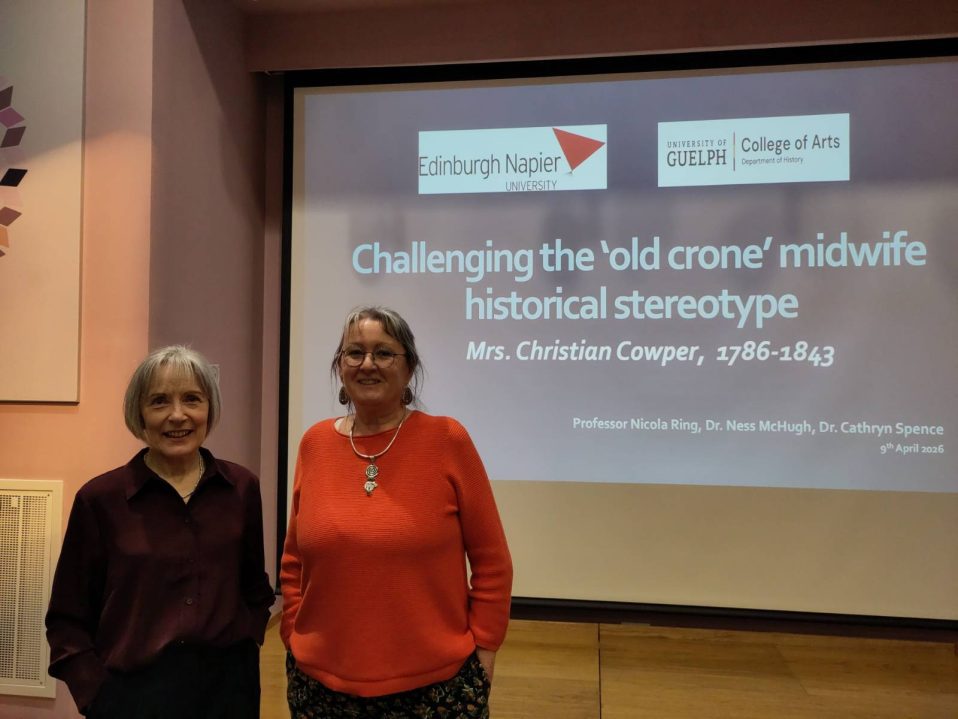
. Ahead of 2026 International Day of the Midwife celebrations, the NLS invited us to share what we had learned about Mrs Cowper. At this sold-out public event, one surprise finding we shared was learning that Mrs Cowper left her remote Highland home in 1786 to be trained in Edinburgh’s Infirmary by a man-midwife professor. Mrs Cowper’s fantastic midwifery story contains lots more surprises. Intrigued? Want to hear more about her extraordinary career? Come to our show at this year’s Edinburgh Fringe Festival where we will be telling her story in the Provocateurs Research Series. Maybe see you there in August!?!?
Dr Ness McHugh, Midwifery Lecturer and Dr Nicola Ring, Nursing Professor and Fellow of the Royal Historical Society
Pictures from NLS event
References
Blunt, J. (1795) Man-midwifery dissected; or the obstetric family-instructor: In fourteen letters. Addressed to A. Hamilton. Occasioned by certain doctrines contained in his letters to Dr. W. Osborn / By John Blunt [i.e. S.W. Fores] Man-Midwifery Dissected: Of the Obstetric Family – Instructor. London: S.W. Fores for the author, [1795?]
https://wellcomecollection.org/works/g6y546aj
Marland, H. (1993) The Art of Midwifery London: Routledge