
Exploring Social Robots and AI in Finance
CEDAR recently hosted an engaging session featuring research presentations on social robotics and artificial intelligence applications. The meeting brought together researchers exploring how technology can address human challenges, from student loneliness to financial data analysis.
Can Robots Be Companions for Lonely Students?
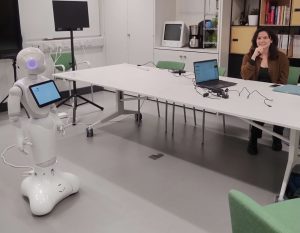
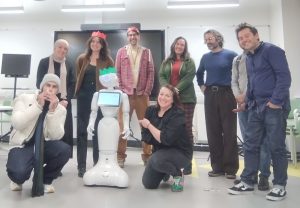
Franziska E. Heck presented fascinating research on whether social robots could help address loneliness among university students—a growing concern often overlooked in favour of studies focused on elderly people or children with autism.
The Loneliness Problem
University students face unique challenges. Established social ties are disrupted during transitions, new networks are still forming, and formal support services often have limited availability, long waiting lists, and concerns about stigma. The costs—both financial and emotional—are high, with loneliness linked to depression, anxiety, lower wellbeing, and reduced academic engagement.

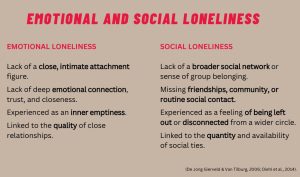
Two Types of Loneliness
Franziska’s research revealed an important distinction:
- Emotional loneliness: The lack of a close, intimate attachment figure, experienced as inner emptiness
- Social loneliness: Missing a broader social network or sense of belonging, feeling left out from a wider circle
Understanding this difference proved crucial, as students experiencing these different types of loneliness responded very differently to robots.
Mapping the Patterns
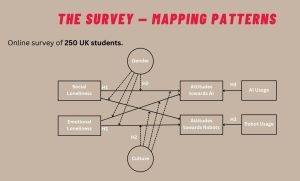
An online survey of 250 UK students examined how different forms of loneliness were associated with attitudes toward AI and robots. The results challenged assumptions:
- Emotional loneliness → more sceptical of AI
- Social loneliness → less negative about robots
- It’s not simply “lonelier = more into robots”
Gender and culture also played roles, with women generally more cautious about robots (especially when emotionally lonely), and those from individualist backgrounds slightly less positive overall.
The Stories Behind the Numbers
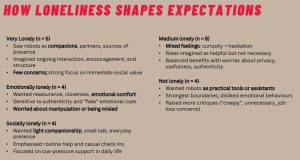
Following the survey, Franziska interviewed 25 UK students grouped into five loneliness profiles, showing them three robots: Pepper, Nao, and Furhat. The conversations revealed remarkably different expectations:
Very lonely students saw robots as companions and partners, imagining ongoing interaction and emotional support with few concerns.
Emotionally lonely students wanted reassurance and closeness but were highly sensitive to authenticity, worried about “fake” emotional cues and manipulation.
Socially lonely students wanted light companionship—small talk, routine help, and low-pressure everyday presence.
Medium and not-lonely students viewed robots as practical assistants, setting strong boundaries and disliking emotional behaviours, often raising concerns about privacy and job loss.
Testing Real Interactions
The next step? Moving from opinions to actual experience. Franziska designed an experiment where every participant interacts with Pepper twice:
- Personal Assistant mode: Structured, task-focused support for goal-setting
- Companion-Disclosure mode: Warm, reflective, relational conversation
The study investigates whether loneliness influences how students respond to and prefer different robot interventions.
The Bigger Question
During discussion, an important critique emerged: Should we invest in creating robot companions when we could simply fund more human counsellors? Franziska acknowledged this applies to most students, but noted certain groups—particularly those on the autism spectrum—demonstrably open up more to robots than humans. The reality is that universities aren’t increasing counselling budgets anytime soon, but many have robots sitting unused. Perhaps the solution isn’t either-or, but finding the right role for each.
Making Sense of Financial Data with Graphs
Dr Zia Ullah, Lecturer in the School of Computing, presented research on using graph neural networks to recognise financial entities in text—a challenge with real-world implications for fraud detection, market analysis, and financial monitoring.
Why This Matters
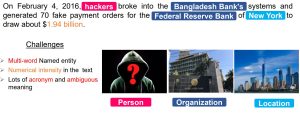
When hackers broke into Bangladesh Bank’s systems in 2016, they generated 70 fake payment orders attempting to steal $1.94 billion. Detecting such events requires systems that can accurately identify financial entities in text: organisations, locations, monetary amounts, and their relationships.
The Challenge
Financial text poses unique difficulties:
- Multi-word named entities
- High numerical intensity
- Extensive acronyms and ambiguous meanings
Traditional systems struggle, particularly with identifying multi-word entities and adapting to financial domain specifics.
The Solution: BiGCAT
Zia’s team developed BiGCAT, combining three powerful approaches:
- BiLSTM: Captures sequential context
- GCN (Graph Convolutional Networks): Models structural patterns
- GAT (Graph Attention Networks): Learns relationships between entities
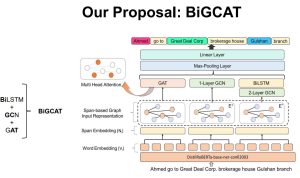
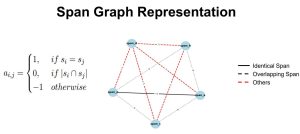
The innovation lies in representing text as a span graph, where entities and their relationships form nodes and edges. By weighting these graphs with large language model embeddings, the system captures both local context and global structural patterns.
Impressive Results
BiGCAT achieved state-of-the-art performance on two financial datasets (FINER-ORD and FIN), significantly outperforming existing baselines. This represents the first application of graph-based representation learning in the financial domain for named entity recognition.
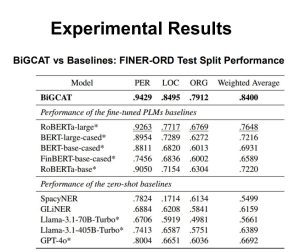
The research opens exciting possibilities for financial monitoring, early fraud detection, and automated market analysis—all areas where accurate entity recognition is crucial.
Bridging Research and Practice
Both presentations highlighted CEDAR’s strength in addressing real-world challenges through innovative technology applications. Whether exploring how robots might support student wellbeing or developing AI systems to analyse financial data, the research combines rigorous methodology with practical impact.
These studies remind us that technology isn’t inherently good or bad—its value depends on thoughtful design, understanding human needs, and acknowledging both possibilities and limitations.
For more information about CEDAR activities or to arrange a lab tour, contact Marina Wimmer (m.wimmer@napier.ac.uk)