On Wednesday, the 29th of October 2025, our first CEDAR meeting of the term took place on the Edinburgh Napier University Sighthill campus and simultaneously on Teams.
Before the presentation of the HEART (Hydrogen-Electric and Automated Regional Transportation) project, Marina Wimmer opened the meeting with updates on CEDAR’s activities and future direction. She highlighted some exciting news:-
-
-
- Congratulations to Suha Saradat on her recent promotion to Professor!
- CEDAR has now been running for three years and continues to evolve with new members and directions
- The lab facilities include augmented reality, fNIRS (functional near-infrared spectroscopy), and eye-tracking equipment
- Looking ahead to 2025: CEDAR will be involved in the UK Creativity Researchers Conference at Napier in June
-
-
Virtual Reality Experiments in Sustainable Aviation: The HEART Project
Professor Pat Langdon introduced the ambitious HEART project, a £6 million UKRI-funded initiative spanning four years.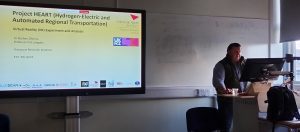 The project aims to transform regional transportation through:
-
-
-
- Zero-emission aircraft powered by hydrogen fuel cells and electric motors
- Automated systems for air traffic control and terminal operations
- Sustainable, modular terminal design using environmentally friendly materials
- Inclusive design ensuring accessibility for all passengers
-
-
The Vision
The HEART concept reimagines regional aviation by reclaiming old airfields for small, automated terminals. Without traditional control towers, the system relies on automated deconfliction technology from partners including Saab and Blue Bear Systems, alongside aircraft manufacturers like Britten-Norman and hydrogen specialists Zero Avia.Research Focus: The Passenger Journey
The research team took a human-centred approach, mapping the complete passenger experience from booking through to arrival. This wasn’t about preconceived airline or terminal perspectives—it was about understanding the lived experience of passengers. The passenger journey is mapped from booking through to arrival, highlighting key touchpoints.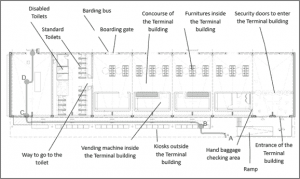
Inclusion at the Core
Working closely with disability organisations and consulting engineer Mike Thomas, a wheelchair user and former Hewlett-Packard engineer, the team explored accessibility challenges across the entire journey:-
-
-
- Ingress and egress from small regional aircraft
- Wheelchair accessibility throughout terminals
- Visual impairment accommodations
- Cognitive impairment considerations
- Physical mobility limitations
-
-
VR Experiments: Testing Terminal Design
Dr Roshan Dhonju presented the innovative VR experimental methodology used to test the terminal design. The research was exploratory, investigating whether VR could be effectively used with participants with various disabilities.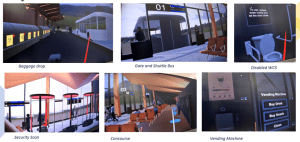
The Experimental Setup
-
-
-
- 27 participants, including wheelchair users, visually impaired individuals, and those with reduced physical ability
- HTC Cosmos headset (now also using HTC Vive 3XR)
- Multiple mission scenarios: arrival and departure journeys
- Variable conditions: high and low passenger density
- Different mobility profiles: standard, slow, wheelchair, stagger, and visually impaired profiles
-
-
Terminal Tasks
Departure passengers completed tasks including:-
-
-
- Automated baggage drop at allocated kiosks
- Hand luggage checks
- Security scanning
- Navigating the concourse
- Using accessible toilets
- Finding gate information
- Boarding the shuttle bus
-
-
-
-
-
- Exiting the shuttle bus
- Concourse navigation
- Toilet facilities
- Luggage collection from designated kiosks
-
-
Key Findings
The VR experiments captured rich data, including participant positions, camera rotations, and movement patterns through the terminal.Movement Analysis
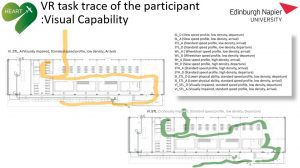
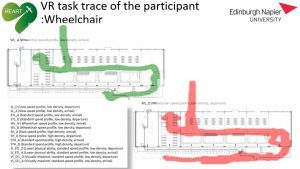
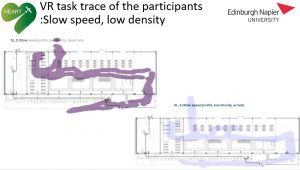
Heat maps and 3D trace visualisations revealed how different users navigated the space, showing distinct patterns for:-
-
-
- Wheelchair users
- Visually impaired participants
- Those with reduced physical ability
- Baseline participants at standard and slow speeds
- High vs low-density conditions
-
-
Statistical Results
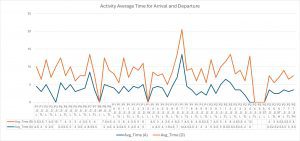
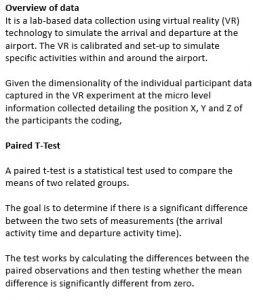
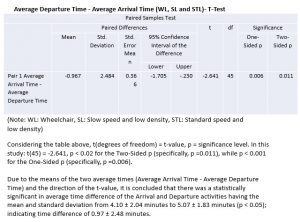
A paired t-test analysis revealed statistically significant differences between arrival and departure times: • Arrival time: 4.10 ± 2.04 minutes • Departure time: 5.07 ± 1.83 minutes • Difference: 0.97 ± 2.48 minutes (p < 0.05) This indicates that departure processes took longer on average, providing valuable insights for terminal design optimisation.VR analysis: Arrival vs Departure
VR analysis statistical
The Terminal Design
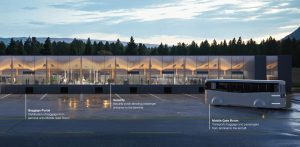
The sustainable, modular terminal featured:-
-
-
- Automated baggage handling systems
- Minimal-intrusion security scanning
- Accessible vending machines and facilities
- Clear wayfinding to shuttle buses
- Modern, sustainable materials throughout
-
-
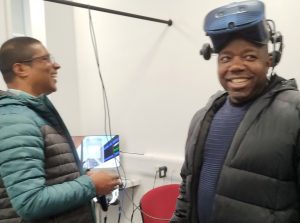
Lab Demonstration
Following the presentation, attendees were invited to experience the VR terminal simulation firsthand in CEDAR’s lab facilities, providing an immersive understanding of the inclusive design principles in action.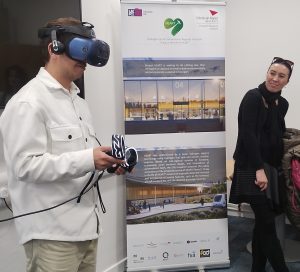
Significance and Impact
The HEART project demonstrates the power of interdisciplinary collaboration, combining engineering, design, human factors research, and inclusion expertise. The use of VR as a tool for inclusive design research opens new possibilities for testing accessibility before physical construction begins.The project partners included major industry players such as Logan Air, Mott MacDonald, and Weston Williamson and Partners (WW + P), ensuring the research has real-world application potential for future regional aviation networks.
The next CEDAR meeting will continue to showcase innovative interdisciplinary research. For more information about CEDAR activities or to arrange a lab tour, contact Marina Wimmer (m.wimmer@napier.ac.uk)