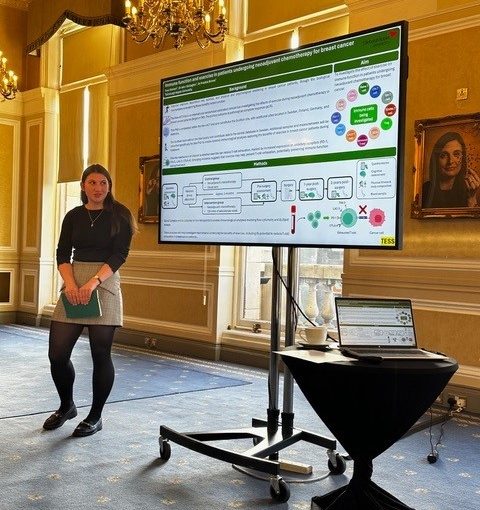
Tess won the best postgraduate student oral presentation at the Centre of Biomedicine & Global Health (CBGH) mini conference in December 2025, hosted at the Royal Society of Edinburgh.
Sweat and Science: How Exercise May Help Fight Breast Cancer
My PhD research combines cancer biology, immunology, and lifestyle interventions, addressing a simple yet powerful question: can exercise help the immune system fight breast cancer? While the benefits of exercise are well established, its effects during chemotherapy remain largely unexplored.
Exercise Meets Cancer Treatment: The Neo-ACT Trial
My supervisors and I form the Scottish site of the Neo-ACT trial, a large, international study led by the Karolinska Institute in Sweden. The trial investigates whether structured exercise during neoadjuvant chemotherapy (treatment given before surgery) can improve outcomes for breast cancer patients and reduce side effects.
In Scotland, we recruit patients with early to locally advanced primary invasive breast cancer from hospitals in Edinburgh and Fife. These patients are planned to receive chemotherapy before surgery. Patients are split into two groups:
- Control group: Receives basic information about exercise and a Fitbit tracker.
- Intervention group: Completes 120 minutes of exercise per week from the start of chemotherapy until surgery (approximately five months). Participants in this group receive a Fitbit tracker, access to the Vitala app, which provides exercise programmes and instructional videos, and ongoing support from the research team.
Participants complete four rounds of testing throughout their treatment and recovery, including fitness assessments, cognitive evaluations, and wellbeing questionnaires. The clinical and wellbeing data collected are contributed to the Neo-ACT trial database in Sweden. In addition, blood samples are collected exclusively for this PhD research, which I analyse to study changes in immune cells.
The Immune System in Focus
My project focuses on T cells, the body’s frontline soldiers against cancer. In the tumour microenvironment, prolonged exposure to tumour antigens can lead to T cell exhaustion, where cells become less effective at attacking cancer. Exhausted T cells produce fewer immune signals, have reduced killing capacity, and express inhibitory “checkpoint” markers that dampen immune activity.
I aim to discover whether exercise can reduce T cell exhaustion, boost anti-tumour immunity, and potentially improve treatment outcomes. Using blood samples, I isolate immune cells and analyse them with flow cytometry and ELISpot assays.
Bridging Research and Real-World Impact
Exercise is not a replacement for cancer treatment, but it is a low-cost, non-invasive intervention that patients can manage themselves. My research aims to provide evidence of how this practical intervention may support resilience and immune health during chemotherapy, bridging laboratory science and patient care.
Looking Ahead
In the next phase of my PhD, I will continue monitoring participants, analysing immune and wellbeing data, and investigating how exercise changes T cell populations over time. Ultimately, I hope this work will inform strategies for integrating exercise into cancer care alongside standard treatment.
Written by: Tess Stewart
For further information, you can contact Tess at: T.Stewart@napier.ac.uk.