Dr Nina Schaffert, a postdoctoral researcher at the University of Hamburg, delivered an engaging online lecture on the role of sonification in high-performance rowing. The session provided valuable insights into how sound can serve as an acoustic feedback mechanism to enhance elite athletes’ performance.
Biomechanical Feedback in Rowing
Dr Schaffert outlined the importance of biomechanical diagnostics in elite rowing, where mobile measurement devices capture dynamic and kinematic parameters such as forces applied by athletes, boat speed, and acceleration. These data points are critical in supporting coaches as they refine technique and optimise training regimens.
Traditionally, this feedback is presented visually, often through graphical displays. However, focusing on a screen while rowing is impractical, especially in changing outdoor conditions. Dr Schaffert noted that rowers naturally rely on acoustic cues, such as water splashes and boat movement, to assess their performance. Building on this, her team explored whether artificially generated sonification could provide real-time auditory feedback to support technique adjustments.
What is Sonification?
Sonification converts data into sound, allowing information to be communicated through auditory cues instead of visual representations. This method is particularly useful in situations where visual attention is occupied, enabling real-time feedback without requiring the user to look at a screen. Unlike traditional auditory feedback, which relies on verbal instructions or pre-recorded sounds, sonification generates dynamic audio based on real-time data, making it an interactive form of feedback.
Different approaches exist within sonification. Parameter mapping sonification, the most commonly used, assigns data values to sound properties such as pitch or volume. Model-based sonification creates sounds based on physical models of movement, mimicking natural acoustic responses. Audification translates raw data directly into sound waves, making patterns perceptible through listening rather than visual analysis.
Dr Schaffert’s research applies parameter mapping sonification, translating rowing boat acceleration into sound. This makes subtle movement variations audible, allowing athletes to refine their technique.
Sonification in Rowing: Communicating Movement Through Sound
In rowing, acceleration varies across the stroke cycle. A rowing stroke consists of two primary phases: drive and recovery. The key transitions—catch, where the oar enters the water, and finish, where it exits—significantly affect acceleration. Sonification maps these variations to sound, enabling athletes to perceive them intuitively.
Dr Schaffert’s team tested this approach during on-water training with the German national rowing team. The system transformed real-time acceleration data into sound sequences delivered via loudspeakers or earphones. By listening to these sounds, rowers identified inconsistencies in their strokes, particularly during the recovery phase. Adjusting their technique in response to the sound led to smoother movement and increased boat speed.
Beyond Rowing: Applications in Other Fields
Sonification has been successfully applied in various domains beyond rowing. In sports training and performance enhancement, it has been used in speed skating, swimming, tennis, and golf. In speed skating, auditory feedback helps maintain optimal rhythm and stride length. In swimming, stroke consistency has been improved by mapping stroke rate and force to auditory signals. In tennis, racket movement has been sonified to enhance swing accuracy. In golf, putting and swing techniques have benefited from auditory cues linked to club speed and angle.
Beyond sports, sonification supports medical rehabilitation, scientific research, and accessibility. In stroke recovery, auditory feedback aids movement coordination, while rhythmic cues improve gait stability for individuals with Parkinson’s disease. Prosthetic limb users refine control and movement patterns through sonified feedback. In scientific analysis, space telescope data has been converted into sound to reveal celestial phenomena, earthquake data has been sonified to detect tremors, and MRI and EEG data have been made audible for brain activity analysis. Sonification also enhances accessibility, with screen readers and navigation tools providing auditory cues for visually impaired users, while complex graphs and charts are transformed into sound for auditory data interpretation.
Sofirow: Acoustic Feedback for Rowers
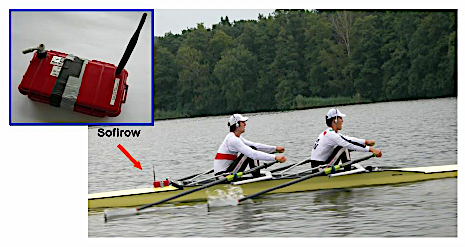
To apply sonification in training, Dr Schaffert’s team developed Sofirow, a system designed to provide real-time auditory feedback based on biomechanical data. It measures boat acceleration with a micro-electromechanical sensor, converts the data into sound, and transmits it wirelessly to rowers and coaches.
Sofirow translates acceleration changes into distinct sound variations, allowing rowers to hear their boat’s motion in real time. The system communicates key performance indicators, including boat speed, acceleration, and deceleration. If a rower moves too abruptly during recovery, the sound reflects this instability, prompting a smoother execution. Conversely, an efficient stroke produces a stable, consistent sound.
A crucial function of Sofirow is improving the recovery phase. The system highlights when a rower disrupts the boat’s glide by moving too forcefully, allowing them to adjust their approach for minimal drag. Timing at the catch is another focal point, ensuring strokes are synchronised to maintain momentum without unnecessary deceleration.
The system was tested during multiple training sessions with the German junior and senior national rowing teams. Sonification was introduced in alternating intervals, with sections of training both with and without sound. Results demonstrated that when auditory feedback was present, rowers achieved a more consistent technique and increased boat speed. Acceleration data revealed smoother transitions and reduced deceleration at key points in the stroke cycle.
Athletes found the auditory feedback intuitive and effective in improving coordination. Dr Schaffert presented recordings of Sofirow’s output, demonstrating how variations in movement execution could be heard through pitch and tone changes.
Future Possibilities for Sonification in Sports
Dr Schaffert highlighted the expanding role of sonification in sports science, where advancements in machine learning, real-time data processing, and interactive feedback systems are transforming athletic training. One area of development is cycling performance, where real-time auditory cues on pedalling mechanics have been shown to improve efficiency and endurance. By integrating wearable sensors that monitor cadence and power output, sonification enables cyclists to make immediate adjustments to optimise their form, reduce fatigue, and maintain consistent performance over long distances.
In racket sports such as squash and tennis, researchers have explored how auditory feedback can assess and refine shot precision. Systems that analyse racket-ball impacts can generate sound cues to help players adjust their stroke technique. This feedback allows athletes to develop greater control and consistency in their shots without relying solely on visual analysis. Similarly, in rowing and endurance sports, sonification can reinforce correct pacing by providing rhythmic auditory signals that help athletes synchronise movement with optimal stroke or stride rates, improving efficiency and reducing energy waste.
The integration of wearable sonification technology is opening new possibilities for personalised training. Smart garments embedded with motion sensors can detect movement patterns and muscle activation, translating this data into sound cues that guide athletes in refining technique. These advancements are particularly relevant in sports requiring precise biomechanics, such as swimming, weightlifting, and gymnastics. With continued progress in real-time data processing, sonification could become a standard training tool, offering immediate and adaptive feedback to help athletes improve performance, prevent injuries, and achieve greater consistency in their movement execution.