How do you preserve the sound of a place?
A building can survive through photographs, architectural drawings, maps and written descriptions. Its dimensions can be measured, materials catalogued and appearance reconstructed long after the original structure has disappeared. Yet places are not experienced through vision alone. A cathedral changes the sound of a choir, a tiled chamber changes the sound of a voice, snow alters the acoustic behaviour of a forest, and the hard surfaces of a mausoleum can allow sound to continue long after its source has stopped. Architecture surrounds every action with reflections, resonances and reverberation, but this part of a place can disappear without leaving anything visible behind.
During his online guest lecture for Edinburgh Napier University, Professor Damian Murphy of the University of York explored almost two decades of work investigating how the acoustics of places can be measured, preserved, reconstructed and experienced. Much of this work centres upon OpenAir, the Open Acoustic Impulse Response Library, which contains acoustic measurements gathered from buildings, landscapes and other environments. Its contents range from cathedrals, churches and theatres to industrial buildings, caves, forests and vehicles, connecting acoustic science with music production, spatial audio, games, archaeology, heritage and historical research. Murphy moved between these different places and applications through a question that became larger as the examples accumulated. What can the sound of a place tell us that its image cannot?
Murphy began with a ruin. The Temple of Decision stands on a hill overlooking the Falkland Estate in Fife, where artists David Chapman and Louise K. Wilson had been commissioned to explore the landscape through sound. Archive material could offer clues about the temple’s former appearance, while historical research could provide fragments of information about its use, but the surviving structure could no longer reveal how the intact building had sounded. What would it have been like to speak inside the room? How might voices have behaved around a table? How would conversation, movement or a fire have interacted with its surfaces? The artists posed a question that provided a starting point for Murphy’s lecture: in the absence of clear echoes, how can we know a place?
Answering that question first requires an understanding of what an acoustic environment contributes to anything heard within it. Imagine a short, sharp sound produced inside a room. A listener initially receives the direct sound travelling along the shortest path from source to receiver. Early reflections arrive shortly afterwards from nearby surfaces, followed by increasingly complex patterns as energy travels through the room, interacting repeatedly with walls, floor, ceiling and objects before gradually decaying. Together, these components form a room impulse response for a particular relationship between a source and receiver. Direct sound carries information about the source and its distance, while early reflections contribute to perceptions of geometry and position. Later reverberation communicates qualities associated with volume, materials and enclosure. Change the architecture and the response changes. Move the source or listener and it changes again. An impulse response is therefore not a complete acoustic identity for a building, but a record of how sound travelled between particular positions under particular conditions.
Once captured, that relationship can be used for more than numerical analysis. Through convolution, a recording made without significant room acoustics can be combined with an impulse response measured elsewhere. Murphy demonstrated the process using a four-part vocal ensemble recorded in an anechoic chamber. The singers had never performed in York Minster, yet convolution with a measured response allowed their dry voices to acquire characteristics of the cathedral. York Minster has a reverberation time of approximately eight seconds through part of the mid-frequency range, compared with around half a second for a typical living room. Voices behave very differently in each environment. Notes overlap, transitions blur and the building continues sounding after the performers have stopped producing sound. The acoustic is not simply decoration placed around a performance. It changes the temporal relationships through which that performance is heard.
Auralisation, however, introduces a distinction between recreating acoustic conditions and recreating experience. Singers performing in an anechoic chamber do not behave as they would inside a highly reverberant cathedral. Performers hear themselves and adapt. Tempo, articulation, phrasing, dynamics and pauses can change in response to sound returning from the room, while musicians continually adjust to one another through the acoustic environment they share. Convolution can reproduce the effect of a measured response upon a recording, but it cannot retrospectively create the performance that might have developed inside that space. Murphy acknowledged this limitation directly when discussing the York Minster example. The anechoic performance was not the performance the singers would have given in the cathedral, and even the spacing of phrases in the demonstration had been altered to allow the reverberation to emerge more clearly.
The distinction matters beyond the simulation of reverberation. A room impulse response can describe how energy travels between defined positions, but people are not passive sound sources or microphones. They move, listen selectively, change their behaviour and respond to what they hear. Preserving a response gives researchers evidence about the acoustic conditions of a place. What people did in response to those conditions remains a different question.
OpenAir developed from an ambition to preserve such evidence and make it available for others to explore. Murphy traced one important influence to Angelo Farina’s work on recording concert halls for posterity. Improvements in measurement techniques and the emergence of practical convolution reverberation created an opportunity to document significant spaces not merely through reverberation times and other summary values, but through impulse responses that could be analysed, reproduced and used creatively. OpenAir extended this principle into a growing archive, with a measurement system designed to collect spatially rich data that could remain useful beyond the immediate research question.
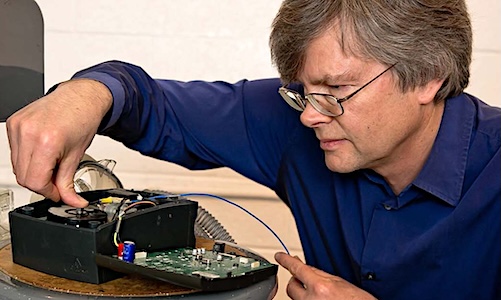
Early measurement sessions used a Genelec S30D loudspeaker to excite the space while microphones captured its response. A computer-controlled turntable allowed measurements at regular angular intervals, and an ambisonic Soundfield microphone was combined with a Neumann KM100 cardioid microphone to provide spatial information alongside material suitable for different forms of analysis and production. Measurements could be repeated across several source and receiver positions, preserving a set of relationships rather than presenting each building through one supposedly definitive response. Ambisonics was particularly valuable for an archive whose future applications could not be predicted. A first-order ambisonic recording represents a three-dimensional sound field through an omnidirectional component and three directional components, separating the captured information from one fixed loudspeaker arrangement. Material can later be decoded for different reproduction systems or manipulated in ways that may not have been anticipated when the recording was made.
Flexibility matters when access to a significant site may last only a few hours. Researchers need to gather material rich enough to support questions that have not yet been formulated and technologies that may change long after a measurement session has ended. During the discussion after the lecture, Murphy described more recent work at St Paul’s Cathedral, undertaken with a composer who wanted impulse responses from the building. Three researchers had only three hours to move equipment through the enormous space and capture responses from locations including the nave, a stairwell and the Whispering Gallery. Practical decisions about where to measure become part of preservation itself. As Murphy observed, there is no single sound of a large building. Different positions offer different acoustic experiences, and any archive necessarily records selected relationships within a much larger field of possibilities.
As OpenAir expanded, its growing range of places made the idea of acoustic preservation less straightforward. York Minster was an obvious candidate, since its long reverberation is closely connected with experiences of worship, tourism and musical performance. Other sites raised different questions about what deserves to be preserved and why. When the former Terry’s chocolate factory in York closed, Murphy and his colleagues gained access before redevelopment and measured spaces including a warehouse and the former typists’ room, a striking interior dominated by glass and wood. The activities for which these spaces had been designed had already disappeared. An empty typists’ room could still be photographed, but its appearance prompted another question: what might it have sounded like when filled with the overlapping mechanical activity of typewriters?
A subterranean reactor hall beneath the Royal Institute of Technology in Stockholm preserved another relationship between architecture and former activity, while measurements in historic churches allowed acoustic theories to be tested rather than merely repeated. At St Andrew’s Church in Lyddington, the team examined jars embedded within the walls, architectural features sometimes interpreted through theories of resonant vessels extending back to the Roman architect Vitruvius. Measurement provided little evidence that the jars were making a substantial contribution to the acoustic character of the church. Their form did not correspond closely with the behaviour expected of effective Helmholtz resonators. Acoustic research could challenge explanations attached to historic architecture as well as document spaces admired for their sound.
York Theatre Royal shifted attention from buildings as fixed objects towards places in changing states. Murphy’s team measured the auditorium before refurbishment and returned afterwards to document its altered acoustic. They also captured measurements with an audience present during a pantomime, recognising that an occupied theatre does not behave acoustically like the same room when empty. Seats, clothing and bodies absorb and scatter sound, making occupancy part of the acoustic system rather than simply a group of listeners placed within it. Materials age, spaces are repurposed and environmental conditions change. Preserving an acoustic environment may therefore involve documenting several states of the same place rather than searching for one definitive response.
Outdoor and semi-outdoor locations created different practical problems, and the original measurement system could not simply be carried everywhere. On the Falkland Estate, the Bottle Dungeon could be reached through a trapdoor, but access was sufficiently awkward that the usual equipment was impractical. A balloon was attached to one stick, a pin to another and a microphone lowered into the space. Bursting the balloon remotely provided the excitation needed to capture a response. The improvised arrangement was far removed from the computer-controlled turntable used elsewhere, yet it addressed the same underlying need: introduce a suitable sound into an inaccessible environment and record how the space transforms it.
Landscapes demanded further adaptation. Equipment had to become portable and independent of mains electricity as researchers travelled into the Yorkshire Dales to measure caves and gorges. Work in Finland examined the same forest under different seasonal conditions. Researchers used GPS alongside ribbons tied around trees to return to the same positions after deep snow had transformed the landscape. Geographically, it remained the same forest. Acoustically, it had changed. Snow altered the interaction between sound, ground and surrounding environment, demonstrating that acoustic character can change while location remains constant.
A collaboration with Codemasters carried that thinking into interactive media. Looking at an archive rich in churches and historic interiors, the developer asked a practical question: what about the environments needed for games? The collaboration encouraged further work on landscapes and led to experiments for GRID Autosport involving vehicle interiors, where the acoustic problem was unusually complex. Codemasters wanted to represent a car gradually falling apart during a race, so the team needed measurements capable of describing changing states, including doors opening or disappearing and the boot being open. The experience of being inside a racing car also comes from more than airborne sound. Engine vibration travels mechanically through the structure and contributes to what an occupant hears and feels.
Conventional room measurement could not fully represent that relationship, so Murphy and his colleagues experimented with using the engine itself as part of the measurement process. Revving the car caused the structure to vibrate as it would during use, after which signal-processing methods were applied to separate the excitation from the resulting cabin response and derive an approximation of the impulse response. The approach sought to preserve something more specific than the reverberation of a small enclosure. It attempted to capture the interaction between a vibrating machine, its structure, the enclosed air and the listener inside it.
Games also demonstrated how preservation can become creative infrastructure. An impulse response gathered for research may later help construct a virtual environment, become part of a music-production tool or support a question that had not existed when the measurement was made. Murphy described OpenAir material finding its way into software used by musicians and audio practitioners, allowing measurements collected years earlier to acquire new purposes. Distribution under a Creative Commons licence reflected this wider ambition. Researchers can analyse the acoustic behaviour of a building, composers can use the same response creatively, sound designers can place fictional events inside measured environments and developers can incorporate selected material into new tools.
OpenAir originally allowed members of the wider community to upload their own measurements. As contributions accumulated, variations in recording quality became difficult to ignore. The team eventually reviewed the existing material, retained the strongest contributions and moved towards a more curated model in which new contributors contact the team directly. Open access expands what an archive can become, but reuse also depends upon confidence in how the material was produced.
These measurements deal with places that still exist, even when they are changing. The Temple of Decision presents a different problem. Its original interior has already gone. Once a room has disappeared, there is nothing left to measure. Its former acoustic behaviour has to be approached indirectly through surviving evidence and modelling.
Using information about a lost structure, researchers can construct a three-dimensional geometric representation and simulate the propagation of sound within it. Virtual rays travel through the model, reflecting between surfaces to generate impulse responses for selected source and receiver positions. Those responses can then be analysed or used to process voices and other recordings, allowing listeners to hear an interpretation of how sound might have behaved inside architecture that no longer survives. Such a result differs fundamentally from measuring an existing building. Geometry may be uncertain, material properties need to be estimated and every modelling method introduces limitations. Historical auralisation produces an evidence-based acoustic proposition rather than a recording recovered from the past.
Work on St Mary’s Abbey in York made both the possibilities and limitations of this approach audible. The former church survives as a ruin, while archaeological and architectural evidence allowed Murphy’s team to construct a three-dimensional representation suitable for acoustic modelling. Simulated impulse responses could then be compared with measurements from York Minster, a surviving building with some comparable characteristics. Estimated reverberation times occupied a similar range, but the reconstructed St Mary’s sounded noticeably brighter. The difference did not necessarily reveal a historical distinction between the buildings. Murphy explained that the ray-tracing model used for St Mary’s was less effective at reproducing low-frequency behaviour than the physical measurement system used in York Minster. Part of what listeners heard therefore belonged to the method of reconstruction itself.
A model may sound convincing while still containing audible consequences of the technique used to create it. Plausibility has to emerge from evidence, comparison and methodological transparency rather than from the apparent realism of the result alone. Once those boundaries are understood, a model can make relationships perceptible in ways that drawings and numerical data cannot. During a public performance among the ruins of St Mary’s Abbey, a live choir was captured and processed through impulse responses derived from the reconstructed church, then projected to an audience gathered at the site. Present-day voices sounded among the physical remains while the model returned an interpretation of the missing acoustic architecture. Research data became part of an experience connecting a surviving place with a vanished interior.
Reconstructing an abbey or temple can help audiences imagine how a lost building might have shaped music and speech. Murphy’s more recent work moved towards a question with wider historical consequences. If architecture changes what people can hear, could reconstruction help investigate who had access to speech in the past?
Working with historians and art historians, Murphy’s team investigated spaces associated with the historic House of Commons within the former Palace of Westminster. Among the most revealing parts of that history was the experience of women who listened to parliamentary debate from a roof space above the chamber. Known as the Ventilator, this space allowed women excluded from formal political participation to gather above the House of Commons and listen through the architectural structure separating them from the debate below. Historical evidence could establish that they were there. Acoustic reconstruction allowed another question to be asked: what could they actually understand?
Answering it required more than recreating the debating chamber as an isolated room. Researchers had to consider the chamber, roof void, Ventilator and routes through which speech travelled. The women listening above did not have a direct line of sight to the speaker, making their experience a problem of acoustic transmission through a complex architectural arrangement rather than ordinary listening within a single enclosure. Murphy connected this project with broader questions of directionality, speech transmission and listening position, while acknowledging that objective measures cannot reproduce every aspect of human attention or historical experience.
No surviving recording can reveal exactly what those listeners heard. The team therefore combined historical reconstruction with comparative measurement, examining surviving spaces connected with parliamentary history or comparable in geometry, scale, period or use. Measurements from rooms at the University of Oxford, York Guildhall and the present House of Commons chamber provided contexts against which aspects of the model could be considered. None could prove how the lost chamber sounded, but together they allowed reverberation and speech intelligibility to be examined across different positions and occupancy conditions. A question about architectural acoustics had become inseparable from a question about political access.
Hearing is a form of access. Architecture, distance, reverberation, occupancy and barriers influence whether speech remains intelligible, while attention, familiarity and expectations affect what can be understood from imperfect information. A person may be physically close to political debate while remaining acoustically separated from it. Reconstructing the conditions of listening can therefore contribute to historical questions about participation and exclusion that visual records alone cannot answer.
The Temple of Decision now appears less like an isolated case and more like the beginning of a much larger enquiry. In the absence of clear echoes, how can we know a place? We can measure what survives, compare different conditions, preserve spaces before they change and build models from evidence when the original architecture has disappeared. We can listen to those models while remaining clear about what they can and cannot establish. Most of all, we can ask questions that become difficult to formulate when architecture is treated only as something seen.
A photograph can preserve the appearance of a parliamentary chamber from one position. An architectural plan can show where walls, doors, galleries and roof spaces were located. Written testimony can tell us that people gathered somewhere to listen. Acoustic research adds another layer by asking how sound travelled between those positions, how reverberation affected speech and whether architecture enabled or obstructed understanding. The same thinking can ask how a ruined abbey shaped musical performance, how a theatre changed during refurbishment or how winter transformed the acoustic behaviour of a forest.
Preserving the sound of a place is not simply an attempt to save an attractive reverberation before it disappears. Places participate in human activity. They change how people speak, perform and listen. Their surfaces and geometry influence whether voices remain intimate or become collective, whether musical phrases overlap or remain distinct, and whether somebody standing beyond a barrier can understand words spoken elsewhere. Acoustic conditions can shape behaviour, access and participation without leaving a visible trace.
The Temple of Decision can still be visited. St Mary’s Abbey remains visible as a ruin. The old House of Commons chamber has disappeared, while the former typists’ room at Terry’s chocolate factory no longer performs its original function. A forest changes when snow arrives and changes again when it melts. Even a building that survives intact contains many acoustic relationships, only some of which can be measured during the limited hours when researchers have access.
Sound is especially vulnerable to disappearance. Once a room changes, an audience leaves or a building is lost, its former acoustic behaviour cannot simply be photographed. Murphy’s lecture showed that it is not entirely beyond preservation. What remains may be a measurement, a model, a comparison or a carefully documented uncertainty, each offering a different way of understanding a place as more than a visual container for history.
In the absence of clear echoes, we may never know a place completely. We can, however, preserve evidence of how sound moved through it, reconstruct plausible relationships when the original has disappeared and ask what those acoustics meant for the people who performed, spoke and listened there. An impulse response may last only a few seconds, yet within it can remain an acoustic trace of a cathedral, a factory, a theatre, a cave, a forest under snow or a room about to change forever. When the room itself has already disappeared, a model can return a possibility rather than a certainty: a voice reflecting from lost walls, a choir inhabiting a ruined abbey or political speech travelling towards listeners hidden above a chamber from which they were excluded.
Preserving the sound of a place means preserving another way of understanding what happened there. Walls determine more than what people can see. They shape what can be heard, how clearly it can be understood and who is able to listen.