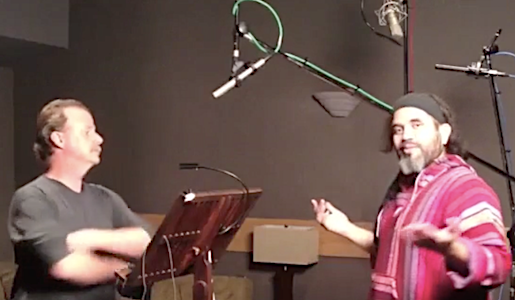
How do you make ADR sound like it was never replaced?
A line of dialogue may last only a few seconds, yet replacing it convincingly can require an extraordinary combination of preparation, performance, technology and judgement. The original production recording must first be identified as unusable, the replacement carefully documented and prepared, the actor returned to the emotional and physical circumstances of a performance recorded months earlier, and the new dialogue captured so that it matches the timing, vocal quality, microphone perspective and acoustic character of the original scene. If the process succeeds, the audience should never know that any of this work happened. During their joint online guest lecture for Edinburgh Napier University, ADR supervisor Paul Carden and ADR mixer Chris Navarro demonstrated this complete process from beginning to end. Rather than discussing Automated Dialogue Replacement only in theory, they created a deliberately compromised line of production dialogue, prepared it for replacement, recorded it on an ADR stage and evaluated the result. Their demonstration revealed a process in which meticulous preparation and technical fluency serve a deceptively simple objective: allowing everyone involved to concentrate upon the performance.
Carden began not in a recording studio, but outside beside a car. His objective was to demonstrate how an apparently simple piece of dialogue could become unusable during production. Wearing a lavalier microphone, he performed the five-word line “I’m late for work” while getting into the vehicle. The exercise immediately revealed how vulnerable production dialogue can be. Clothing could obscure the microphone, a zipped jacket could change the sound, movement could complicate recording and the closing car door could mask the line itself. The example was deliberately simple. Carden was standing almost still, knew exactly what he was going to say and had constructed the situation specifically for the demonstration. On a real production, actors may be walking, running, interacting with objects and performing emotionally demanding scenes while the production sound team manages multiple radio microphones and one or more booms. From this perspective, the surprise is often not that some lines require replacement, but that so much production dialogue survives at all.
The demonstration also established one of the central tensions within ADR. Production dialogue is not simply speech recorded on location. It contains a performance created at a particular moment, within a particular physical environment, as part of an interaction with other performers. Months later, an actor may arrive on an ADR stage while already immersed in an entirely different project and be asked to recreate a few seconds from that earlier performance. The recording environment offers little of the original context. The actor stands in a comparatively neutral room, watches an image on a screen, listens for cues and attempts to reproduce not merely the words, but the emotional and physical conditions under which those words were originally spoken. Carden emphasised that this is one reason actors can find ADR difficult. Matching a line involves returning to a performance that may no longer feel immediate or familiar.
Before any actor reaches the stage, however, the line must become an ADR cue. Carden demonstrated this preparation process by locating the damaged dialogue within the picture, defining the cue and documenting the reason for replacement. The cue was assigned a unique identifier, linked to its scene information and accompanied by notes explaining that the car door had closed over the line. He also demonstrated the value of professional flexibility. Where a production line was imperfect but potentially usable, he might identify the replacement as optional rather than forcing an unnecessary argument over whether it must be replaced. The cue sheet then carried the information required by the recording stage, including project details, version information, character and actor names, cue number, timecode and recording information. A five-word performance therefore arrived at the stage supported by an extensive information system designed to ensure that everybody was working on the correct material.
Version control was particularly important. Carden described production teams as living and dying by version dates, reflecting the practical reality that picture changes can quickly make carefully prepared cues inaccurate. Cue numbering performs a similarly essential role. Each take is voice-slated so that the recording itself retains its identity even if paperwork becomes separated from the audio. These details may appear administrative when viewed from outside professional production, yet they protect the continuity of the entire process. An ADR session may contain hundreds of replacement lines recorded across multiple days, actors and facilities. The actor should not have to think about whether the cue is correctly identified or whether the stage is working from the right picture version. Preparation creates the stability within which performance can happen.
Carden also offered one deceptively simple instruction for aspiring ADR mixers: keep recording until somebody clearly indicates that the take has ended. An actor may continue the performance, a director may decide to record another version immediately or the session may move into wild recording without a formal interruption. Stopping too early can lose useful material for no meaningful benefit. Storage is cheap; an unrecoverable performance is not. The advice reflected a wider principle that would continue through the lecture. Good ADR practice depends upon remaining attentive to what is happening in the room rather than allowing the machinery of recording to dictate the session.
The second stage of the demonstration moved into Navarro’s ADR facility. Even though the project consisted of a single line created for the lecture, he established the session as though it were a conventional production. Folder structures, documents, Pro Tools sessions and media were organised according to the same principles he would use for a project involving one session or hundreds. His ADR template was already configured for the ordinary demands of recording, while remaining adaptable when unusual situations arose, such as multiple actors performing together with several microphones each. A good template does not prescribe every session in advance. It removes predictable technical work so that attention remains available for situations that cannot be predicted.
Even the imported picture introduced a practical lesson. Navarro noticed that the system was responding sluggishly and identified the compressed H.264 picture as a likely cause, since the computer had to decode it continuously during playback. The moment was minor, but revealing. Professional technical fluency often appears not through dramatic troubleshooting, but through the ability to recognise quickly why a system is behaving unexpectedly and continue without allowing the problem to dominate the room. Earlier, Carden had offered similarly pragmatic advice about computer failure: save the work, restart the system and continue rather than allowing panic to consume valuable time. Both speakers treated technical expertise as calm familiarity rather than technological display.
Microphone selection then revealed how ADR matching differs from conventional voice recording. The objective is not to capture the most beautiful possible version of the actor’s voice. It is to create a recording that can inhabit the existing production soundtrack without attracting attention. Navarro showed that the stage had previously been configured for voice-over work, with microphones positioned closely and directly to produce the clear, present sound required for narration. ADR demanded a different approach. Carden had recorded the original line using a lavalier, so the replacement needed to reproduce the qualities of that production perspective rather than simply offering a technically superior recording.
Carden explained that ADR sessions commonly record both boom and lavalier microphones, ideally using the same models employed during production. Even when the original line appears to come predominantly from one microphone, alternatives can prove unexpectedly useful. Navarro demonstrated this by positioning a shotgun microphone close to Carden but substantially off-axis. Pointing it directly at the performer would have produced a cleaner and more extended sound, but that was not necessarily desirable. The off-axis position rejected particular frequencies and created a tonal character that could potentially sit closer to the lavalier recording. The result was counterintuitive: the boom microphone could, under those conditions, sound more like the production lavalier than the replacement lavalier itself. Matching therefore began not with assumptions about microphone categories, but with listening.
This distinction between technical quality and contextual suitability runs throughout professional ADR. A beautifully recorded line can fail if it sounds too clean, too close, too rich or too controlled for the image and surrounding production dialogue. Conversely, a microphone position that would appear unconventional in another recording context may provide exactly the spectral character required for a convincing match. The mixer must understand microphones well enough to use their imperfections deliberately. The question is never simply which microphone sounds best. It is which recording can become part of the scene without revealing the process that created it.
Once Carden stepped in front of the microphone, the demonstration moved from equipment towards performance. The familiar system of three audible beeps established the timing, with the actor beginning the line where an imaginary fourth beep would occur. In principle, the task appeared straightforward. In practice, Carden repeatedly entered early, became self-conscious about the timing and discovered how quickly an apparently trivial five-word line could become difficult once performance, synchronisation and technical awareness competed for attention. His reaction gave the students an unusually useful demonstration of the psychological demands placed upon actors during ADR. Knowing the line is not enough. Understanding the timing is not enough. Even achieving synchronisation is not enough. The replacement still has to sound as though it belongs to the original performance.
At one point, Carden produced a take that was synchronised correctly but immediately recognised that the performance itself was wrong. Navarro’s response was subtle. He did not ask for shouting or a dramatically louder delivery. He suggested only slightly more projection. The difference was not simply level. A small change in the physical production of the voice altered its tone and gave the line the additional presence heard in the original recording. When the replacement was compared directly with production dialogue, the improvement became obvious. The exercise demonstrated that ADR matching cannot be reduced to waveform alignment, pitch correction or equalisation. Performance changes the spectrum of the voice before any microphone or processor becomes involved.
Navarro later developed this point in greater depth. Two performances can have similar apparent loudness and pitch while differing substantially in vocal quality. An actor performing naturally on set may have a relaxed throat and a particular physical relationship with the surrounding scene. On the ADR stage, tension, self-consciousness or the effort to satisfy technical instructions can change the voice. A performer may become tighter, brighter or less natural even while reproducing the words and timing accurately. Matching therefore requires attention to qualities that are difficult to describe numerically. Projection, pitch, volume and rhythm matter, but so do muscular relaxation, breath and the physical origin of the voice.
This presents the ADR mixer with a delicate problem. The mixer may hear precisely what is preventing a line from matching, yet communicating every technical observation to the actor may make the performance worse. Navarro warned that performers can absorb only so many notes before they begin thinking about the mechanics of speech rather than the character. A useful intervention must therefore translate technical listening into language that supports performance. Sometimes the correct decision is to offer a suggestion. Sometimes it is to communicate through the director. Sometimes it is to recognise that an imperfection is not important enough to justify disturbing the creative balance of the room. Hearing a problem and knowing whether to mention it are separate professional skills.
The lecture also demonstrated an older approach to ADR recording that remains remarkably useful. Navarro sampled the original production line and played it repeatedly into Carden’s headphones. Instead of concentrating simultaneously upon picture, beeps and performance, Carden could hear the original line and immediately reproduce it, repeating the process several times. Navarro then edited the resulting takes into position and compared them with the production recording. The method offered a direct reference for timing, intonation, volume and vocal character, allowing the performer to respond to the sound of the original performance rather than attempting to reconstruct every detail intellectually.
Navarro’s explanation of this technique revealed an important insight into perception. Picture can sometimes become a distraction. An actor watching for a mouth movement may wait until it becomes visually apparent, by which time the correct moment to begin has already passed. If the original audio is correctly synchronised to picture, matching its rhythm and timing can naturally reproduce picture sync. The performer can therefore concentrate upon hearing and responding rather than continually monitoring several streams of information at once. Despite the age of the sampling technique, Navarro regarded it as one of the most useful tools available on the stage. Its continued value comes not from technological sophistication, but from the way it simplifies the performer’s task.
The same objective shaped Navarro’s control room. His system contained extensive routing, multiple microphone inputs, separate monitoring paths and a heavily customised control surface, yet the purpose of this complexity was to make the session itself feel simple. He might need to manage separate mixes for the control room, recording stage, actor headphones, supervisor headphones and remote participants, with each requiring different material during rehearsal, recording and playback. Attempting to reconfigure every route manually between passes would slow the session and create repeated opportunities for error. Navarro therefore designed systems that allowed complex changes to happen immediately.
His customised keypad provided a particularly revealing example. Individual buttons could trigger sequences of macros that armed tracks, initiated recording and performed repetitive editing operations once a take had finished. Navarro had spent months developing the core system and continued refining it whenever he noticed himself repeating unnecessary keyboard operations. He had begun his career as an ADR recordist and understood the division of labour on a two-person stage, where one person could manage recordings and files while the mixer concentrated upon the performers. Working alone, he used automation to reproduce some of that support, delegating repetitive technical operations to macros so that his attention could remain directed towards the stage.
This led to one of Navarro’s most important ideas: the ADR mixer must work at the speed of creativity. An actor or director may suddenly discover a new approach to a line and want to record it immediately. If the mixer responds by asking everyone to wait while tracks are configured, routes changed or files prepared, the idea may lose its immediacy. A delay of only a few seconds can alter the atmosphere of a performance. Technical speed therefore has a human purpose. The mixer learns the system thoroughly enough that machinery does not interrupt thought.
Navarro connected this principle to advice he had received about respected ADR mixer Tommy O’Connell. Asked what distinguished O’Connell’s work, a sound editor gave a simple answer: he anticipates. Useful actions are completed before anyone needs to request them. Navarro interpreted this not as a mysterious talent, but as the result of attention. If the mixer is watching the stage, listening to conversations and understanding the direction in which a session is moving, preparation for the next action can begin before a formal instruction arrives. Anticipation therefore depends upon both technical readiness and social awareness. A mixer whose attention is buried in the workstation may complete every requested task correctly while still remaining one step behind the session.
Carden’s preparation of the cue and Navarro’s management of the stage reveal two sides of the same professional process. Carden reduces uncertainty before the session begins through accurate cueing, documentation, version control and communication. Navarro reduces friction during the session through templates, routing, automation and anticipation. Neither form of preparation is intended to make the process more rigid. Both preserve the possibility that an actor, director or mixer can respond immediately when something unexpected and valuable occurs.
Microphone signal flow offered another example of this balance. Navarro described a deliberately clean recording path from microphone through preamplifier into Pro Tools, avoiding unnecessary outboard processing. Within the workstation, compression and equalisation could be used sparingly, but he warned against making irreversible decisions without good reason. Recording completely flat preserves maximum flexibility for the re-recording mixer, while careful decisions made during the session can still produce useful, committed tracks. Heavy processing may be difficult to undo later. A technically impressive recording decision is not valuable if it reduces the options available to the production.
Navarro’s session was configured to make microphone comparison immediate. Several microphone inputs could remain available, feeding dedicated record tracks at appropriate levels. A boom and lavalier could be recorded simultaneously as discrete channels, preserving both perspectives for later evaluation. The workflow reflected the uncertainty inherent in matching. The microphone expected to work best may not produce the most convincing result once the line is placed against production. Recording alternatives gives later editors and mixers material from which to construct the most believable transition.
His discussion of recording format was equally pragmatic. For conventional ADR, he worked at the established production standard of 48 kHz, 24-bit audio. Higher sample rates could be valuable for sound effects intended for extensive manipulation, where recordings might later be slowed or processed heavily. ADR serves a different purpose. Recording at unnecessarily high rates would increase storage requirements before the material was eventually converted to the format used by the production. The appropriate technical choice depends upon what will happen to the sound. More data is not automatically more useful.
As the lecture progressed, it became increasingly clear that the most difficult parts of ADR were not contained within any equipment specification. Navarro estimated that learning the technical fundamentals and becoming comfortable with Pro Tools took years, yet he distinguished that competence from the broader ability to run a session. Recording dialogue in sync with picture is ultimately a technical process that can be learned. Managing actors, directors, supervisors, performance, uncertainty and the emotional energy of the room represents a different level of expertise.
Actors may arrive nervous. Directors may be highly collaborative, completely self-sufficient or resistant to suggestions. A performer may struggle with a line while becoming increasingly aware of the difficulty. The mixer must understand how much intervention the situation can support. Navarro described the importance of creating a calm and comfortable environment, particularly when clients are unfamiliar with the process. Confidence can be communicated without dominance. If someone is uncertain, the mixer can explain what will happen, answer questions and demonstrate that the session is under control. Technical authority becomes useful when it reduces anxiety rather than displaying superiority.
Carden and Navarro also acknowledged the professional judgement involved in deciding when not to intervene. A mixer may recognise an aspect of a performance that could be improved, yet nobody has asked for technical input and the issue may not be important enough to disrupt the session. Navarro framed this as a balancing act. Would the intervention materially improve the line? Is the director open to suggestions? Will another note distract the actor from a performance that is already working? Expertise includes recognising problems, while professional maturity requires distinguishing consequential problems from imperfections that do not matter.
The ADR stage therefore brings technical precision and emotional sensitivity into the same process. The mixer must hear minute changes in vocal quality, understand microphone behaviour, maintain synchronisation, manage several monitoring environments and operate the recording system almost instinctively. At the same time, attention must remain on body language, conversation, confidence, frustration and creative momentum. Mastery of the technology is essential precisely so that the technology no longer consumes the attention needed elsewhere.
Carden’s demonstration also placed the scale of professional ADR into perspective. Their five-word line required production recording, cue preparation, documentation, stage setup, microphone selection, rehearsal, multiple takes, alternative recording methods, editing and comparison. A skilled actor might complete around ten or twelve conventional cues in an hour, while a feature film may contain 150 or 200 ADR lines. Complicated performances naturally take longer. What appears to an audience as a few moments of seamless dialogue can therefore represent days of concentrated work.
Yet the success of that work is measured largely through its invisibility. When Navarro compared Carden’s replacement line with the production recording, the evaluation concerned relationships: volume, tone, vocal quality, perspective and the way the replacement interacted with the surrounding scene. The door slam that had originally damaged the line was restored around the new performance, returning the replacement to the event from which it had temporarily been separated. Heard alone, the ADR recording was merely a voice on a stage. Placed back into the scene, it became part of an action.
This transformation captures the philosophy shared by both speakers. ADR is often described as the replacement of unusable dialogue, but their demonstration showed that replacement is only the beginning of the problem. The objective is reconstruction. The actor reconstructs a performance. The mixer reconstructs a microphone perspective. Editors reconstruct timing and continuity. The final soundtrack reconstructs the relationship between voice, action and environment so successfully that the audience experiences a single uninterrupted moment.
The joint nature of the lecture made this especially clear. Carden approached ADR through the complete production process, showing how a line travels from location problem to documented cue and finally to the recording stage. Navarro approached the same process from inside the control room, revealing the technical systems, listening skills and interpersonal judgement required to capture a convincing replacement. Their perspectives met at the point where professional preparation serves human performance.
By the end of the session, the deliberately damaged line had become something much larger than a technical demonstration. It revealed why ADR demands more than synchronisation, why the cleanest microphone is not always the correct microphone, why a performer can match timing while missing the voice, why an old sampler can remain useful in a modern digital workflow and why a highly automated control room can make a session feel more human rather than less. Above all, Carden and Navarro showed that successful ADR depends upon where attention is directed. The actor should be thinking about performance rather than machinery. The director should be thinking about the scene rather than routing. The mixer should be watching and listening to the room rather than fighting the workstation. The audience, finally, should be thinking about none of these things. When every part of the process works together, they simply hear a character speak.