Who are we designing for?
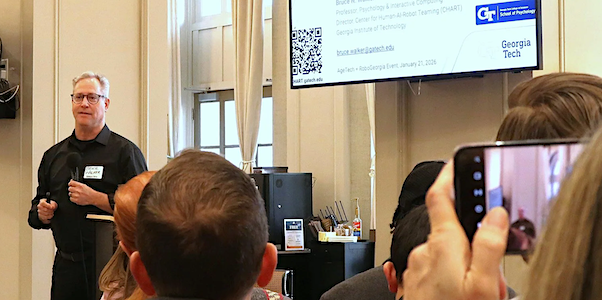
At first glance, the answer appears obvious. Designers create products for users. Engineers build systems to help people accomplish tasks. Technology exists to solve problems. Yet during his online guest lecture for Edinburgh Napier University, Professor Bruce Walker repeatedly returned to examples suggesting that the answer is often more complicated than it first appears. Again and again, he described situations in which technically impressive systems failed to account for the realities of the people expected to use them. A solution might work perfectly according to engineering specifications while proving frustrating, distracting, or simply undesirable in practice. Across projects involving navigation, education, museums, accessibility, sonification, and auditory interfaces, Walker argued that successful design begins not with technology but with understanding human needs.
Sound provided the central thread running through the lecture. Many people associate auditory interfaces with simple alerts and alarms. Computers beep. Phones ring. Vehicles issue warning tones. Yet Walker demonstrated that sound can serve far more sophisticated purposes. It can guide navigation, communicate data, support education, enable accessibility, assist decision-making, and provide entirely new ways of interacting with technology. These possibilities emerge not from adding sounds indiscriminately but from carefully considering what information people need, when they need it, and how they can use it effectively.
This emphasis on understanding users before designing solutions appeared throughout the lecture. These broader questions became particularly visible in Walker’s discussion of the SWAN project, the System for Wearable Audio Navigation. The goal was deceptively simple. Could sound help people navigate when they could not rely on vision? Blind users are an obvious example, though Walker deliberately framed the problem more broadly. Firefighters moving through smoke-filled buildings, soldiers operating at night, divers underwater, and workers engaged in visually demanding tasks may all find themselves unable to look or unable to see. Rather than designing exclusively for a particular group, the project focused on a shared perceptual challenge.
Approaching the problem in this way immediately changed the nature of the design process. Navigation might seem like a familiar activity, something most people perform every day without conscious thought. Yet once the team began analysing the task carefully, they discovered layers of complexity hidden beneath the surface. People need to know where to go, though they also need information about obstacles, changes in terrain, landmarks, hazards, and points of interest. Navigation is not simply a matter of moving from one location to another. It involves understanding an environment while continuously making decisions within it.
The resulting system employed spatialised audio beacons that users could follow through space. Walker compared them to a virtual carrot suspended ahead of the listener. Rather than receiving a sequence of verbal instructions, users simply moved towards a sound source. When a turn became necessary, the sound shifted position accordingly. The concept appears elegant partly because it exploits abilities listeners already possess. Humans are remarkably good at locating sounds. Rather than teaching an entirely new interaction technique, the system builds upon existing perceptual skills.
What makes the project particularly revealing, however, is the extent to which users shaped its development. Early assumptions frequently proved incorrect. Designers initially believed they should describe surface transitions in detail, informing users when they were moving from pavement to grass or from one surface to another. Users quickly pointed out that such information was often redundant. They already knew where they were standing. What mattered was knowing what was coming next. By listening carefully to users rather than insisting upon their original assumptions, the team produced a more efficient and less intrusive system.
This pattern appeared repeatedly throughout the lecture. Successful auditory interfaces emerge through collaboration, observation, and evaluation rather than through technological enthusiasm alone. Walker repeatedly emphasised the importance of testing systems with real users performing real tasks. Maps of navigation paths, performance data, error rates, and subjective feedback all played important roles in understanding whether a design genuinely worked. The question was never whether a system could be built. The question was whether it improved people’s ability to accomplish what they were trying to do.
Perhaps nowhere was this philosophy more apparent than in the team’s work with bone-conduction audio. Navigation systems often rely upon stereo or spatial audio, which typically requires headphones. Yet many users rejected conventional headphones immediately. Blind people rely heavily upon environmental sounds. Firefighters need to hear what is happening around them. Covering the ears solved one problem while creating another. Rather than treating this as an unavoidable limitation, the researchers reconsidered the entire system. Bone-conduction devices allowed spatial audio to be delivered without blocking environmental awareness. Once again, the solution emerged not from pursuing technology for its own sake but from understanding the realities of users’ lives.
Walker extended these ideas beyond navigation into the design of auditory menus and interfaces. Modern computer systems contain large amounts of information organised visually through menus, icons, scroll bars, and navigation structures. Translating these elements into sound presents significant challenges. Simply reading everything aloud through text-to-speech quickly becomes inefficient and frustrating. Long contact lists, extensive music libraries, and complex software systems require more sophisticated approaches.
Many of the solutions developed by Walker and his collaborators demonstrate an intriguing combination of technical ingenuity and psychological insight. Spearcons, for example, compress spoken words into highly abbreviated auditory cues that users rapidly learn to recognise. Spindex systems provide indexing sounds that help listeners move efficiently through large collections without hearing every item in sequence. Whispered speech can indicate unavailable menu items while preserving the overall structure of an interface. These innovations are clever, though their importance lies less in their novelty than in their effectiveness. Each emerged through extensive experimentation designed to determine what users actually understood and preferred. What makes this work particularly interesting is that it was never simply about making visual interfaces audible. Instead, it explored how auditory interfaces might exploit the strengths of listening itself. Users do not experience sound in the same way they experience vision, and successful interfaces acknowledge that difference rather than treating audio as a substitute for a screen.
The lecture repeatedly highlighted a distinction between engineering and design. Engineering can produce systems that function correctly. Design concerns whether people will actually want to use them. Walker discussed several examples of technically impressive systems that failed precisely because they neglected this distinction. Some provided too much information. Others demanded excessive attention. Many ignored the broader contexts within which people operate. A system may be capable of delivering enormous amounts of information, though that does not necessarily mean people want to receive it.
Questions of accessibility broadened these concerns further. Much of Walker’s work focuses on enabling participation rather than merely providing access. He described projects supporting education for blind students, making scientific information more accessible, and improving experiences within museums and aquariums. These examples revealed another recurring theme. Accessibility is not simply about removing barriers. It is about ensuring that people can engage meaningfully with experiences, opportunities, and ideas.
His work within museums and aquariums illustrates this particularly well. Modern cultural institutions often provide physical access while leaving informational and emotional access largely unresolved. A blind visitor may be able to enter an aquarium, though the experience remains fundamentally visual. Standing before an enormous tank filled with whale sharks and rays offers little if the most important aspects of the exhibit remain inaccessible. Walker’s team explored ways of using tracking systems, sonification, narration, and auditory displays to communicate not only what was present but what was happening. The objective was not merely to describe the environment. It was to create opportunities for engagement, curiosity, and wonder.
Educational projects revealed similar concerns. Throughout the lecture, Walker repeatedly returned to the distinction between access and participation. Providing information is only one part of inclusion. Students also need opportunities to explore, question, discover, and develop understanding independently. Whether working with scientific data, classroom materials, museum exhibits, or public spaces, the challenge remained remarkably consistent. How can information be presented in ways that support meaningful engagement rather than passive reception? Accessibility, in this sense, becomes a question of design quality rather than a specialised feature introduced at the end of a project.
Underlying many of these projects is the field of sonification, the practice of representing information through sound. Walker described sonification as both a design challenge and a research problem. Any attempt to translate data into sound requires decisions about mapping, scaling, timing, context, and interpretation. Should temperature be represented through pitch, loudness, or tempo? How should complex information be organised so that listeners can understand it? These questions have no universal answers. Effective solutions depend upon understanding both the data and the people expected to interpret it.
One reason sonification remains challenging is that many listeners have relatively little experience interpreting information through sound. Graphs, charts, and maps are familiar cultural forms. Auditory representations are far less common. Designers therefore need to balance learnability with expressiveness. A system may communicate information accurately while remaining difficult to interpret. Conversely, a system may sound appealing while conveying very little. Walker’s research repeatedly demonstrated that effective sonification emerges through iterative testing with users rather than through theoretical assumptions alone.
Such challenges reveal why Walker remains sceptical of simplistic approaches to auditory design. Throughout the lecture, he criticised the tendency to reduce audio interfaces to collections of arbitrary beeps and alerts. Sound possesses enormous communicative potential, though realising that potential requires careful thought. Designers must consider attention, context, usability, aesthetics, cultural expectations, and human behaviour. A sound that performs well in a laboratory may fail completely in everyday life. A technically accurate representation may prove ineffective if users cannot interpret it.
The phrase “beeps and bops” became a useful shorthand for this problem. Many technologies employ sound only at the most superficial level, relying upon alerts, warnings, and notifications while overlooking the richer possibilities of auditory interaction. Walker’s work points towards a broader conception of sound, one capable of supporting navigation, exploration, learning, communication, and discovery. The challenge is not simply adding sound to technology. It is designing meaningful auditory experiences.
Towards the end of the discussion, Walker reflected on what he described as a “failure of imagination” in technology design. Sometimes designers struggle to imagine how people actually live with technologies. At other times, users struggle to imagine possibilities that do not yet exist. Successful innovation requires navigating both challenges simultaneously. Revolutionary technologies rarely emerge through user requests alone. Yet genuinely useful technologies also cannot emerge through engineering in isolation. Design becomes a process of bridging these perspectives.
Looking back across the lecture, what emerges most clearly is not a story about auditory interfaces but a broader philosophy of design. Sound happens to be the medium through which Professor Walker explores these questions, though the underlying principles extend much further. Navigation systems, auditory menus, museum exhibits, educational technologies, sonification projects, and accessibility tools all reveal the same challenge. Technologies succeed not when they demonstrate technical sophistication but when they become meaningful parts of human activity.
Perhaps this is why Walker repeatedly resisted framing accessibility as a specialised concern. The challenges faced by blind users, firefighters, drivers, students, museum visitors, and countless others often reveal broader truths about human interaction with technology. Designing for specific needs frequently produces insights that benefit everyone. When designers stop asking what a system can do and start asking what people need, entirely new possibilities begin to emerge.
Throughout the lecture, examples ranging from spatial navigation to aquarium exhibits pointed towards the same conclusion. Successful technologies rarely begin with devices, software, algorithms, or interfaces. They begin with people. Understanding how people listen, learn, move, explore, communicate, and make decisions provides the foundation upon which everything else is built.
For Professor Bruce Walker, the future of auditory interfaces does not lie in adding more sounds to the world. It lies in understanding how sound can help people navigate, learn, communicate, discover, and participate more fully in the experiences around them. The technology matters. The research matters. The engineering matters. Yet each ultimately serves a more fundamental question, one that quietly shaped the entire lecture from beginning to end: who are we designing for?