

Did you know that October is Cybersecurity awareness month? The campaign was set up by the US Department of Homeland Security and by the National Cyber Security Alliance.
Dr Shane Horgan, Associate Professor of Criminology (Social Sciences, within the School of Applied Sciences (SAS) at Edinburgh Napier University) has expertise in cybercrime, having undertaken a PhD in this area.
Shane works closely with Dr Rebecca Foster, Lecturer in Criminology (Social Sciences, within SAS), being colleagues in the same team but also through Rebecca’s work leading on outreach and recruitment for the Social Sciences subject group. Shane wanted to do a talk on cybercrime as part of Cybersecurity awareness month, and Rebecca had an idea to host this in a community library. Rebecca lives in Stirling and regularly goes to St Ninian’s library, which is in the outskirts of the city. This library offers a wide range of community activities and supports. Lead Librarian Alex Galletly is often the driving force behind these initiatives. So, Rebecca had the idea to host the talk at St Ninian’s…and then we got organising!
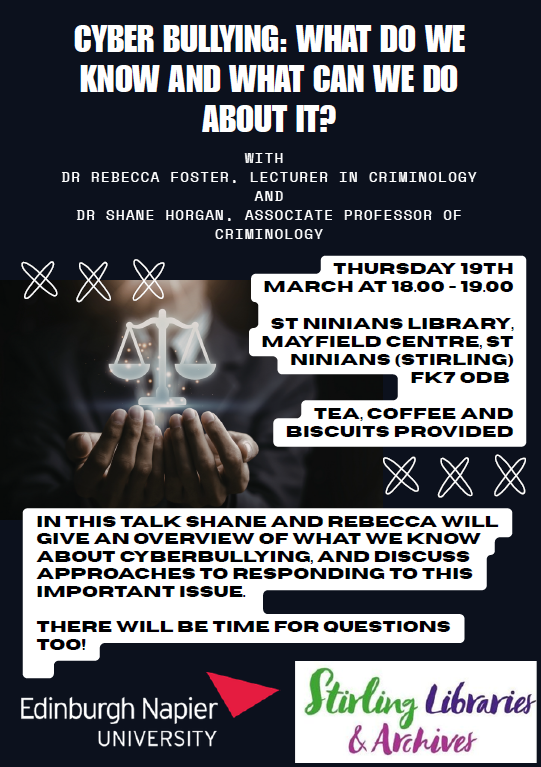
On Friday 10th October 2025, Shane delivered his talk at the library, titled ‘Cybercrime – what it is, what you need to know and what you can do about it’. It went really well. Alex shared the flyer invite with a wide range of people and groups and this was reflected in who came along on the day. Attendees included: interested (concerned!) members of the public; local high school pupils; Stirling council employees from different departments including digital skills; and volunteers.
Our goal with this session was to demystify the range of complex terminology and technologies that surround cybercrime and and use current examples to answer the simple questions above. We also wanted to challenge some assumptions about ‘responsibility’ and urge people to think about victims a little differently.
Evidence suggests that ‘awareness campaigns’ have very little effect if people can’t relate to the awareness message or understand its relevance to their lives. The challenge is complicated further in cybersecurity by all the culturally informed ways we think about who or what ‘cybercriminals are’, ‘how they work’ and ‘what they want’.
When we understand how we and our data fit into these big complex cybercrime events, we can more easily understand how ‘a strong password’, ‘2-factor authentication’, or privacy settings can make a big difference to our lives, and potentially to the lives of those who depend on us.
The private and public sector have spent a decade instructing us on how we should be keeping ourselves safe. As a result of that process, as a society we tend to talk about victims as if they are to blame for what has happened, and not the perpetrator; “they should have known better” or “how could they be so gullible?!”. The moment we apply this logic to victims of crimes with which we are more familiar, this underlying assumption becomes unacceptable.
We wondered if it may be more productive, or at least less harmful, to support communities to keep each other safe and promote collective efficacy, instead of foregrounding individual responsibility?
We (Rebecca and Shane) are grateful to Alex and colleagues for helping us to organise this and for being so supportive of it.
We feel like it was a successful event in terms of conveying criminological knowledge/research in an accessible way. We were happy to get positive feedback from attendees, and it was also a good way of promoting our work and ENU study opportunities.
What’s next? We’re working with Stirling Libraries to prepare some more sessions this spring (2026), and this is kindly supported by funds from ENU’s Public Engagement. The first event will take place on Thursday 19 March at St Ninian’s Library. Please come and join us!