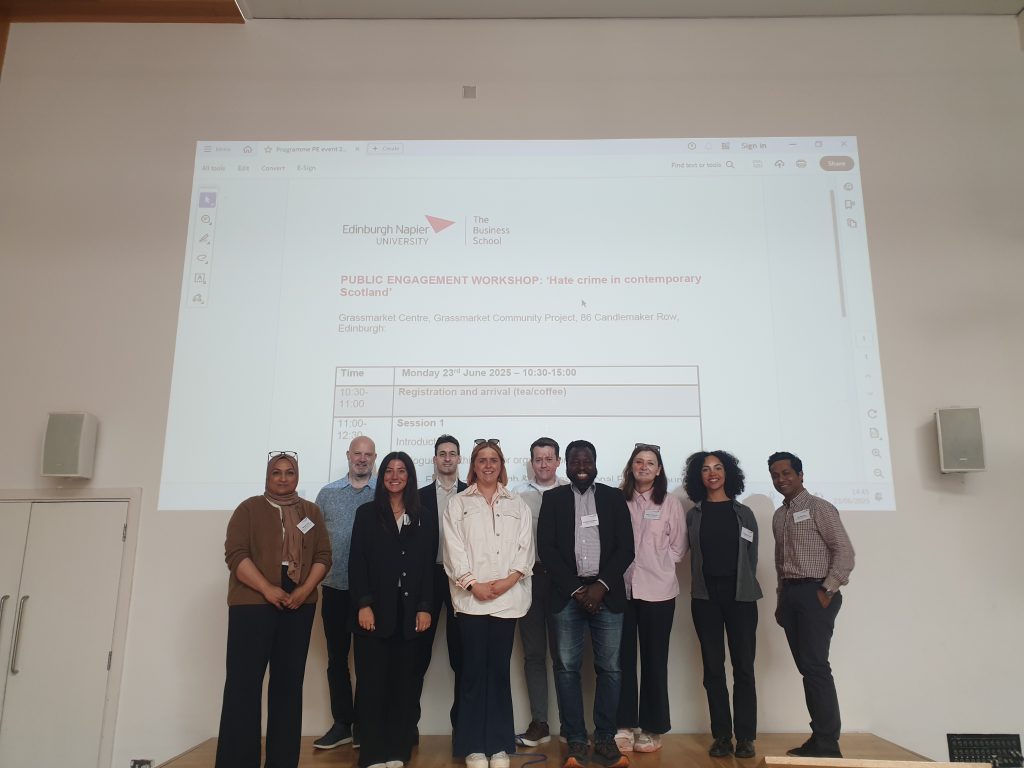
Dr Marco Galimberti facilitated a workshop in June 2025 to discuss the recent Hate Crime and Public Order (Scotland) Act 2021, bringing together representatives from third-sector organisations which work across Scotland to support victims of hate crime. The event engaged the participants in examining the effectiveness of current responses to tackling hate crimes. Participants included members of organisations which play a key role in actively raising the voices of targeted individuals, groups and communities with lived experience of hate crime, as well as representatives of Police Scotland and the Safeguarding Team at Edinburgh Napier University.
The workshop evolved thanks to Dr Marco Galimberti’s research and teaching iof the contemporary (and controversial) issue of hate speech, sparking an interest in looking into this topic beyond the academia and establishing connections with wider society.
The event took place at the Grassmarket Community Project, in Edinburgh, on 23rd June 2025, and it was structured into two main sessions. The researcher opened the workshop with an introduction to the concept of hate crime and the challenges that this poses in contemporary society. Participants were then engaged in a Mentimeter survey as an ice-breaking activity which facilitated a preliminary discussion both within smaller groups and collectively. The survey included a range of questions aiming to reflect on the effectiveness of existing reporting tools and mechanisms for hate crime victims, the main barriers that the participants have been facing, and any weaknesses that they view as affecting current hate crime policies and legislation.
In the second session, members of third-sector organisations delivered (in-person or online) presentations of their own work and expertise in supporting victims of hate crime across Scotland. Each presentation was followed by Q&A time with all other participants, including representatives of Police Scotland. A Power Point presentation on hate crime, the recent Act and its open questions was also circulated to the participants.
The workshop provided an inclusive forum in which to assess constructively the effectiveness of existing policies and legislation, share best practices and lessons learned, identify current weaknesses and discuss challenges ahead. In the aftermath of the event, participants commended the new connections established with other third-sector organisations as well as an increased knowledge and understanding gained through the workshop. The research-practice integrated approach underpinning the project supported participants to identify relevant legal issues as well as more effectively informing their policies, proposals and campaigns, thus improving the overall quality of their services for the communities that they represent and the wider public.