Innovation and Experimentation in Animation Layout for New Signs for Animation: AnimSign (2024)
New Signs for Animation: AnimSign is an inclusive research and creative project funded by Edinburgh Napier University’s Public Engagement fund and CTN (Creative Talent Network). Created by animator and educator Jonathan Mortimer, the initiative began as a short animated film highlighting a significant gap in sign language vocabulary for animation and games terminology. Many technical terms commonly used in industry and education have no established equivalents in British Sign Language (BSL) or other signed languages, creating barriers for Deaf and Hard-of-Hearing [DHH] students and professionals.
First released as New Signs for Animation (2021) and later expanded into AnimSign (2024), the project combines animation, sign language performance, and voice-over narration to explore how new terminology might be developed collaboratively. It positions animation not just as a storytelling medium, but as a tool for linguistic innovation and educational access.
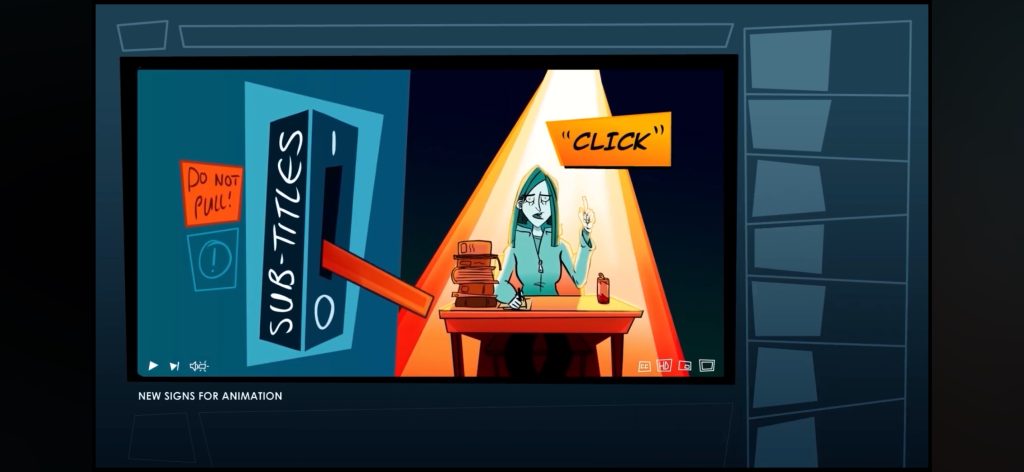
1. Influences and Constants
In developing AnimSign, I drew particular inspiration from Fraser MacLean and his book Setting the Scene: The Art & Evolution of Animation Layout (2011). The book traces the historical development of animation layout – from early studio systems through to contemporary practice – and foregrounds layout as both a technical discipline and a storytelling craft.
Engaging with this history prompted a deeper consideration of how layout shapes meaning. MacLean’s exploration of staging, spatial clarity, and the evolution of visual storytelling reinforced the idea that layout is never neutral; it determines what the audience sees, how they see it, and where their attention rests.
During the development of AnimSign, I also reached out to Fraser MacLean directly to discuss the project and its approach. Those conversations were invaluable in situating the film within a broader lineage of layout practice, while also recognising that this work pushes layout into less conventional territory – as a tool for accessibility and linguistic development.
- I arranged a video call with Fraser MacLean, the artists involved in the short film, and a BSL interpreter to facilitate the discussion: https://youtu.be/OXS8vLa0P0Y
With Pete Docter (Chief Creative Officer of Pixar Animation Studios and director of Monsters, Inc. and Up), who has a strong interest in layout and also wrote the foreword to Maclean’s book, I decided to reach out for his perspective. He kindly shared the following:
Hello Jon,This is a tough one! To me, not being accustomed to signers, I find them to be distracting. As animators, our goal is to completely direct the viewers’ eye. We spend great effort to show our characters’ inner thoughts, which we believe is done through expressions and body language more than through their dialog. If you’re looking away, you’ll miss key information. We try to make our films semi-intelligible, even if you don’t speak the language.
So as an animation purist I would vote for the 1st option below: bespoke animation. Unfortunately that’s probably only seldomly economically feasible. Animation is super time consuming.What about subtitles? Is that an option for deaf students? Since subtitles don’t move around, they don’t grab a person’s attention as much, which therefore keeps the design of our movement intact.Good luck to you!Pete
I also sought industry perspective from James Williams, who was Head of Layout at Sony Pictures Animation at the time of contact. Williams generously offered notes and advice on staging, compositional clarity, and the practical considerations of integrating subtitles into the frame without compromising visual balance or readability. His feedback reinforced the importance of:
-
Protecting clear sightlines
-
Managing visual hierarchy
-
Considering subtitle placement as part of layout design rather than an afterthought
-
Balancing aesthetic composition with accessibility needs
These conversations grounded the project’s experimentation within established professional practice.
The primary influence on the background design and layout stemmed from a deep admiration for Maurice Noble and Chuck Jones. Their bold use of colour, inventive compositions, and ability to balance visual storytelling with mood served as a guiding inspiration, shaping the way environments were crafted and layouts were approached throughout the project. This influence can be seen in the way backgrounds not only support the action but also enhance the emotional tone, creating a cohesive visual narrative that feels both dynamic and intentional.
—————————————————————————————————————————————————————————
2. Rethinking What Layout Does
In New Signs for Animation, layout focused on the following questions:
-
How do we prioritise sign language on screen?
-
How do we balance signed, spoken, and animated information?
-
How do we prevent visual overload while communicating complex ideas?
-
How can spatial design support the creation of new terminology?
The project reframes layout as an accessibility framework – not an afterthought layered on top of content, but the structural logic of the film itself.
See ‘Prisoner of the bubble’ [Schmitt, 2017 – Representations of Sign Language, Deaf People, and Interpreters in the Arts and the Media on JSTOR].
—————————————————————————————————————————————————————————
3. Modular Layout as Innovation
The film is designed to have a modular structure, so it can be adapted to different languages – spoken or signed.
The layout accommodates:
-
Sign Language
-
Voice-over narration
-
Animated visual explanation
-
Contextual information and statistics
This modularity allows the project to expand, adapt, and evolve. It can accommodate new signs, new contributors, and new linguistic contexts.
Rather than designing a fixed composition, the film proposes a scalable layout system – one that can grow alongside the language it supports.
From the animatic and storyboard stages onward, a placeholder signer was incorporated during pre-production to ensure they were embedded in the storytelling process from the very beginning- not added as an afterthought. Please see animatics below.
—————————————————————————————————————————————————————————
4. Animation as a Tool for Terminology Creation
A key aim of the project is highlighting for discussion with the Deaf community, the potential lack of established signs for animation and games terminology. Words such as “pipeline,” “render,” or “rigging” often lack agreed sign equivalents.
This is where animation layout becomes experimental in a deeper sense.
The film uses:
-
Animated metaphors
-
Spatial positioning
-
Visual demonstrations
-
Controlled pacing
to help clarify meaning while signs are introduced or developed. The frame becomes a collaborative space for linguistic innovation.
Layout does not just present information – it participates in meaning-making.
- The layout and placement of elements also needed to accommodate sound effect graphics, ensuring they complemented rather than distracted from the animation and signer performance. This approach was heavily influenced by a lifelong engagement with comic books, where dynamic lettering and visual cues guide the reader’s attention, as well as by Cece Bell’s graphic novel El Deafo (2014), which demonstrates how sound, space, and text can be integrated thoughtfully to convey narrative and character experience. Drawing on these influences, the project sought to use sound effect graphics not just as embellishments, but as active components of the storytelling, reinforcing rhythm, mood, and meaning within each scene.
—————————————————————————————————————————————————————————
5. Managing Multi-Layered Communication
The film operates across multiple communication channels at once:
-
Signed language
-
Spoken narration
-
Animated explanation
-
Visual design
Balancing these layers requires careful control of rhythm and hierarchy. Too much motion risks distracting from the signer. Too little visual support risks losing conceptual clarity.
The layout negotiates this tension by distributing attention rather than concentrating it. It avoids clutter, manages tempo, and respects cognitive load.
This reflects a broader experimental shift: treating accessibility as a design constraint that generates creative solutions rather than limiting them.
-
I wanted to further experiment with integrating signer performance into the animation, using Deaf actors to make the signer an active part of the storytelling. While I was able to hire Deaf actors for the BSL versions of the short films, I wasn’t able to fully explore this integration. However, a short test and a blooper reel allowed me to capture some of the humour and energy that this approach could bring to the animation.
- Animation test with Brian Duffy – https://youtu.be/2mQPCN4dNl0
- Blooper reel with Amy Murray – https://youtu.be/9qCSlW-w2bQ
—————————————————————————————————————————————————————————
6. Implications for Animation Practice
New Signs for Animation: AnimSign (2024) suggests that layout can be:
-
A linguistic interface
-
A collaborative space
-
A tool for inclusion
-
A method of experimentation
The timing of the animation was carefully adapted to align with key moments in the sign language performance, using specific keywords as landmarks to pace the action. This process was repeated for each version of the animated short film, tailored to the particular structure and rhythm of the different sign languages. The goal was to create a shared viewing experience that could be enjoyed by both hearing and Deaf or Hard-of-Hearing (DHH) audiences, ensuring that the animation, narration, and signing worked together as seamlessly as possible. By synchronizing visual cues with signing, the project aimed to preserve both clarity and narrative flow, while respecting the unique tempo and expressiveness of each language.
For animation students and practitioners, it offers an expanded definition of what layout can do. It invites designers to consider:
-
Who is centred in the frame?
-
Whose communication modes are prioritised?
-
How does spatial design influence understanding?
-
Can layout itself be a form of research?
—————————————————————————————————————————————————————————
7. Conclusion
New Signs for Animation: AnimSign (2024) explores how animation layout can serve purposes beyond traditional storytelling, acting as a framework for communication, learning, and accessibility. By integrating sign language from the earliest pre-production stages, using modular compositional strategies, and carefully managing visual hierarchy, the project aims to balance clarity, inclusivity, and the expressive potential of animation.
The work has been informed by a range of influences, from pioneers like Maurice Noble and Chuck Jones to contemporary thinkers such as Fraser MacLean, whose research into the history and craft of animation layout provided valuable context for understanding how staging, spatial clarity, and visual hierarchy shape meaning. Guidance from industry professionals such as Pete Docter and James Williams further reinforced the importance of practical staging considerations while experimenting with accessibility. Together, these perspectives underscore that innovation in layout often builds on both historical knowledge and collaborative insight.
While necessarily exploratory, AnimSign demonstrates how layout can support multi-layered communication, facilitate the introduction of new terminology, and create space for collaboration with Deaf and Hard-of-Hearing communities. Ultimately, it represents one step toward rethinking how animation can be designed with inclusion in mind, showing that thoughtful layout choices can enhance storytelling, foster understanding, and contribute to ongoing experimentation and learning in accessible animation practice.
—————————————————————————————————————————————————————————
8. Further research
Further research is needed to explore how layout can adapt to new formats and modes of storytelling. One area worth investigating is the use of motion comics, where a signed video could be “sliced” and integrated into a sequential, animated structure. This approach could open up new possibilities for highlighting signer performance, controlling pacing, and maintaining visual clarity, while still allowing the animation to support meaning and engagement. Early tests, such as the motion comic video and reference footage, suggest that experimenting with these hybrid forms could offer valuable insights for both accessibility and creative expression in animation.
Reference video: https://youtu.be/4JF6gI0tz1w
Animation test: https://youtu.be/g2WhrSCnsDU