Category: General Interest

  • Reflections on Graduation and a New Academic Year

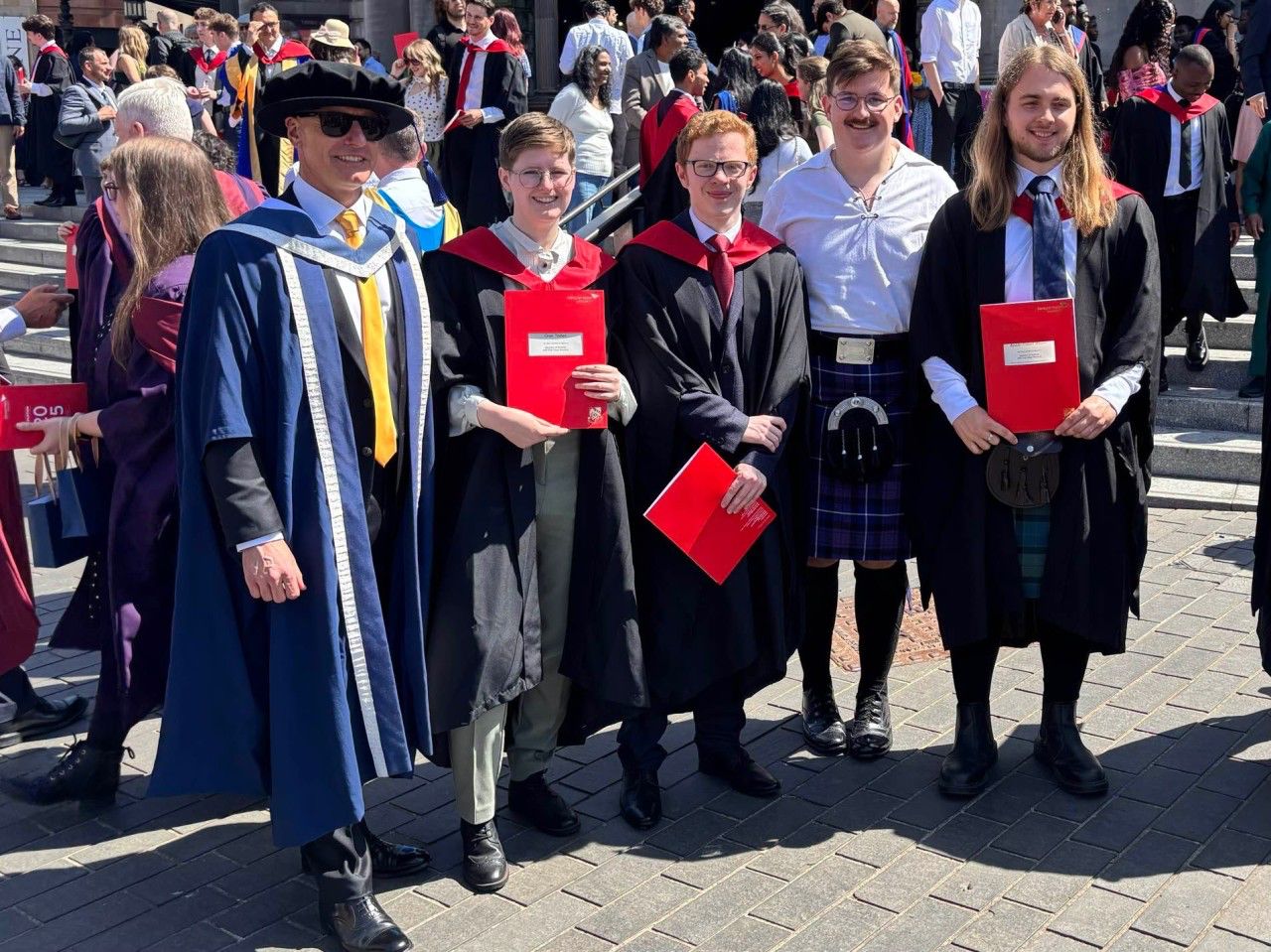
    BSc graduates Oran Talbot, Mitchell MacPherson, Andrew Clelland, and Aedan Wilson after receiving their awards.
    BSc graduates Oran Talbot, Mitchell MacPherson, Andrew Clelland, and Aedan Wilson after receiving their awards.

    This week marks Freshers’ Week at Edinburgh Napier University—the beginning of a new academic year and a time when I welcome new MSc Sound Design students. For the first time, I’ll be greeting both on-campus students and those joining us from around the world. Alongside in-person attendance, we’re introducing new modules designed to challenge and inspire.

    But before diving into Trimester 1, I’d like to take a moment to reflect on a key event from the previous trimester: graduation.


    Celebrating Success at the Usher Hall

    In July, we held our summer graduation ceremony at the iconic Usher Hall in Edinburgh. Six students from the MSc Sound Design programme were awarded their degrees. While three couldn’t attend in person, the other three travelled from England, Italy, and the USA to celebrate their achievements.
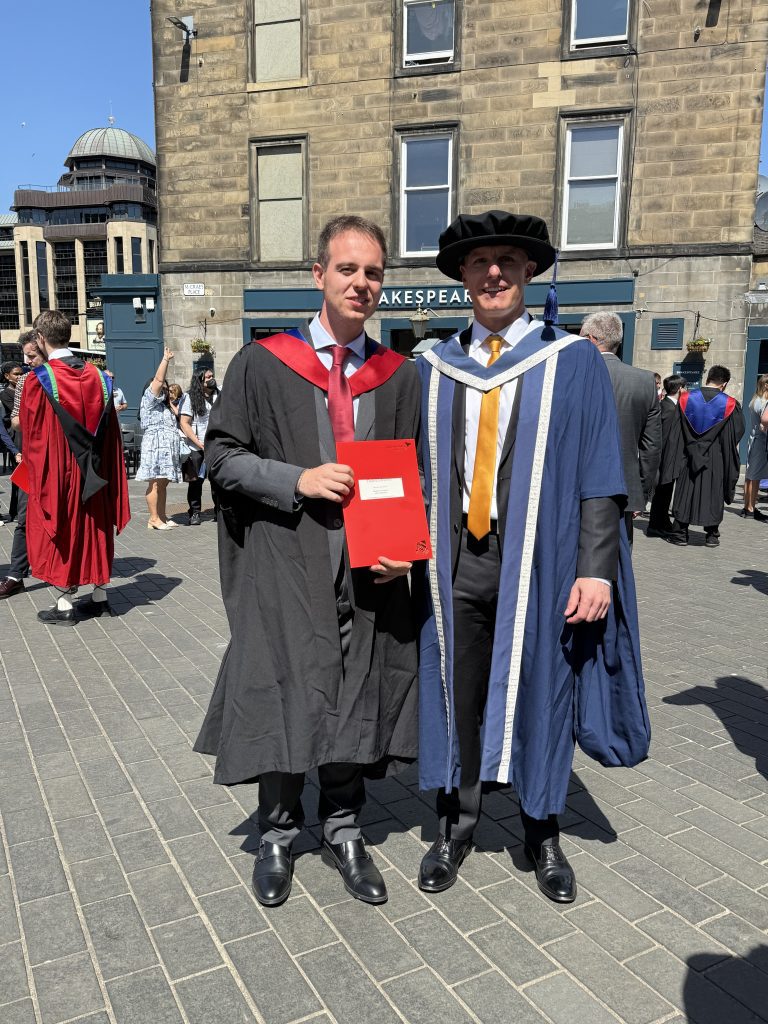
    MSc graduate Federico Aramini with his MSc award
    MSc graduate Federico Aramini with his MSc award

    Their dissertations covered a fascinating range of topics, including:

    • Infrasound in horror films
    • Sound design in smart homes
    • Game audio adapted for age-related hearing loss
    • Authenticity of AI in podcasts
    • Techniques to improve dialogue intelligibility

    As always, supervising these projects was a learning experience for me too.


    My First Time on the Graduation Stage

    The day was a glorious summer’s day. After locating the staff entrance, donning a gown, and blagging a hat, I joined the academic procession into the hall. This was my first time participating in such a ceremony—my last ENU graduation was when I received my honours degree in electronics, more years ago than I care to admit!

    I found myself seated at the edge of the front row, with the Chancellor’s procession front and centre. The speeches were heartfelt, praising students for their hard work and thanking their loved ones for their support. It was a resonant reminder of the sacrifices made by those closest to our students.


    A Moment of Pride

    As the awards were handed out, I spotted several MSc and BSc Sound Design students I had supervised. I was the only lecturer from the Sound Design team present, so I clapped especially enthusiastically when our students crossed the stage—doing my best to make some noise from behind the Chancellor!

    One student even gave me a big thumbs-up as they walked across the stage—a lovely moment of levity and pride.

    It’s easy to forget how transformative the journey through postgraduate study can be. Many of these students began with uncertainty, juggling work, family, and study. Seeing them walk across the stage, confident and accomplished, was a powerful indication of why we do what we do. Their success is not just academic—it’s personal, creative, and deeply human.


    Sunshine, Smiles, and Goodbyes
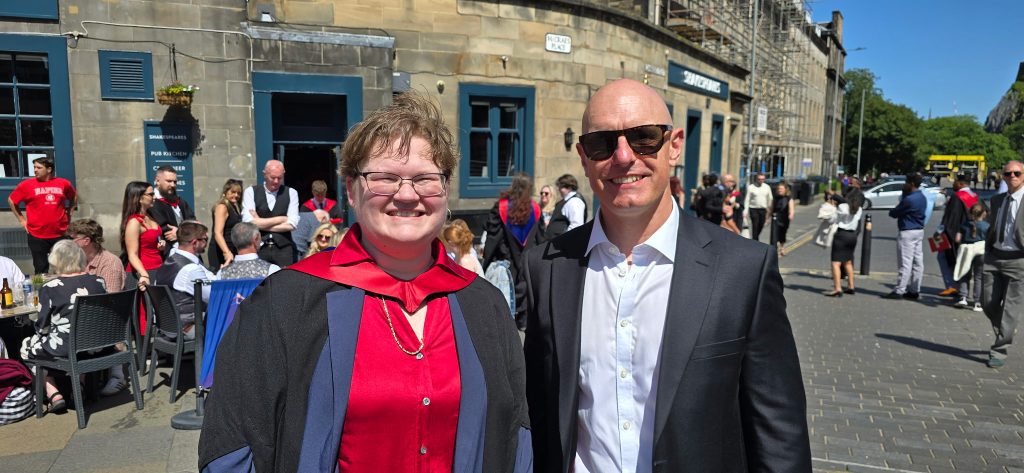
    MSc graduate Amanda Rainey travelled all the way from Nashville, USA, to receive her MSc award.
    MSc graduate Amanda Rainey travelled all the way from Nashville, USA, to receive her MSc award.

    After the ceremony, we stepped out into the sunshine to meet students and their families. Hands were shaken, photos were taken, and robes were returned. There was laughter, hugs, and a few emotional moments as students said goodbye to classmates and staff.

    Graduation is always bittersweet. While it marks the end of one chapter, it also signals the beginning of new adventures. I’m excited to see where our graduates go next—and equally excited to welcome the next cohort of students ready to begin their own journey.


    Looking Ahead

    This year, the MSc Sound Design programme continues to evolve. We’ve introduced three new modules: Advanced AI for Audio and Sound DesignIntroduction to Audio Programming, and Soundscapes. These additions reflect the changing landscape of sound design and aim to give students fresh opportunities to explore emerging technologies and creative practices.

    It’s an exciting time to be teaching and learning in this field. The boundaries of sound design are expanding rapidly, and our students are right at the edge of that frontier. Whether they’re interested in immersive audio, interactive media, or sonic arts, the programme now offers even more pathways to explore.
  • Designing Funny Sounds: A Practical Framework for Comic Timing, Texture, and Payoff

    Why are some sounds instantly funny, while others just miss the mark? Sound has enormous power in comedy, but it is rarely discussed in its own right. It is not just about squeaks and splats. Funny sounds are about timing, tension, layering, and audience permission. Done well, they can elevate a moment into something memorable. Done poorly, they can kill the joke.

    This article lays out a practical, principle-based approach to designing funny sounds, from animation and film to games, performance, and beyond. Whether you are a sound designer, editor, creative director, or someone who just enjoys thinking about what makes people laugh, this framework is for you.

    1. Funny sounds need a comedic foil

    No funny sound works in isolation. It needs a setup, something believable, serious, or steady to push against. This is the role of the comedic foil. A squeaky shoe is funny in a formal hallway. A wet splat is funny against silence. Without the foil, the comic moment has nothing to rupture.

    2. Mistiming is everything, even when it misfires

    Comedy lives in surprise. Funny sounds often arrive just too soon, or just too late. But sometimes what makes a moment land is that it does not land — the creak that never resolves, the fanfare that fails, the punchline that falls flat. These “failures” become part of the rhythm. They create nervous, awkward, or self-aware laughs. The mistimed moment says something went wrong, and that is the joke.

    3. Sequence, overlap, and layering

    No sound exists on its own. Comic moments are shaped by how sounds are arranged, layered, and spaced. A groan over a thud followed by a squeak can create a mini gag in sound alone. A quiet, odd noise buried under other activity can reward the attentive listener, a sonic in-joke. The best comic sound design pays attention to sequence and interplay, not just isolated gags.

    4. Do not leave me hanging

    Funny sound needs to feel either deliberately cut short or uncomfortably extended. A thud that ends abruptly, or a groan that goes on too long, creates a kind of tension that becomes funny through its refusal to resolve. This incomplete rhythm mirrors the social unease of awkward pauses or missteps, and gives the audience something to laugh through.

    5. Mismatch the dynamics

    Big moments with tiny sounds, or small moments with huge sounds, are comic staples. A whisper with the impact of a cannon. A major fall with the sound of a teacup breaking. This mismatch between visual scale and auditory response undermines realism and forces laughter. It is the wrong sound, delivered with full confidence.

    6. Escalate repetition

    The same sound is only funny if it builds. Repetition works when each instance raises the stakes, longer, louder, brighter, more absurd. The laugh comes from tension and excess, not just from hearing the sound again. Without escalation, repetition flattens. With it, the sound becomes a rising joke that demands release.

    7. Use texture to tip it over the edge

    Detail matters. A splat is funnier when it has brightness or a hint of filth. A creak becomes unbearable when it has upper harmonics. The texture pushes the sound closer to bodily, embarrassing, or disgust-inducing territory, just enough to provoke a reaction without crossing into revulsion. Funny sounds often sit right on this line.

    8. Let empathy in, just a little

    Comic sound often represents failure, pain, or humiliation. The audience laughs, but a part of them knows they probably should not. That flicker of empathy, just enough to feel the fall, not enough to stop the laugh, creates comic tension. The sound designer can dial that balance in texture, tone, and pacing.

    9. Place it in the world

    The reaction of characters matters. Does anyone hear it? Is someone embarrassed? Oblivious? Does the sound exist only for the audience? These choices shape the comedy. A sound acknowledged in-world lands differently than one the characters ignore. Comic sound must be worldised, not just audible, but meaningful in the story space.

    10. Leave space for the laugh

    If you do not leave room, the audience cannot laugh. Comic sound design must make space: a beat of silence, a held shot, a moment of stillness after the noise. Without this pause, even the best gag can disappear. The laugh often lives in what follows the sound, not the sound itself.

    11. Use afterthoughts for the final flick

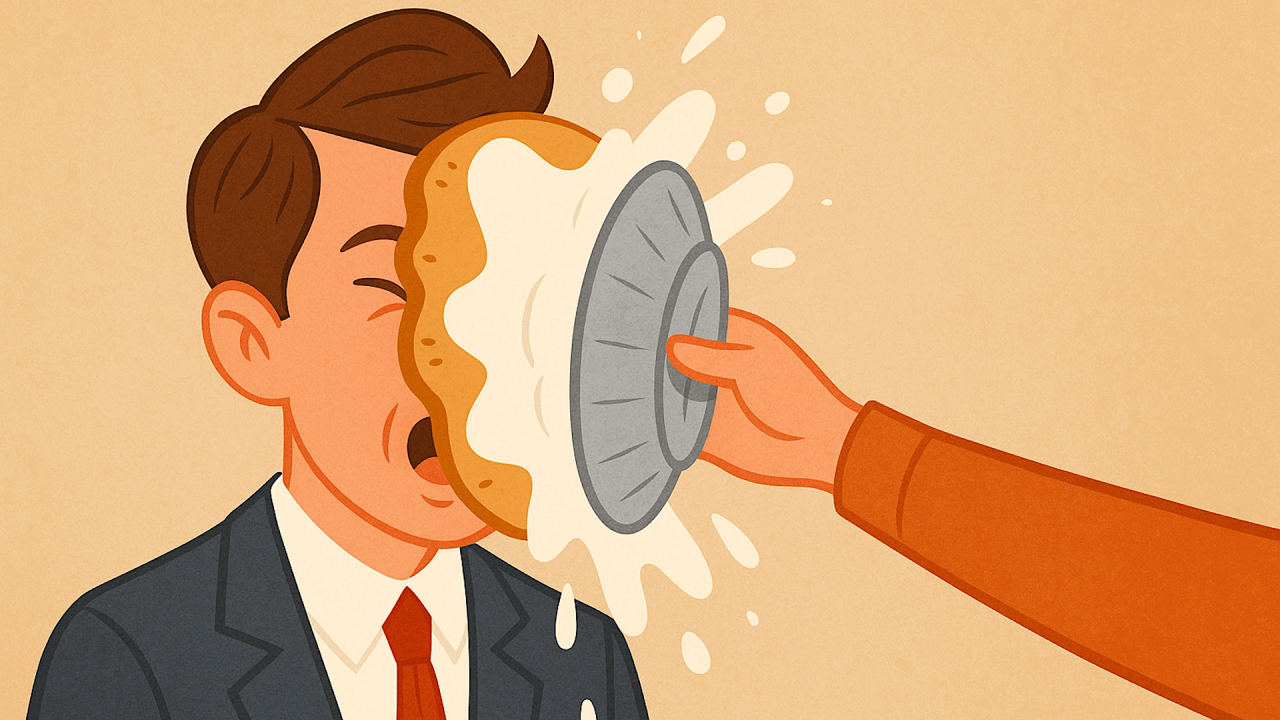
    Sometimes the funniest sound is not the main event, but the tag at the end. A glob of pie hitting the floor. A delayed squeak after a pratfall. A faint ding as something small falls offscreen. These afterthoughts punctuate the moment, not by escalating, but by extending the rhythm in a new, often absurd direction.

    12. Preview the collapse

    Anticipation makes comedy stronger. Let the sound world warn the audience: creaks, rattles, drips, and growing instability. These are previews, and they invite the audience to imagine what is about to go wrong. The laugh builds before the gag lands.

    13. Let the audience in on the joke

    Not every funny sound needs to be big or shared. Sometimes the best comic sound is quiet, tucked into the mix, and heard only by those paying attention. These subtle, almost secret gags invite the listener into a private joke. They create a sense of complicity, as if the sound designer is winking directly at the audience.

    14. Stylise to make the pain safe

    When a comic moment pushes too far, when a fall looks painful or a slap sounds violent, stylised sound can signal that it is okay to laugh. Cartoonish exaggeration acts as an emotional buffer: a boing, a sproing, a rubbery wobble. These reassure the audience that no one is truly hurt. Stylisation protects the joke by softening its impact.

    These principles apply across comic styles, from deadpan realism to farce, but how far each is pushed depends on the tone of the piece.

    Comic sound is not about chaos or randomness. It is about control, of timing, contrast, rhythm, and texture. It is about how a squeak becomes a laugh because of when it lands, what surrounds it, and who reacts. Whether bold or barely noticeable, funny sound lives in friction. And the more carefully it is designed, the more effortlessly it lands.

    Have you used sounds to land a joke, or save one? We would love to hear how others approach funny sound, especially in screen media, games, or performance.